


 Posts
Posts


In this week's New York Press (links are mine):
BEST GENRE-BENDING NONPROFIT THEATER
Stolen Chair Theatre Company
Every creative artist thinks their über-wacky parody of noir is one for the ages. Not Off-Off-Broadway’s Stolen Chair Theatre Company, which gave such pretentiousness the bird when it premiered Kill Me Like You Mean It earlier this year, the second installment in its “CineTheatre tetralogy.” Their trick is the opposite of being derivative: They smash genres in a theatrical supercollider and see what happens, such as noir being fused with the idiocy of Ionesco in Kill Me. Stage Kiss, meanwhile, fused Charles Ludlam’s theatre of the ridiculous with Elizabethan blank verse; The Man Who Laughs was a silent film for the stage. Stolen Chair’s latest, Kinderspiel (subtitle: “all art is useless”), currently at the Kraine [CORRECTION: Under St. Marks], is yet another genre-bender: a drop of Weimar cabaret in political drama.
Thanks, New York Press!
Wednesday, October 24, 2007


Ausverkauft
Google tells me this is how you say SOLD OUT in German. I don't trust Google's translations all that much, but I do trust SmartTix's box office report which says we are now officially out of tickets for Kinderspiel. Do not despair, though, because we usually end up releasing between 5 and 10 tickets at the door. So, if you want to catch one of the final three performances, please arrive at the theatre at 7pm to make sure your name gets on the waiting list for no-shows or overflow seating.
Monday, October 22, 2007
We're #2! We're #2!
Check it out over at indietheater.org.
Now all we have to do is find a way to dispose of those Jersey Boys :)
Just 12 tickets left for the run. Buy your tickets online this instant!
I'll be posting a photo album of our "Get Drunk and Play" night in the next few days. Good times...we'll definitely have to throw another one of those sometime very soon.
Now all we have to do is find a way to dispose of those Jersey Boys :)
Just 12 tickets left for the run. Buy your tickets online this instant!
I'll be posting a photo album of our "Get Drunk and Play" night in the next few days. Good times...we'll definitely have to throw another one of those sometime very soon.
Wednesday, October 17, 2007
4 Stars from Time Out NY
UPDATE: The online edition is up. Read it here.
Though the TONY online edition hasn't yet been posted, here's a snippet of Raven Snook's 4-star review of Kinderspiel:
Though the TONY online edition hasn't yet been posted, here's a snippet of Raven Snook's 4-star review of Kinderspiel:
"The inventive folks at the Stolen Chair Theatre Company explore the [Weimar] era with the existential KINDERSPIEL; think NO EXIT decked out in fishnets and Art Deco decay...Jon Stancato directs Kiran Rikhye's unsentimental script with a minimum of fuss...The overall effect is haunting. Watching these slightly cracked adults play with desperate abandon reminds us that the worst of times may bring out the best in artists, but in the end it's the politicians who get to rule (and ruin) the world"
Tuesday, October 16, 2007
A flavorful pill to swallow
Pardon the painful pun, but here's what Flavorpill's Mr. Paschalides had to say about Kinderspiel:
"There's a delightful irony in watching Kiran Rikhye's delectable frolic of a play Kinderspiel: audiences sit in a musty — yet appropriately atmospheric — basement to watch a play about a bunch of Weimar-era demimonde oddballs who sit around and play like children while customers pay to watch. The playwright provides insight into a glorious era of Berlin history, contrasting it with the economic depression and political upheaval of its time and drawing parallels to contemporary affairs. The childlike idiom is brilliantly developed and performed by the talented cast, leaving Under St. Marks' crowd wanting more."
"There's a delightful irony in watching Kiran Rikhye's delectable frolic of a play Kinderspiel: audiences sit in a musty — yet appropriately atmospheric — basement to watch a play about a bunch of Weimar-era demimonde oddballs who sit around and play like children while customers pay to watch. The playwright provides insight into a glorious era of Berlin history, contrasting it with the economic depression and political upheaval of its time and drawing parallels to contemporary affairs. The childlike idiom is brilliantly developed and performed by the talented cast, leaving Under St. Marks' crowd wanting more."
Monday, October 15, 2007
Pick of the Week
Kinderspiel marks Stolen Chair's third "Pick of the Week" over at nytheatre.com.
Check it out here.
Thanks, Martin.
Check it out here.
Thanks, Martin.
Sunday, October 14, 2007
Get Drunk and Play w/Stolen Chair
"GET DRUNK AND PLAY" NIGHT
Thursday, Oct 18 @ 10pm
Remember transforming your family's old refrigerator box into a dungeon?
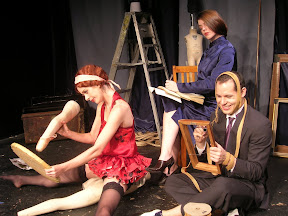 The Stolen Chair Theatre Company has spent the past 6 months training to play like kids for KINDERSPIEL ("Child's Play"), a provocative and playful new production running every weekend in October. We've had such a great time "kinderspieling" that we want to invite everyone we know to come join us for a playdate. We've got loads of free wine and a stage filled with fun objects, and we invite you to get drunk and play with us. Or skip the drinks and just play with us. Or skip the playing and drink all you want while you watch other people play with us. Or sit in a corner and play by yourself while knowing that there are people drinking and watching you play.
$10 gets you the open wine bar and about two hours to recapture your youth in the company of friends and complete strangers.
Space is extremely limited so please RSVP by contacting jon@stolenchair.org.
You can find out more about Kinderspiel at www.kinderspiel.us, where you can also click through to SmartTix and purchase your ticket for the show that Martin Denton calls "required viewing for the theatrically adventurous and those in search of the most provocative and thought-provoking work that indie theater has to offer."
Thursday, Oct 18 @ 10pm
Remember transforming your family's old refrigerator box into a dungeon?
The Stolen Chair Theatre Company has spent the past 6 months training to play like kids for KINDERSPIEL ("Child's Play"), a provocative and playful new production running every weekend in October. We've had such a great time "kinderspieling" that we want to invite everyone we know to come join us for a playdate. We've got loads of free wine and a stage filled with fun objects, and we invite you to get drunk and play with us. Or skip the drinks and just play with us. Or skip the playing and drink all you want while you watch other people play with us. Or sit in a corner and play by yourself while knowing that there are people drinking and watching you play. $10 gets you the open wine bar and about two hours to recapture your youth in the company of friends and complete strangers.
Space is extremely limited so please RSVP by contacting jon@stolenchair.org.
You can find out more about Kinderspiel at www.kinderspiel.us, where you can also click through to SmartTix and purchase your ticket for the show that Martin Denton calls "required viewing for the theatrically adventurous and those in search of the most provocative and thought-provoking work that indie theater has to offer."
Friday, October 12, 2007
Rants and Raves
Martin Denton from nytheatre.com calls it "required viewing for the theatrically adventurous and those in search of the most provocative and thought-provoking work that indie theater has to offer." (Read more...)
Jerry Portwood from Backstage calls it "obnoxious." (Read more...)
Come to the show and decide for yourself. You can buy your tickets here.
Jerry Portwood from Backstage calls it "obnoxious." (Read more...)
Come to the show and decide for yourself. You can buy your tickets here.
Thursday, October 11, 2007
FREE WINE and rave review
If you're dance card's not too full, come on down to the Village tonight and catch the 7:30pm performance of Kinderspiel. We're bringing a case of wine in and we want to leave empty handed so it's your civic duty to come and drink our free wine.
And while you go order your tickets, make sure to browse Aaron Riccio's rave review of the show over at New Theater Corps. A snippet:
And while you go order your tickets, make sure to browse Aaron Riccio's rave review of the show over at New Theater Corps. A snippet:
Stolen Chair bills itself as a company dedicated to the "theft" of "historical performance styles," but it's a crime for which they'd never be convicted. Between this and their recent Commedia dell'Artemisia, they're dramatic Robin Hoods, stealing from a rich theatrical past and producing for a poorly educated present, and I look forward to their next production.
Friday, October 05, 2007
Open for business
Nice loud house last night and we have a big Friday night crowd waiting for us tonight.
I'll post thoughts on the weekend as a whole this Sunday, but here is what the esteemable Mister John Clancy had to say (full disclosure: in addition to being the co-founder of FringeNYC, an Obie-Award winning director, the author of the totally kick-ass Fatboy, and the first winner of the Edinburgh International Festival Award, John and his wife Nancy have been Stolen Chair's consultants for about a year now, advising us as we move forward to the company's 2nd five years):
I'll post thoughts on the weekend as a whole this Sunday, but here is what the esteemable Mister John Clancy had to say (full disclosure: in addition to being the co-founder of FringeNYC, an Obie-Award winning director, the author of the totally kick-ass Fatboy, and the first winner of the Edinburgh International Festival Award, John and his wife Nancy have been Stolen Chair's consultants for about a year now, advising us as we move forward to the company's 2nd five years):
"Once again, Stolen Chair demonstates what a company can achieve when it commits to the discipline and sacrifice of the laboratory process. Kinderspiel has all of this company's burgeoning trademarks: exquisite, surprising language, fluid, meticulous direction and mesmerizing and courageous performances from an outstanding ensemble. It is a pleasure to watch this young company grow in strength and confidence."Only 11 performances left! Buy your tickets now...
Wednesday, October 03, 2007
My goodness that Jon Stancato is a handsome fellow
 Check out the Horse Trade roundtable from NYtheatrecast, featuring Stolen Chair's director Jon Stancato chatting about Kinderspiel (have you bought your tickets yet? We open in a few hours...) and the rest of Horse Trade's October productions with tech god Justin Sturges, director johnmichael rossi, and writer/director Todd Michael.
Friday, September 28, 2007
8 weeks of tech rehearsals
So, to give you some light reading material while you BUY YOUR TICKETS to Kinderspiel, I thought I would muse a little bit about what's going on in our final stages of rehearsal (we open Thursday, people!).
After what was positively the most pleasant cue-to-cue we've ever had (after what has easily been the most challenging rehearsal process we've ever had), Emily had this simple but brilliant realization:
In the lead-up to the past nine shows which have, as Jimmy Comtois says, since gone to the great production in the sky, we spent almost all of our last 20 hours of rehearsal dealing with tech issues, principally trying to figure out the most artful and least stupid ways of transitioning from scene to scene, a task made especially arduous by our CineTheatre projects, which usually have short scenes alternating between quite a few different locations, each with their own set. This time around, our evil-genius-set-designer-David has surpassed his genius if not his evil in providing us with a devilishly organic set which requires no interscene physical transformations (which is not to say his last 4 sets weren't brilliant cuz...um...they frickin' are!). What this means, however, is that we've spent every rehearsal since day one working out how the stage action itself can creatively transform the set over the course of a given scene. So, essentially, we've had about eight weeks of the logistically maddening what-goes-where-wait-when-was-that-supposed-to-be-preset rehearsals as we've simultaneously tried to develop a new work (with an original script) from the ground up.
The good news: instead of spending each minute up until opening night's curtain trying to work out how to cover the sound of dropping venetian blinds with a trumpet riff, we get to spend these last few hours delving even deeper (does anyone ever use the word "delve" for anything but that cliche?) into understanding the play's rhythms. And this is good.
Rehearsal in the morning tomorrow. An excerpt of the play performed at the Fourth Arts Block Festival in the afternoon. Rehearsal all day Sunday. A little brush-up on Tuesday and then we'll see some of you for Thursday's opening night.
Oh, and by the by, if you or someone you know is an artist (of any breed) whose work draws inspiration from the aesthetic, politics, or literature of 1920s Berlin, please let me know as we'll be kicking off our interview series next week.
After what was positively the most pleasant cue-to-cue we've ever had (after what has easily been the most challenging rehearsal process we've ever had), Emily had this simple but brilliant realization:
In the lead-up to the past nine shows which have, as Jimmy Comtois says, since gone to the great production in the sky, we spent almost all of our last 20 hours of rehearsal dealing with tech issues, principally trying to figure out the most artful and least stupid ways of transitioning from scene to scene, a task made especially arduous by our CineTheatre projects, which usually have short scenes alternating between quite a few different locations, each with their own set. This time around, our evil-genius-set-designer-David has surpassed his genius if not his evil in providing us with a devilishly organic set which requires no interscene physical transformations (which is not to say his last 4 sets weren't brilliant cuz...um...they frickin' are!). What this means, however, is that we've spent every rehearsal since day one working out how the stage action itself can creatively transform the set over the course of a given scene. So, essentially, we've had about eight weeks of the logistically maddening what-goes-where-wait-when-was-that-supposed-to-be-preset rehearsals as we've simultaneously tried to develop a new work (with an original script) from the ground up.
The good news: instead of spending each minute up until opening night's curtain trying to work out how to cover the sound of dropping venetian blinds with a trumpet riff, we get to spend these last few hours delving even deeper (does anyone ever use the word "delve" for anything but that cliche?) into understanding the play's rhythms. And this is good.
Rehearsal in the morning tomorrow. An excerpt of the play performed at the Fourth Arts Block Festival in the afternoon. Rehearsal all day Sunday. A little brush-up on Tuesday and then we'll see some of you for Thursday's opening night.
Oh, and by the by, if you or someone you know is an artist (of any breed) whose work draws inspiration from the aesthetic, politics, or literature of 1920s Berlin, please let me know as we'll be kicking off our interview series next week.
Monday, September 17, 2007
Kinderspiel website launch and press photos
Jeez it's been awhile since I've posted. If you haven't already figured it out while browsing stolenchair.org, we are in the thick of final rehearsals for Kinderspiel. This piece has challenged us to go to so many new places that my mind will continue reeling well into the winter. There's so much I've wanted to write about but I'm reluctant to run my mouth off and reveal too much about the show now that audiences are about to close the creative circuit with us...and it's about time! After 6 months of fooling around in a basement on St. Marks Place, I'm really curious about how the heck this fruit of our collective loin is gonna feel in front of an audience (heh heh heh, we're going to feel our loin's fruit while you watch!)
The official website with snazzy flash bling by Aviva Meyer is at kinderspiel.us.
You can buy tickets there or here.
You can look at some pretty photos here, also courtesy of Aviva Meyer.
Kinderspiel opens October 4 and I'll hopefully get back into my once-weekly posting schedule.
The official website with snazzy flash bling by Aviva Meyer is at kinderspiel.us.
You can buy tickets there or here.
You can look at some pretty photos here, also courtesy of Aviva Meyer.
Kinderspiel opens October 4 and I'll hopefully get back into my once-weekly posting schedule.
Friday, August 31, 2007
All art is quite useless...
Finally finalized the final drafts of the postcard image and blurb. Enjoy!
In the seedy and seditious demimonde of Weimar Berlin, five lost souls find each other (and sold-out audiences) when they create a scandalous club where adults play like children...and customers pay to watch!

Tickets will go on sale soon...stay tuned!
In the seedy and seditious demimonde of Weimar Berlin, five lost souls find each other (and sold-out audiences) when they create a scandalous club where adults play like children...and customers pay to watch!
Tickets will go on sale soon...stay tuned!
Tuesday, August 07, 2007
A ditty on development
Sung to the tune of "Band on the Run":
Well, we've been busting our butts, for 5 long years, trying to get some dough.
And, though the orgs all said our applications were strong, it was always no after no.
Grant number 1, we just got grant number 1
Grant number 1, oh yeah, we just got grant number 1
And the DCA we'll thank everyday for giving us their funds.
[They gave us] Grant number 1, oh yeah we just got grant number 1

This program is supported, in part, by public funds from the New York City Department of Cultural Affairs.
...you'll be seeing that logo and reading that credit line all through June 2008 so get used to it! :)
Well, we've been busting our butts, for 5 long years, trying to get some dough.
And, though the orgs all said our applications were strong, it was always no after no.
Grant number 1, we just got grant number 1
Grant number 1, oh yeah, we just got grant number 1
And the DCA we'll thank everyday for giving us their funds.
[They gave us] Grant number 1, oh yeah we just got grant number 1
This program is supported, in part, by public funds from the New York City Department of Cultural Affairs.
...you'll be seeing that logo and reading that credit line all through June 2008 so get used to it! :)
Monday, August 06, 2007
Final Commedia Round-up: Photos and Press
The DVD's coming out soon, but in the meantime...here are all of the reviews and the photo highlights:
Photos ©2007 Joseph Belschner & Aviva Meyer
"...the result of putting genres into an aesthetic supercollider and pressing the trigger...supple, smart...daring."
-Leonard Jacobs
...more @ The Clyde Fitch Report
"[I]t's important that this newly written old-school hit be recognized. That rape could be funny, not tragic, who knew? The producers and writers of Stolen Chair, that's who. With swagger and grace and a man who's ribald, the show woos us and flatters us, we're never appalled...[T]his show's a must see...The only sad part about Commedia Dell' Artemisia is that it's condensed to stay under an hour."
-Aaron Riccio
...more @ PBS' New Theater Corps
-Ishah Janssen-Faith
...more @ NYtheatre.com
Photos ©2007 Joseph Belschner & Aviva Meyer
Wednesday, August 01, 2007
Clyde Fitch Report on Commedia
"...the result of putting genres into an aesthetic supercollider and pressing the trigger...supple, smart...daring."Read the rest of what Leonard Jacobs has to say about the show on the Clyde Fitch Report.
All of us at Stolen Chair thank Leonard for giving us a great soundbite to describe what it is exactly we do: "Just as contemporary subatomic physics is all about what happens when you smash protons, neutrons, neutrinos and all kinds of indescribably small objects in order to simply find out what makes them tick, Stolen Chair will take genres you don't necessarily think of as inextricably wedded...and link them up, smashing them together to see what, if anything, happens, and what we can learn about what makes each of those genres/styles/elements/aesthetics tick."
So, if you didn't get a chance to see what an assortment of critics called an "exquisite," "dizzying," "supple, smart...[and] daring" "must see...old-school hit" which "gives the audience rich food for thought," now's the time to start crying because after 3 separate runs in 3 separate theatres in the months of June and July, the show is going to take a little rest...
...but we hope we'll be back rhyming and raping by the winter as we try to put together a college tour for spring semester 2008! If anyone has any leads on how to go about doing this or would like to book the show (and accompanying Commedia workshop) for their school or performing arts center, please contact me.
I imagine we won't be posting much on the show until then (except a li'l slideshow when the last round of pictures comes in and, perhaps, a YouTube clip once the DVD is mastered), as we'll now be turning our full attention to Kinderspiel.
Saturday, July 28, 2007
A rave for Commedia!
"[I]t's important that this newly written old-school hit be recognized. That rape could be funny, not tragic, who knew? The producers and writers of Stolen Chair, that's who. With swagger and grace and a man who's ribald, the show woos us and flatters us, we're never appalled...[T]his show's a must see...The only sad part about Commedia Dell' Artemisia is that it's condensed to stay under an hour."Read more from PBS' New Theater Corps critic Aaron Riccio or BUY TICKETS!!!
Thursday, July 26, 2007
Pluggity plug plug
Two more chances to catch Commedia dell'Artemisia in NYC before we pile our masks, costumes, and props back into the repertory closet...to accumulate dust...alongside Hugo the nearly decomposed corpse (The Man Who Laughs) and Lyly the disemboweled stuffed reindeer (Stage Kiss).
Sad thought, huh? Need to be cheered up? Well, I have an idea: buy your ticket for this weekend's encore performances of Commedia dell'Artemisia right now and you'll take comfort knowing you have 45 minutes of nearly-nonstop rhyming raping delight awaiting you!
Sad thought, huh? Need to be cheered up? Well, I have an idea: buy your ticket for this weekend's encore performances of Commedia dell'Artemisia right now and you'll take comfort knowing you have 45 minutes of nearly-nonstop rhyming raping delight awaiting you!
Wednesday, July 18, 2007
Finger on the pulse...
"They are all part of an emerging downtown trend, as cabaret acts superimpose a risqué German style onto the performance art and theater scene below 14th Street. 'The Weimar aesthetic has taken over,' said Justin Bond..." (read more here)Just before Commedia dell'Artemisia opened in 2005, the Great One Man Commedia Epic opened a few doors down and Commedia/Clown was suddenly everywhere.
Just before Stage Kiss opened, Measure for Pleasure, a pseudo-Elizabethan gender-bender opened at the Public, and everyone from "off-off" to "on" was dabbling in the Ridiculous aesthetic.
Just before Kill Me Like You Mean It opened, there were about half a dozen plays trafficking in noir themes and styles, and "film noir" had become practically synonymous with "parody."
Despite the best of our iconoclastic intentions, Stolen Chair always seems to get swirled up in the same zeitgeist that's sucked in everyone else. What does this mean? Well, I'd love to think that we here at Stolen Chair have our finger on the pulse on what's hip and happening in NYC theatre and that someday we'll find a way to be the first one out of the gate, setting trends instead of following them...More likely, however, is that in the midst of our obsession with our own current idee fixe, we see resonances of it everywhere we look. For me, this used to be a paranoid endeavor, constantly looking over my shoulder to protect our precious (intellectual) property. Once I started the blog last November, however, I realized that a much better way to process this energy was to launch an interview series with the people who have beat us to the punch, often with much higher-profile productions, allowing Stolen Chair to be in dialogue with their work instead of in (imagined) competition with it.
So, here's to Weimar taking over downtown! If you're an artist associated at all with one of these Weimar-inspired events or if you're dabbling with Weimar as a period and/or style in your work, please contact me and we'll set-up an interview...
Sunday, July 08, 2007
Language of Play: Kids, Dada, Expressionists, etc.
"Her lips trembled, colon, quotation marks, Eleanore, dash, Eleanore, dash, quotation marks, quotation francs, quotation dollars--going, going, gone!"I've spent the past few days with my head alternately buried in 3 Kinderspiel-related books: Paley's The Boy Who Would Be a Helicopter (hat tip to Liza for pointing me to her work!), Doblin's Berlin Alexanderplatz, and Lucy Lippard's dadas on art. Musings on storytelling in the classroom, a Weimar-era expressionist novel, and an anthology of dadaist manifesti...While it's truly amazing how the mind naturally seeks to make coherent sense of stimuli it's fed (my favorite dream theory, activation-synthesis, posits that dreams are just the narratives our minds try to develop around the automated synapse firings that our brains perform as part of their nightly 100-point check-up inspections), I think, in this case, there's a strange and beautiful bond between these three source materials which have been commingling in my wee little brain of late.
-From Alfred Doblin's Berlin Alexanderplatz, 1929
"The little girl comes. The mother comes. The daddy. The brother. A dog. They go to sleep. They wake up. They have breakfast. Then they eat lunch. Then they eat dinner. They brush their teeth. They go to sleep. They wake up. They eat breakfast."
-a 4-year old's story as transcribed by Vivian Paley for her book The Boy Who Would Be a Helicopter
**********
"Dada doubts everything. Dada is an armadillo. Everything is Dada, too. Beware of Dada. Anti-dadaism is a disease...But the real dadas are against Dada.'
-Tristan Tzara, co-founder of Dadaism
"There's a no-helicopter in my story. A not-helicopter. It's a not airplane. My helicopter is in it. The helicopter goes up to the sky. Then crash! This helicopter. Crash! Then I fix it. A not-airplane story."
-Another 4 year-old in Paley's classroom
The moments in which Doblin's masterpiece transcend formal modernist linguistic play and ease towards a glorious sort of post-modern jouissance send me immediately towards the often unintentional post-structuralist puns of the under-5-year-old set, each, in its own way, celebrating language's slippery nature. Children, not yet having gained mastery of their language, incorporate allusions, repetition, and poetic devices like assonance, alliteration, and rhyme in ways strangely reminiscent of such 20th century wordsmiths as Joyce and Nabokov and even Tom Robbins. Are these modernists cum post-modernists emulating kidspeak? Doubtful. Have these writers internalized and reprocessed the decades-long obsession with the "brilliant naivete of the child" that the dadas championed? Possibly. Do I need to come up with an answer to these whys and wherefores? Nope.
Because that's what Stolen Chair tries to do, right? We try to find these unholy hybrids (film noir and absurdism, commedia and rape, "Ridiculous" drag and Elizabethan boy-actors) in the hopes that mashing them together teaches us something about their commonalities and their divergences. In merging the worlds of dadaist Weimar cabaret and children's literature we are hoping to uncover parallels which can shed light on questions of art's role in times of distress (be they the terrifying uncertainties of childhood or post-war Berlin), capitalism's power to absorb and commercialize all transgression, and the ways in which nihilism always seems to give way to another -ism. On a formal level, we get to explore the relationship between chaos and control, between spontaneity and precision. And we get to play with language and in language and on language to the point at which the rules of language become as improvised and fluid as those of play.
The new news (July 7, 2007)
A new e-blast was just sent out to our newsletter subscribers. Have you signed up yet?
E-blast summary: plugs for Commedia's encore performances, a link to the production stills from Commedia @ the Brick, and the announcement that Stolen Chair's love affair with Layna Fisher has now been officially consumated.
E-blast summary: plugs for Commedia's encore performances, a link to the production stills from Commedia @ the Brick, and the announcement that Stolen Chair's love affair with Layna Fisher has now been officially consumated.
Monday, July 02, 2007
Pretentious Accolades
 Stolen Chair's Commedia Dell'Artemisia has officially won the Pretentious Award for Most Powerful Use of Cognitive Dissonance!
...and, if you don't know what that means, you are, as one of the festival's mottos claimed, simply unworthy.
Sadly, that last barb is likely the end of my pretentious posturing, or at least the expiration of my festival-bestowed license to alienate. From here on in we will be resolutely low-brow and appeal to the public's baser tastes.
And so:
If you want to see a SHORT play about GREED, LUST, RAPE, FAME, and TORTURE, featuring not one but TWO WOMEN WHOSE BOSOMS HAVE BEEN AUGMENTED BY DUCT TAPE, check out Commedia dell'Artemisia at the Underground Zero festival in late July.
Sunday, July 01, 2007
Pretentious Pictures and Encore Performances!
Enjoy Joseph Belschner's stills from Friday's show...
...and if you haven't already picked this up off our website or from the press release that's been circling the blogosphere, Commedia dell'Artemisia will have 2 encore performances as part of the Underground Zero Festival in July at Collective: Unconscious. We're excited to be sharing the bill with the Flying Machine, a Lecoq-inspired group whose theatricalization of a French author's suicide should be very simpatico with our theatricalization of an Italian painter's rape trial. And our partners in pretension, Mssrs. Trav SD and Ian W. Hill, will be hosting an open mic night called The Moxie Show!
The whole shebang is being put together by Paul Bargetto, Artistic Director of East River Commedia and co-founder of the League of Independent Producers, the advocacy group trying to reform the equity code. The festival's mission is to bring productions back from (sorry James, gonna quote you again) that "Great Production in the Sky" and its intent is to put forth a model of repertory performance by which indie theatre shows might live past their initial runs and continue to build audience.
Incidentally [warning: pride bordering on boastfulness shall follow hereafter], this will mark the 5th incarnation/iteration/permutation of Commedia dell'Artemisia and I think that's something to pat ourselves on the back for. Along the same lines, I realized that by the end of our 2007 season, Stolen Chair's work will have been presented in at least 6 different theatres, none of which we rented!
The company is officially on vacation until the 3rd week of July. Between the 10 of us we have a pretty impressive travel roster for a bunch of starving artists; Kiran and I will be heading to Stolen Chair's Parisian HQ to rewrite Kinderspiel, popping over to Berlin for a few days for some research. Blogging for the next few weeks will be irregular, dependent entirely on the nature of our my internet connection...if you really miss me, feel free to check out my food blog, Three Little Truffle Pigs.
...and if you haven't already picked this up off our website or from the press release that's been circling the blogosphere, Commedia dell'Artemisia will have 2 encore performances as part of the Underground Zero Festival in July at Collective: Unconscious. We're excited to be sharing the bill with the Flying Machine, a Lecoq-inspired group whose theatricalization of a French author's suicide should be very simpatico with our theatricalization of an Italian painter's rape trial. And our partners in pretension, Mssrs. Trav SD and Ian W. Hill, will be hosting an open mic night called The Moxie Show!
The whole shebang is being put together by Paul Bargetto, Artistic Director of East River Commedia and co-founder of the League of Independent Producers, the advocacy group trying to reform the equity code. The festival's mission is to bring productions back from (sorry James, gonna quote you again) that "Great Production in the Sky" and its intent is to put forth a model of repertory performance by which indie theatre shows might live past their initial runs and continue to build audience.
Incidentally [warning: pride bordering on boastfulness shall follow hereafter], this will mark the 5th incarnation/iteration/permutation of Commedia dell'Artemisia and I think that's something to pat ourselves on the back for. Along the same lines, I realized that by the end of our 2007 season, Stolen Chair's work will have been presented in at least 6 different theatres, none of which we rented!
The company is officially on vacation until the 3rd week of July. Between the 10 of us we have a pretty impressive travel roster for a bunch of starving artists; Kiran and I will be heading to Stolen Chair's Parisian HQ to rewrite Kinderspiel, popping over to Berlin for a few days for some research. Blogging for the next few weeks will be irregular, dependent entirely on the nature of our my internet connection...if you really miss me, feel free to check out my food blog, Three Little Truffle Pigs.
Friday, June 29, 2007

Tuesday, June 26, 2007
Messymaking on the 6th Floor: Kinderspiel's staged reading at the Ohio
As I've written in earlier manifesti, Stolen Chair is a laboratory theatre and, as such, we often try to use the metaphor of a pharmaceutical lab (as they often both have non-profit and commercial components) to articulate our relationship to the ideas of process and product. In such a lab, one works out ones experimental drug as fully as one can before subjecting poor unsuspecting humans to the nasty side effects. With a theatre's lab reading, however, a script/production concept is tested out in front of an audience (hopefully of colleagues and intimates) long before it's fit for human consumption. Sure you can learn a lot from testing your drug/play on humans while it's still really rough around the edges, but is it a good idea?
In the past, Stolen Chair has had a very rickety relationship with the notion of a reading. The very first public reading we had (Virtuosa in late 2004) was 2 years into our company history and, strangely enough, about 6 months after we had produced the play itself. Not exactly the traditional path of play development.
Since becoming resident artists at Horse Trade, lab readings (of the chair and music stand variety) have been par for the course. But because these plays have been written specifically for an ensemble of actors, scripted on their bodies, and already tested out in rehearsal, I can't say that these readings have been extraordinarily enlightening for Emily, Kiran, or me; primarily they've served to bring our designers, board members, and co-producers into the process.
When we submitted Kinderspiel to the 6th Floor Series, we literally had no idea what we were getting ourselves into. Not only was the production just a microscopic zygote of a conceit at the time we applied, but we had never even had a chance to see another company tackle the 6th Floor format as many of us work on Monday nights.
We entered the space at 5pm on Saturday night with a box full of props and roughly 20 pages of text, neither of which the cast had ever seen before as most of our R&D on this project has centered around developing character, exploring the Weimar setting, and experimenting with the notion of child's play. All we knew was that we had 10 hours to create some forum in which we could, as a creative team, actually make discoveries about this project rather than, as we had in the past, simply use the reading as an opportunity to clue our collaborators in.
So, the traditional chair & music stand format wasn't going to work for us as one of the most importants things we needed to learn was how an audience would respond to the play's kinderspieling moments, the indulgent expanses of child's play that the production's entire conceit rests on (and, incidentally, the carry-over from the very first exercise we did after warm-up in our Kinderspiel retreat in February).
We began trying to roughly stage the entire play, to do a sort of first pass and establish a few marks to hit in each scene. Dee-zas-ter. It's one thing if you're doing pychological realism and can create enough solid ground just by scoring when people enter, when they exit, when they stand, and when they sit, but to do the physicality of a Stolen Chair production half-way would just make us all look bad (and, for what it's worth, also made the text's meaning less discernible). Like oh so many rehearsals for this challenging project, it was only in the last 45 minutes of Saturday's rehearsal that we began to hit upon a way to make this work.
We came in on Sunday with a clearer plan for action: Emily and I selected a list of about 2 dozen stage directions (roughly 1/4 of which were kinderspieling episodes) that we could actually direct on stage, as it were. We intentionally picked textless moments to stage so the actors could leave their scripts at music stands, fully commit to the staging, and then return. In order for the actors to have the opportunity to fully invest in their characters physicalities, we ditched the chairs and had 4 of the 5 characters standing. When we were done it certainly didn't look like any reading I'd ever been to.
Roughly 15 people showed up for Monday's reading, almost half of which were newcomers to Stolen Chair's work and had heard about it through Soho Think Tank's emails and the listing in the Onion. The 20 pages of text ran over an hour in performance and we made a big ol' mess on stage (forcing us, with great relish, to realize that our set will likely be destroyed by play's end each night). Though it was by no means ready for the masses, I was really proud with how much spaghetti we were able to throw against the wall after only 10 hours of rehearsal, and, based on the feedback we received afterwards, it seems as though some of it actually stuck :)...People really responded to the way in which we used the conceit of child's play and fairy tale-ish prose to approach some rather dark material (to paraphrase a comment from Vanessa Sparling, the series' curator: "Sexualizing children is disturbing; sexualizing adults who are playing like children,is very disturbing!"), to the questions the play poses about rationalizing art, about class, and about mainstreaming the marginal, and to the gusto and commitment with which actors involved in this project must throw themselves (Layna smashed not one, but two props in the heat of the action; to be fair she broke one of the props on the other so it was kind of a twofer).
We also learned a lot about what didn't stick. We obviously still need to develop the plot and the play's emotional arc more clearly. The balance between monologue and action needs to be tinkered with and we're likely going to alter the conceit of the text, as well, losing the Germanic syllables while keeping the German grammar.
If you happened to catch the reading and have more feedback you'd like to offer, comment away.
And now we get to go switch gears again and focus on the upcoming Commedia dell'Artemisia performance at the Brick's Pretentious Festival on Friday. Have you bought your tickets yet?
Monday, June 25, 2007
NYtheatre.com review of Commedia dell'Artemisia
"Kiran Rikhye's script is clever...witty...and gives the audience rich food for thought. Cameron J. Oro has an amazingly commanding voice and precisely the light quality of movement needed for such demanding work. David Bengali...is a true virtuoso... The company is clearly on the right path."
Read more of Ishah Janssen-Faith's review here.
Read more of Ishah Janssen-Faith's review here.
Saturday, June 23, 2007
Busy week for the Chairs!
 [Begin plugging in 5...4...3...and...go!]
Just a reminder that in just a few days (Monday, June 25th, 7pm) we'll be previewing our newest collective creation, Kinderspiel, in a (free!) staged reading at the Ohio Theatre as part of Soho Think Tank's 6th Floor Series.
Here's the blurb:
Set in the demimonde of Weimar Berlin, one cabaret offers access to the ultimate taboo: watching adults play as children. Stolen Chair presents the world's greatest children's story, told exclusively for an adult audience. After all, why should childhood be wasted on the young?
Please come and help shape this bizarre new creation while it's still in its infancy.
 And, if for some reason you're unable to attend our Kinderspiel reading, you can make sure to get your June Stolen Chair-fix at our 2nd and last performance of Commedia dell'Artemisia at the Pretentious Festival (Friday, June 29th, 7pm). You can buy your tickets here.
Friday, June 15, 2007
"Jon Stancato is f***in funny"
...at least according to the venerable Mssr. Leonard Jacobs. Thanks, Leonard! It's been a blast doing Stolen Chair's PR for the Pretentious Festival as it has let me play-act with a publicity persona, as evidenced by my uber-pretentious interviews here and here. It's easy to forget (for some of us, at least) that publicity is performance and those among us who do it best are those who have chosen a clear character, not just for their companies, but for themselves. As the co-artistic director of the SCTC, I must confess I'm often guilty of making up words (it's true; my most frequent sin: turning intransitive verbs into transitive ones like "we evolved the idea"), mixing metaphors, and struggling to pitch to too many audiences at the same time. As an uber-pretentious auteur...jamais! I'm more than a little sad that I just have 2 more weeks to be pretentious...what's next? Neurotic introverted genuis? Bombastic vaguely abusive guru? Cool detached intellectual? You be the judge: comment below! :)
(Now, for what it's worth, I'm sure I would have had a much harder time with both of these interviews if they were conducted face-to-face or--god forbid--on the phone; as Kiran says, "We don't talk good." )
(Now, for what it's worth, I'm sure I would have had a much harder time with both of these interviews if they were conducted face-to-face or--god forbid--on the phone; as Kiran says, "We don't talk good." )
Thursday, June 14, 2007
Wallowing in Pretension
Our partners-in-Pretentiousness over at the Brick have just posted an exceedingly erudite interview with yours truly on their blog.
Here's a sample:
Here's a sample:
The late Roland Barthes once wrote "For the theatre one needs long arms; it is better to have them too long than too short. An artiste with shortarms can never, never make a fine gesture." Explicate.Read more here...
Too many artistes take the current artistic climate at face value, somehow naturalizing the stylistic idiosyncrasies that define it. These short-armed simpletons somehow believe that naturalism is actually natural and that realism is real. Stolen Chair uses its long arms (collectively, our company's arms span approximately 60 feet) to reach deep into the past and around the world to remind ourselves that style is always a choice.
Wednesday, June 13, 2007
Swarthmorean Sojourn (w/slideshow!!!)
The show always goes on, doesn't it? After what was one of the most difficult tech weeks Stolen Chair ever had, we somehow managed to pull off last weekend's gig performing Commedia dell'Artemisia at Swarthmore College's Alumni Weekend. In the week leading up to our departure, David and I probably slept a combined total of 6 hours, staying up far too late to build the set in my apartment (my neighbors must looove me!). And if it wasn't for the kindness of a Rosebrand associate named Marco, the two hours we spent in traffic just blocks from the Holland Tunnel might have prevented us from picking up the backdrops that were central to the design. But we made it to Swarthmore, PA with the set and the cast in about as many pieces as they were supposed to be.
The weekend was Kiran and my 5th reunion and Stolen Chair's 5th anniversary all wrapped up together. Our directing mentor, Allen Kuharski, arranged the event as an opportunity for us to perform at the school that has been so generous in its support of the company for the past 5 years. It was also the show's "out-of-town trial," an opportunity to put it up in front of a large audience before bringing it to the Pretentious Festival this weekend (have you bought your tickets yet?!). We had great turnout from class years '42 through '02 and brilliant Swarthmorean feedback from the audience; the performance simultaneously whet my appetite for the upcoming Pretentious shows and began the countdown towards the inevitable post-pardum depression that will set in when this fabulous show goes, as James Comtois says, to that Great Production in the Sky. Luckily, even before Commedia closes on the 29th, we'll be kickstarting Kinderspiel in earnest at a June 25th reading for Soho Think Tank's 6th Floor Series.
Stressful though it might be to spend every waking moment with the same group of people, all of us dealing with pre-show jitters and sleep deprivation in our own ways, I was really excited to live and breathe theatre and only theatre for 48 hours straight. No day jobs. No cell-phone signal (at least for me...damn T-mobile!). Just Commedia dell'Artemisia. Again and again and again. The weekend had me lusting after the possibility of a future college tour circuit. (Any colleges out there want to book Commedia? Cross-lists with both Art History and Gender Studies...any takers? Email me if you want to chat about it...)
I'll let the 31 pictures below speak the remaining 31,000 words I had originally intended for this posting. Some on stage, some backstage, some far off stage on Swarthmore's lovely campus. Enjoy!
The weekend was Kiran and my 5th reunion and Stolen Chair's 5th anniversary all wrapped up together. Our directing mentor, Allen Kuharski, arranged the event as an opportunity for us to perform at the school that has been so generous in its support of the company for the past 5 years. It was also the show's "out-of-town trial," an opportunity to put it up in front of a large audience before bringing it to the Pretentious Festival this weekend (have you bought your tickets yet?!). We had great turnout from class years '42 through '02 and brilliant Swarthmorean feedback from the audience; the performance simultaneously whet my appetite for the upcoming Pretentious shows and began the countdown towards the inevitable post-pardum depression that will set in when this fabulous show goes, as James Comtois says, to that Great Production in the Sky. Luckily, even before Commedia closes on the 29th, we'll be kickstarting Kinderspiel in earnest at a June 25th reading for Soho Think Tank's 6th Floor Series.
Stressful though it might be to spend every waking moment with the same group of people, all of us dealing with pre-show jitters and sleep deprivation in our own ways, I was really excited to live and breathe theatre and only theatre for 48 hours straight. No day jobs. No cell-phone signal (at least for me...damn T-mobile!). Just Commedia dell'Artemisia. Again and again and again. The weekend had me lusting after the possibility of a future college tour circuit. (Any colleges out there want to book Commedia? Cross-lists with both Art History and Gender Studies...any takers? Email me if you want to chat about it...)
I'll let the 31 pictures below speak the remaining 31,000 words I had originally intended for this posting. Some on stage, some backstage, some far off stage on Swarthmore's lovely campus. Enjoy!
Monday, June 11, 2007
Commedia dell'Artemisia Interview #3: Christopher Bayes
 Ask any of the country's best clowns how they learned to do what they do and they'll likely answer: Christopher Bayes, a veritable household name in the physical comedy world. He has been a company member at Theatre de la Jeune Lune and the Guthrie, been a faculty member at Julliard, Yale, and Tisch, and has staged work at nearly every theatre in the city.
 Here is Christopher's take on Commedia, Moliere, and more:
How do you define Commedia dell'Arte?
Commedia is the art of the virtuosic actor. It is a celebration of the art of the actor as well as a celebration of the theatrical form itself. It is the on-going playful tragedy of the underdog trying to "stick it to the man".
What do you think is the most common misconception of Commedia?
That it is dated. It is a living form that continues to evolve as the rich get richer and the poor do all of the work to help them do so.
Why do you think Commedia dell'Arte is an important training for contemporary actors?
It encourages "physical psychology" and playful abandon. It teaches actors to think with their bodies and appetites. It removes the possibility of the "polite or appropriate" body. It is deeply vulgar and violent. It kills realism or naturalism by encouraging the actor to play in grand scale with truth, fun and poetry. You can't play commedia unless you can listen with your body.
Do you have a favorite Commedia character to play?
Pantalone. Why? He is such a skeevy, tragic bastard.
How does your background in Commedia influence your directorial choices when you work on a Moliere play?
Moliere trained with a commedia company and shared a theater with one. He was deeply inspired by the Lazzi and the lengths that they might be pushed. He brought his own sense of poetry to a comic/tragic world but kept the root of the characters in the commedia. The misconception is that Moliere is polite. So…I try to uncover what inspired him so that I
might be inspired as well. More hitting!
While Commedia-inspired groups like the Mime Troupe have been around for decades and while some elements of Commedia-esque satire have been absorbed by the sketch comedy world of SNL and such, do you think that we'll ever see a traditional masked travelling Commedia troupe dealing with contemporary material?
No one can afford to have a company anymore. The producing structure has killed the company system. And television has seduced the artists. How long can you pass the hat?( God I' so cynical.)….. Sure. god bless'em! How can I help?
What can Commedia and its legacy teach us about creating contemporary satire?
Look at the Simpsons. It's commedia.
As the soon-to-be-head of the Physical Acting program at Yale Drama, can you give us a sneak peek at the syllabus?
More squirrelly fun.
Anything you'd like to plug?
Yes, but it would be impolite and vulgar to actually write it down.
Tuesday, June 05, 2007
The new news (June 5th, 2007)
The latest newsletter just went out today. Read it here.
And for Jon's sake (why should Pete get all the love?), please sign up on our e-blast list.
And, um, HAVE YOU DONATED YET?
No? Well then, er...HAVE YOU BOUGHT TIX FOR COMMEDIA DELL'ARTEMISIA YET?
And for Jon's sake (why should Pete get all the love?), please sign up on our e-blast list.
And, um, HAVE YOU DONATED YET?
No? Well then, er...HAVE YOU BOUGHT TIX FOR COMMEDIA DELL'ARTEMISIA YET?
Saturday, June 02, 2007
Commedia dell'Artemisia Interview #2: Verse Playwright Kirk Wood Bromley
 I'd like to introduce you all to a man who surely needs no introduction if you have been a working indie theatre artist in NYC for the past decade or so: verse playwright Kirk Wood Bromley. As Artistic Director and founder of Inverse Theater, Kirk has written and self-produced 8 verse plays and 2 musicals, one of which, Want's Unwisht Work is published in Playing with Canons alongside Stolen Chair's The Man Who Laughs. His awards and accolades are far too many to mention, but you should get to know this playwright's work as soon as you possibly can. I'll give you two options: either a) go to his website and download one of his e-texts or b) see the remount of No More Pretending that kicks off this years Ice Factory Festival at the Soho Think Tank.
And now, the questions...
1. When did you start writing in verse? Are there any prose plays hiding in a box under your bed?
I started writing in verse when I discovered that the rhythms in my head had to come out or I’d eat my fingers off (a habit only slightly abated by such release), somewhere around 19 years old. But my plays are only half in verse, so I have tons of prose lying around. Too much, in fact.
2. What do you find the greatest challenges and delights of the playwriting constraints you've given yourself?
The greatest challenge is the greatest delight – doing it well.
3. While Inverse's website is quite compelling in its elucidation of your mission, why do you feel it's important to create new verse work now?
I don’t really think it’s important for others to create new verse work. n fact, I generally can’t stand what’s come to be called a “verse play,” which is mostly some run-off of Seneca or Yeats. I think it’s important for me to create new verse work now because if I don’t do it I get incredibly sad.
4. How did you find the transition from writing a verse play to a verse musical?
I found no difference between writing a verse play and a verse musical, save that certain passages are meant to be sung, so I pop into “lyric” mode, which is more structurally diverse than the normal iambic pentameter in which (for some reason) I continue to slog.
5. Have you found more playwrights tackling verse in the years since you emerged? If so, how do you feel about the trend?
I’m not really sure. Some people have said this is the case, but I can’t say. And to be honest, I don’t feel anything about the trend, not only cuz I’m not sure there is one, but cuz I think people should write what they want and so be it.
6. NO MORE PRETENDING received rave reviews in its last incarnation. How has it changed from the version you presented earlier this year?
It is completely different, mostly because the beginning, middle, and end are completely different. Mobad still rants and rants, but the reason he’s ranting has changed big time, and given it, I think, a deeper bang. Though to be honest I strongly suspect I’ve ruined a good thing.
And, a few silly ones for kicks:
1. What's your favorite poetic meter? Free verse is my favorite poetic meter, I’m just not free enough to do it.
2. How do you feel about rhyme? I love rhyme, as long as I don’t hear it.
3. What's your favorite word you've invented? Vachina, from “Made in Vachina.”
4. Shakespeare or Moliere? Good question. I have never met anyone who shares my feelings about Moliere, which is that he is an absolute waste of stage. So, Shakespeare, though I hope to hell I feel different soon.
[Editorial comment: but Moliere is so fabulous!!! How could Mr. Bromley say such a thing? That said, we fully respect his opinions and would love to hear more about his complaints against the great Moliere...]
Friday, June 01, 2007
Why should you see Commedia dell'Artemisia?
“Audiences will dig it,” Stancato assured, “because it's a biting and vicious diatribe about history, hypocrisy, rape, romance, art, and artifice all dressed up as a cute little sex comedy.” The Stolen Chair theatre company has been performing variations of this piece for over three years and presents it again at The Pretentious Festival as a means of collaborating with The Brick and continuously re-orienting the themes to modern day relevance.Read the full article from the Courier for more...or, you know, you could just go and BUY YOUR TICKETS NOW!
Stancato believes “Commedia Dell’Artemisia,” presented on June 17 and 19 [CORRECTION: June 17 & 29], holds its own in the festival because it’s “the only piece that has masks, the only piece in rhyming couplets, the only piece based on an obscure trial transcript, and the only piece to wring humor from the horrible real-life experiences of an Italian female painter.”
(If you need more convincing, you could always come to the Opening Night Cabaret tonight at 7pm at the Brick, wherein we'll be presenting scene one of the play.)
Sunday, May 27, 2007
A very pretentious cabaret
A heads up for next week: Scene 1 of Commedia dell'Artemisia will be making an appearance at the Pretentious Festival's Opening Night Cabaret. The festivities will be this Friday night, beginning at 7pm at the Brick Theater.
Check out their website or more info...
Check out their website or more info...
Friday, May 25, 2007
Our "Music" Rehearsal
For those of you who needed a good reason to GO AND BUY YOUR TICKETS for the Pretentious Festival appearance of Commedia dell'Artemisia, look no further than the exquisitely awful cell-phone video shot by evil genius set-designer/performer David Bengali at our "music" rehearsal:
Hey, David, do you have a version of that with sound?

Hey, David, do you have a version of that with sound?
Monday, May 21, 2007
Commedia dell'Artemisia Interview #1: Mask-Maker Jonathan Becker
Long time blog readers will remember the film noir and absurdism interview series we conducted in the weeks leading up to the opening of Kill Me Like You Mean It. Well, as we countdown to the opening of Commedia dell'Artemisia at the Pretentious Festival, we wanted to bring in some of the country's leading experts on mask design, commedia dell'arte, Moliere, and verse playwriting to share their thoughts.
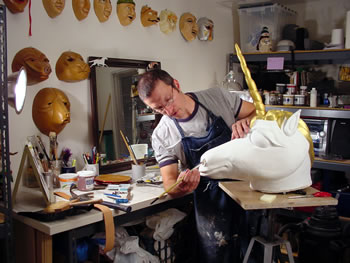 Today I'd like to introduce you to Jonathan Becker: actor, teaching artist, dancer, puppeteer, puppet designer, dancer, fight choreographer and...mask-maker! I've been teaching Commedia and directing with Jonathan's neoprene masks (purchased at theater-masks.com) since 2004. The masks have been dropped, kicked, left out in the sun and in blizzards, and forced to absorb gallons about gallons of actor-sweat and they still look like they've been freshly cast (unfortunately, they've since lost that new mask smell...). In addition to the complete set of Commedia masks he offers, Jonathan has a variety of other character and decorative masks available. (I might add, that his Commedia masks do double duty as my living room's wall decorations.) And if you don't like anything he shows on the site, you can do what Disney and Lincoln Center did: order a custom mask.
And here's what he has to say...
1. How do you define Commedia dell'Arte?
Hmmmmm… The Commedia is so many things. I would define the Commedia as the ultimate human comedy. It is an outrageous celebration of the foibles of humanity. The Commedia is forever contemporary given that it is based on archetypes and universal themes. It is trickery at its finest.
Everything in the commedia is a ruse even the act of story telling. One thinks one is off to see a play but in the end it is what the characters of the commedia choose to give that evening that is the experience of the audience.
As a style, in the commedia, it is the style itself that’s in play. It is different in other forms of theatre. For example, it is the text in Shakespeare, the story in a melodrama, and the characters in Contemporary American Realism. The style itself is what is important in the commedia.
In commedia you have an actor playing an actor playing a character having a direct conversation with the audience.
2. What do you think is the most common misconception of Commedia?
That it is an historical form of theatre that needs to played as such and that it is based completely in improvisation.
3. Where does the inspiration for your Commedia masks come from?
The masks are based on both the historical forms of the traditional commedia masks but also on the animals that are closest to the charters in personality and temperament.
4. Tell us about Neoprene. What are the advantages of working with this material as a sculptor and as an actor?
I would hope so. But I’m not sure that it can happen in our culture. We in America do not have a tradition of masked performance and so have a difficult time relating to masked styles of performance. The masks of our culture are Darth Vader, Freddy from Friday the Thirteenth and evil clown masks for Halloween. It’s difficult. Maybe if we tire of the virtual world we will long for something else and truly theatrical forms of performance will begin to flourish.
9. What can Commedia and its legacy teach us about creating contemporary satire?
Situation is the basis for comedy and the universal is what is funny. That it is ultimately the physical nature of the comedy the rings true and is most exciting. I always think of Lucile Ball, Bill Cosby, Rhett Skelton, Archie Bunker (all of the characters in this sit com) oh and
stupid and ridiculous are a good place to start when solving most problems.
10. Anything you'd like to plug?
Sure… Buy lots of masks from www.theater-masks.com or just send me all your money. That works too.
...In addition to today's interview, you can look forward to hearing from Christopher Bayes, one of the country's leading teachers of clown and Commedia and Kirk Wood Bromley, New York's most prolific verse playwright. Have another interview suggestion? Comment away...
Today I'd like to introduce you to Jonathan Becker: actor, teaching artist, dancer, puppeteer, puppet designer, dancer, fight choreographer and...mask-maker! I've been teaching Commedia and directing with Jonathan's neoprene masks (purchased at theater-masks.com) since 2004. The masks have been dropped, kicked, left out in the sun and in blizzards, and forced to absorb gallons about gallons of actor-sweat and they still look like they've been freshly cast (unfortunately, they've since lost that new mask smell...). In addition to the complete set of Commedia masks he offers, Jonathan has a variety of other character and decorative masks available. (I might add, that his Commedia masks do double duty as my living room's wall decorations.) And if you don't like anything he shows on the site, you can do what Disney and Lincoln Center did: order a custom mask.And here's what he has to say...
1. How do you define Commedia dell'Arte?
Hmmmmm… The Commedia is so many things. I would define the Commedia as the ultimate human comedy. It is an outrageous celebration of the foibles of humanity. The Commedia is forever contemporary given that it is based on archetypes and universal themes. It is trickery at its finest.
Everything in the commedia is a ruse even the act of story telling. One thinks one is off to see a play but in the end it is what the characters of the commedia choose to give that evening that is the experience of the audience.
As a style, in the commedia, it is the style itself that’s in play. It is different in other forms of theatre. For example, it is the text in Shakespeare, the story in a melodrama, and the characters in Contemporary American Realism. The style itself is what is important in the commedia.
In commedia you have an actor playing an actor playing a character having a direct conversation with the audience.
2. What do you think is the most common misconception of Commedia?
That it is an historical form of theatre that needs to played as such and that it is based completely in improvisation.
3. Where does the inspiration for your Commedia masks come from?
The masks are based on both the historical forms of the traditional commedia masks but also on the animals that are closest to the charters in personality and temperament.
4. Tell us about Neoprene. What are the advantages of working with this material as a sculptor and as an actor?
Neoprene is an industrial latex compound that cures to a mostly rigid form. It’s original application was as an additive for adhesives. Someone figured out that it could be used to make masks. I wish it had been me then I’d feel like a smart person.
In a neoprene mask the wall of the mask turns out to be about 1/8” thick and is slightly flexible. This material has been being used by mask makers here in the US for about 18 years. It provides for a very professional grade working mask. Its greatest asset is that the masks can be made in an affordable way.
The weight and feel of the mask is similar to that of a leather mask. The masks are padded and strapped. The wear on the mask will depend on the care that it gets and how many times it is exposed to extreme cold and extreme heat. For the most part, neoprene masks are pretty much indestructible. I toured with a company that had to make changes so quickly that the masks were often thrown on the floor over and over again and those masks would last a year or more of constant touring and playing 250 or so performances a year.
5. Why do you think Commedia dell'Arte is an important training for contemporary actors?
Commedia is an important training tool because it involves the use of masks which are designed as living sculpture. This means that in order to support the mask and maintain the life of the sculpture the actor must always be in a constant state of honest discovery. It is impossible to lie under a mask. Learning to play commedia is like learning to play the violin. One has to be a virtuoso to pull it off. It is hugely technical and an absolute mastery of the technique must be had in order to play.
The actor must have a true mastery of the principles of the craft of performance to succeed at the commedia.
6. You teach workshops which fuse both Grotowski-based and Lecoq-based actor training. How do you reconcile the two distinct styles in your own work and pedagogy?
In a neoprene mask the wall of the mask turns out to be about 1/8” thick and is slightly flexible. This material has been being used by mask makers here in the US for about 18 years. It provides for a very professional grade working mask. Its greatest asset is that the masks can be made in an affordable way.
The weight and feel of the mask is similar to that of a leather mask. The masks are padded and strapped. The wear on the mask will depend on the care that it gets and how many times it is exposed to extreme cold and extreme heat. For the most part, neoprene masks are pretty much indestructible. I toured with a company that had to make changes so quickly that the masks were often thrown on the floor over and over again and those masks would last a year or more of constant touring and playing 250 or so performances a year.
5. Why do you think Commedia dell'Arte is an important training for contemporary actors?
Commedia is an important training tool because it involves the use of masks which are designed as living sculpture. This means that in order to support the mask and maintain the life of the sculpture the actor must always be in a constant state of honest discovery. It is impossible to lie under a mask. Learning to play commedia is like learning to play the violin. One has to be a virtuoso to pull it off. It is hugely technical and an absolute mastery of the technique must be had in order to play.
The actor must have a true mastery of the principles of the craft of performance to succeed at the commedia.
6. You teach workshops which fuse both Grotowski-based and Lecoq-based actor training. How do you reconcile the two distinct styles in your own work and pedagogy?
Do you have an hour… here is the short answer:
I fuse them. Lecoq is all about space and rhythm which involves a relationship to the audience since they are part of the space. The physical conditioning of the plateau work and the attention to the kinesthetic and intuitive sense of physical impulse is second to none in the Grotowski work. I use the two at different points in the training process and to accomplish different goals depending on the outcome I am reaching for.
7. Do you have a favorite Commedia character to play? Why?
I most often play Pantelone because he is closer to me in real life but I love playing Tartaglia. The simple stupidity of this character appeals to me.
8. While Commedia-inspired groups like the Mime Troupe have been around for decades and while some elements of Commedia-esque satire have been absorbed by the sketch comedy world of SNL and such, do you think that we'll ever see a traditional masked traveling Commedia troupe dealing with contemporary material?
I fuse them. Lecoq is all about space and rhythm which involves a relationship to the audience since they are part of the space. The physical conditioning of the plateau work and the attention to the kinesthetic and intuitive sense of physical impulse is second to none in the Grotowski work. I use the two at different points in the training process and to accomplish different goals depending on the outcome I am reaching for.
7. Do you have a favorite Commedia character to play? Why?
I most often play Pantelone because he is closer to me in real life but I love playing Tartaglia. The simple stupidity of this character appeals to me.
8. While Commedia-inspired groups like the Mime Troupe have been around for decades and while some elements of Commedia-esque satire have been absorbed by the sketch comedy world of SNL and such, do you think that we'll ever see a traditional masked traveling Commedia troupe dealing with contemporary material?
I would hope so. But I’m not sure that it can happen in our culture. We in America do not have a tradition of masked performance and so have a difficult time relating to masked styles of performance. The masks of our culture are Darth Vader, Freddy from Friday the Thirteenth and evil clown masks for Halloween. It’s difficult. Maybe if we tire of the virtual world we will long for something else and truly theatrical forms of performance will begin to flourish.
9. What can Commedia and its legacy teach us about creating contemporary satire?
Situation is the basis for comedy and the universal is what is funny. That it is ultimately the physical nature of the comedy the rings true and is most exciting. I always think of Lucile Ball, Bill Cosby, Rhett Skelton, Archie Bunker (all of the characters in this sit com) oh and
stupid and ridiculous are a good place to start when solving most problems.
10. Anything you'd like to plug?
Sure… Buy lots of masks from www.theater-masks.com or just send me all your money. That works too.
...In addition to today's interview, you can look forward to hearing from Christopher Bayes, one of the country's leading teachers of clown and Commedia and Kirk Wood Bromley, New York's most prolific verse playwright. Have another interview suggestion? Comment away...
Kinderspiel's Dramatis Personae
Down below are the characters we explored on Saturday's rehearsal as we tested out the konceit detailed in Kinderspiel Korrections: Part 2. We used the "dropping-in" exercise I picked up from Larry Sacharow in 2001 to find the characters' physicalities and then the ensemble created a very long but very brilliant composition which staged how these characters might deal with the 4 tropes of child's play that I wrote about on Friday. Finally, the ensemble spent some time trying to stage Kiran's very first zygotic stab at the play's language, a fabulously demented mix of English words following German grammatical rules, German/English hybrid words, and nonsense words made out of strange English or German compounds. You can read a little bit of this in the excerpt section of Kinderspiel's finally posted show page on stolenchair.org. And while you're navigating away from the site, feel free to take a gander at the production's webpage placeholder at www.kinderspiel.us. (I know, I know, we couldn't get dot-com...)
If you've navigated back to blog (or never left at all), I hereby present to you, in no particular order, the possible dramatis personae for Kinderspiel:
"Anita" played by Alexia Vernon

"Max" played by Cameron J. Oro

"Heinrich" played by Sam Dingman

"Anna" played by Elisa Matula

"Sylvia" played by Liza Wade White

(You might have recognized some of the above pix. They are all photos or paintings of famous writers, painters, and performers from 1920s Berlin.)
If you've navigated back to blog (or never left at all), I hereby present to you, in no particular order, the possible dramatis personae for Kinderspiel:
"Anita" played by Alexia Vernon

"Max" played by Cameron J. Oro

"Heinrich" played by Sam Dingman

"Anna" played by Elisa Matula

"Sylvia" played by Liza Wade White

(You might have recognized some of the above pix. They are all photos or paintings of famous writers, painters, and performers from 1920s Berlin.)
Friday, May 18, 2007
Kinderspiel Korrections: Part 2
(If you haven't read Part 1, please see below.)
Last we saw our fearless Co-Artistic Directors, they were in the middle of a dual to the death with the Dionysian forces attempting to overthrow their pet project Kinderspiel. Will their partner in criminally brilliant theatricality, the Dramaturg, step in and save the day? Stay tuned...
...
...
........
(trying to live up to the vicious insult that Alexia launched at me: blog tease. Can you believe that?! The nerve!)
....
...
............okay, I can't take it anymore. Our new and improved and more than slightly demented vision for Kinderspiel takes its lead from Hedwig and the Angry Inch (the play, not the movie). Through the structure of various musical acts, each fully genre'd, Hedwig tells his/her origin tale: how he became she and then he again (more or less. kind of. it's complicated. see the movie). Similarly, we'll present an evening cabaret performance composed of acts, moderated by an MC, which, combined with banter and monologue, will explain the origin story of the Kinderspielers and how they came to do what they do. Except our acts will be sequences of child's play, consisting not of play-acting, but the following tropes:
(Cry for help: if anyone out in the blogosphere knows of actual studies that categorize and or analyze kid's play, please comment or email me directly so we can be better informed. Emily, can you cast about for this, too?)
So, if the piece is essentially the interwoven biographies of 5 kinderspielers, who are these Weimar-era men and women anyhow? Check back on Monday for details as we present Part 3 of Kinderspiel Korrections.
In the meantime, comments are eagerly solicited, especially on one troublesome subject in particular: how do we develop this piece in such a way that it is read as a riff on how childhood is processed by adults rather than just a celebration of the oft-cliched "wisdom of the child"?
Last we saw our fearless Co-Artistic Directors, they were in the middle of a dual to the death with the Dionysian forces attempting to overthrow their pet project Kinderspiel. Will their partner in criminally brilliant theatricality, the Dramaturg, step in and save the day? Stay tuned...
...
...
........
(trying to live up to the vicious insult that Alexia launched at me: blog tease. Can you believe that?! The nerve!)
....
...
............okay, I can't take it anymore. Our new and improved and more than slightly demented vision for Kinderspiel takes its lead from Hedwig and the Angry Inch (the play, not the movie). Through the structure of various musical acts, each fully genre'd, Hedwig tells his/her origin tale: how he became she and then he again (more or less. kind of. it's complicated. see the movie). Similarly, we'll present an evening cabaret performance composed of acts, moderated by an MC, which, combined with banter and monologue, will explain the origin story of the Kinderspielers and how they came to do what they do. Except our acts will be sequences of child's play, consisting not of play-acting, but the following tropes:
- Questions & Answers:
- ex. Q: "Why is the sky blue?" A: "Because if it was black we wouldn't be able to see anything during the daytime."
- These questions can be stimulated by real world phenomena or by imaginary constructs from the below tropes. They are often deadly serious and carry the force of logic.
- Role-Playing:
- ex #1: "Let's play house! You'll be the daddy and I'll be the mommy and we'll be poor because you can't get a job and I'll let in strange smelly men and give them a tour of the bedroom while you wait on bread lines."
- ex #2: [5 year old talking on pretend cellphone] "Hello, honey. I'm at the station! Can you hear me? I need you pick me up. I'm at the station. Can you pick me up at the station? I'm by the train."
- These simulations of "adult" life often boil down stereotypes of domestic life and ones community in ways that only the sharpest of satires can mimic.
- Games:
- ex: "Okay, so each time you walk past the bench you need to jump twice and say the name of the person behind you but unless you say it backwards you have to walk backwards."
- These games often have so many invented and/or improvised rules than no adult can comprehend how they could possibly be fun. But they are probably the truest example of direct democracy...assuming, of course, that there isn't a bossy 8-year old barking out all the rules herself!
- Experiments:
- ex: magnifying glasses on ants, salt on slugs, stacking things so high they fall and break, and designing and building a robot of scrap metal in the dumpster in the hopes of creating a friend who will clean your room, do your homework, and get you a girlfriend (not that I ever did that. Because I didn't! And I definitely didn't try to plug it in and get electrocuted! Who would be that stupid?! Stop looking at me like that!).
- These experiments can often be destructive and cruel but they can also be the way kids learn about life, death, gravity, electrocution, and many of the other truisms that will govern their adult lives.
(Cry for help: if anyone out in the blogosphere knows of actual studies that categorize and or analyze kid's play, please comment or email me directly so we can be better informed. Emily, can you cast about for this, too?)
So, if the piece is essentially the interwoven biographies of 5 kinderspielers, who are these Weimar-era men and women anyhow? Check back on Monday for details as we present Part 3 of Kinderspiel Korrections.
In the meantime, comments are eagerly solicited, especially on one troublesome subject in particular: how do we develop this piece in such a way that it is read as a riff on how childhood is processed by adults rather than just a celebration of the oft-cliched "wisdom of the child"?
Kinderspiel Korrections: Part 1
 So, we spent about 3 weeks toying with a concept for Kinderspiel that just doesn't look like it will either a) actually address the questions we want to address or b) actually be possible to do.
Fortunately, we learned a lot in those 3 weeks of experiments. It can be awfully frustrating for all parties involved to flail about in unknown territory only to come to the conclusion that nothing has been concluded. But such is the valiant and commendable mission of a laboratory theatre company! The alternative is what? We would only do plays that were already written or develop ideas that we were 100% certain we could pull off. Where would the fun be in that?
As it stands now, Kinderspiel PR reads: "Set in the demimonde of Weimar Berlin, one cabaret offers access to the ultimate taboo: watching adults play as children. Stolen Chair presents the world's greatest children's story, told exclusively for an adult audience. After all, why should childhood be wasted on the young?"
In our rehearsal experiments, we had been interpreting "play as children" to mean "play-acting as children." Putting aside for the moment whether or not the nature of our ensemble's play-acting was or was not faithful to actual child's-play, this interpretation forcibly skews the play too far towards the Dionysian on Nietzsche's artistic spectrum (Um...can you tell I've been spending too long doing PR for Stolen Chair's gig at the Pretentious Festival?). While about 8 years ago, in the thick of my Grotowski-worship, I would have bribed, maimed, and killed for the opportunity to direct a paratheatrical experiment, Stolen Chair's whole formula is based on reinvigorating classical (or classic) structures. We make perversely-conceived and aesthetically-preposterous well-made plays. And...we tell stories! Good stories. We just couldn't find the Apollonian structures necessary to keep the play-acting component and find opportunities to forge those into a well-made play and a good story.
The chief problem play-acting poses is that it fully negates character; part of play-acting means so fully committing to the spirit of the moment that the social clues that reveal character just disappear. And it's reductive: while there's room therein for wild creativity, the plot tropes it seems to force (Grotowski similarly noticed that in his early paratheatre experiments, most of the improvisations revolved around certain banalities like pseudo-tribal conflict and group celebration) won't give us the opportunity to explore the questions which originally gave rise to this piece.
But, where does that leave us? Ah, well that's part two, coming to an RSS-feed near you in about 3 hours...
Brick-o-lage
 Kiran, Cam, Liza, Emily, and I crouched down and crawled through the Brick's adorably lilliputian entrance for the first time today. The space is like an airier, brick-ier Red Room, with a layout that all the Chairs are really familiar with, narrow and deep. It was nice directing in the space and all of the Brick associates we met were really welcoming.
Tonight was a very special rehearsal: our first time actually digging into the moments that we've spent the past month creating. For those of you who haven't been in a rehearsal with us, we have an interesting 2-phase "blocking" process. Phase 1 happens in a frenzy, with what seems like 5 dozen people shouting out ideas simultaneously until the entire play is staged before any of us has anything even resembling a handle on the play's characters or important themes. This phase of the process can be very jarring for actors who like to cook up their characters slowly, especially when they don't know that Phase 2 will follow shortly thereafter.
Phase 2: we spend the rest of the rehearsal process refining/undoing our hastily staged moments so that can actually live in the same performative world and support character throughlines. This phase of the process can also be very frustrating for actors, especially those who wrote down the blocking for Phase 1 in pen :).
What I love about working with this company is by the time we're half-way through phase 2, I start to get existentially depressed as I watch rehearsal and see only brilliance on stage, no longer remembering an ounce of how I may once have contributed to said magic. I mean it: I actually enjoy wallowing in that deep despair because it's a testament to just how much of a big messy collaboration our work always is.
And now we just have to write the damn ending...
Thursday, May 17, 2007
Friday, May 11, 2007
"Put that in your blog and smoke it"
This posting's title is courtesy of Layna Fisher, Tuzia in our remount of Commedia dell'Artemisia. We are about 2/3 of the way done restaging the rewrites (with a recast ensemble) and I am having the time of my life working on this (and I hope the rest of the creative team is too). I spend most of each rehearsal laughing mine arse off, yet somehow we're right on schedule. I'm more than a little bit sad that we're only going to have three chances to share this.
Back when we first tossed up the possibility of remounting this show, I asked Emily (resident dramaturg) if it was an "immature" work. Not "immature" as in poop jokes and rubber chickens (alas, we haven't found a way to work either of these into Stolen Chair's ouevre), but "immature" insofar as it was something we developed before all of the growth that the company had in 2005 and 2006 (which was, in a sense, first catalyzed by the Stampede Festival performance of Commedia dell'Artemisia).
As we've rehearsed it over the past month, I've rediscovered a certain sharpness in it that really hasn't been in any of our pieces since. While I've blown out my vocal chords debating the "meaning" of most of our pieces, these meta-conversations about Commedia seem so much more loaded. Perhaps because this is one of the few projects on which we've worked that actually has the potential to raise controversy and ruffle the feathers of even the most liberal of audiences. It's a comedy about rape, a raucous and ribald farce about sexual violation, with a little torture thrown in for good measure (Hey, Kiran, you should make sure to work in some of the 24-backlash popularization of torture stuff into the last scene, huh?). And the rape we're satirizing is the actual historical forceful defloration of the Italian painter Artemisia Gentileschi. Delicate stuff, and we're not exactly "tip-toeing on egg shells" around it. We are trying, however, to be even more faithful to the story's original details, perhaps only because the truth, in this case, is far sicker (and, truth be told, far more comical) than any fiction we could invent.
Ultimately, the piece is a diatribe against those who attempt to universalize the subjectivity of human experience: those who look at Artemisia's "rape" and process it with the same context that it would have in our contemporary society, those who actually believe there is any throughline in the history of marriage (one besides the historical subjugation of women, of course), those who believe that great art has always been driven by personal demons, those who eschew responsibility for their ideologies by hiding behind a wall of tradition that is as variable as the Billboard music chart.
Diatribes aside, it also has more slapstick than any piece I've ever had the pleasure of directing. Prat falls, slaps, and kicks in the groin galore. Who could ask for anything more? (Hey, that was almost a couplet! Watch out, Kiran!)
There are only two NYC performances (and each house size is only about 50!) so buy your tickets now, and don't forget to support the rest of our friends at the Pretentious festival!!!
Back when we first tossed up the possibility of remounting this show, I asked Emily (resident dramaturg) if it was an "immature" work. Not "immature" as in poop jokes and rubber chickens (alas, we haven't found a way to work either of these into Stolen Chair's ouevre), but "immature" insofar as it was something we developed before all of the growth that the company had in 2005 and 2006 (which was, in a sense, first catalyzed by the Stampede Festival performance of Commedia dell'Artemisia).
As we've rehearsed it over the past month, I've rediscovered a certain sharpness in it that really hasn't been in any of our pieces since. While I've blown out my vocal chords debating the "meaning" of most of our pieces, these meta-conversations about Commedia seem so much more loaded. Perhaps because this is one of the few projects on which we've worked that actually has the potential to raise controversy and ruffle the feathers of even the most liberal of audiences. It's a comedy about rape, a raucous and ribald farce about sexual violation, with a little torture thrown in for good measure (Hey, Kiran, you should make sure to work in some of the 24-backlash popularization of torture stuff into the last scene, huh?). And the rape we're satirizing is the actual historical forceful defloration of the Italian painter Artemisia Gentileschi. Delicate stuff, and we're not exactly "tip-toeing on egg shells" around it. We are trying, however, to be even more faithful to the story's original details, perhaps only because the truth, in this case, is far sicker (and, truth be told, far more comical) than any fiction we could invent.
Ultimately, the piece is a diatribe against those who attempt to universalize the subjectivity of human experience: those who look at Artemisia's "rape" and process it with the same context that it would have in our contemporary society, those who actually believe there is any throughline in the history of marriage (one besides the historical subjugation of women, of course), those who believe that great art has always been driven by personal demons, those who eschew responsibility for their ideologies by hiding behind a wall of tradition that is as variable as the Billboard music chart.
Diatribes aside, it also has more slapstick than any piece I've ever had the pleasure of directing. Prat falls, slaps, and kicks in the groin galore. Who could ask for anything more? (Hey, that was almost a couplet! Watch out, Kiran!)
There are only two NYC performances (and each house size is only about 50!) so buy your tickets now, and don't forget to support the rest of our friends at the Pretentious festival!!!
Monday, May 07, 2007
Pretentious Update
Tickets for our production of Commedia dell'Artemisia at the Pretentious Festival are now on sale. Buy 'em here.
We'll be doing a very special post for the Pretentious blog in a few days and we'll simul-post that here.
I'll also be sending out process updates on Kinderspiel and Commedia dell'Artemisia throughout the week.
We'll be doing a very special post for the Pretentious blog in a few days and we'll simul-post that here.
I'll also be sending out process updates on Kinderspiel and Commedia dell'Artemisia throughout the week.
Subscribe to:
Posts (Atom)