Showing posts with label Manifesti. Show all posts

Saturday, May 16, 2009

The speech that got booed

So I was one of the five artists on the "cultural entrepreneurs" on the panel at Wednesday's New Economy Smackdown, hosted by The Field & Galapagos. The unedited audio of the entire event is already online. You can read Claudia La Rocco's take on the event here and Morgan von Prelle Pecelli's own panel statement here. Below, however, is the speech I made, a speech which received the event's first boos. The offending statement is in bold and I stand by the remarks even more after hearing how many hackles it raised.
Jennifer asked all to create a soapbox manifesto reflecting on how the current arts economy is affecting us and our work. I struggled to get any thoughts out, because the more I thought about it, the more I realized none of us in this room should be here talking about the arts economy. There is no such thing as an arts economy since non-commercial arts by their very definition don't follow market logic and can't compete in the market place without dependence on non-profit support structures and the government . So we can embrace our role in the margins of the economy and struggle the way that performing artists have struggled since theatre and religion parted ways, or we can model ourselves on the only other two positions left to us in a market-driven economy: as charity (quite like an endangered species) or as community resource (like a neighborhood garden). Well, if we're a charity we should follow the model of other charities: humpback whales don't send out end-of-year asks or write grant applications, so we shouldn't either. We should depend entirely on the goodwill of people who don't want to imagine a world without theatre and therefore raise awareness, funds, and support to ensure we continue to exist. But, I don't want to be a charity, in large part because I don't think our social cause has enough merit to compete with other charities who actually change lives on a grand scale. So, the only round hole we can force our square peg of a "business model" into is as community resource. In this interconnected, digital age, if our art can serve as a meeting place for communities of like-minded individuals to connect, celebrate, and be challenged, then we might find a way of restoring theatre's primacy in people's lives and creating sustainable theatre-making organisms (not organizations).

But, since we are, however, here to debate the "arts economy," I'll add:

Why is there now, why has there been, and why will there always be prime, beautiful, ready to theatricalized real estate sitting vacant for extended periods in all 5 boroughs? If someone can work out insurance, tax deductions, box-office splits, zoning laws, etc so that businesses have a reason to open their doors to artists then we can do what we do best, drive in droves of foot traffic, people with expendable cash some of whom may be looking to rent a new office or storefront. 80% of Stolen Chair's operating budget goes towards space rental. Knock out that cost and we can pay our artists not only living wages, but competitive ones.

As producer of a company made up of people whose survival jobs are freelance and often paid hourly, I am sick of arranging (or trying to arrange) quid-pro-quo deals that will help Stolen Chair the organization save money at the expense of the individuals who are Stolen Chair. In most cases, we'd be better off adding an extra-hour to our work-weeks and donating that money to the company.

We need the next generation of gatekeepers or, in the very least, our current crop needs to start communicating with each other and rethink what it means to support "emerging" art. The supply of indie theatre in New York will always outstrip the demand, but by presenting, critiquing, and funding the same two dozen artists, our gatekeepers stifle innovation and creative movements the same way corporate monopolies do.
So. Yeah. Boos. (And then some cheers in response to the boos.).

I obviously wouldn't work eleventy-billion "survival" jobs and put trillions of hours into each Stolen Chair show if I didn't believe in the fundamental power of art to transform lives and feel strongly that the choice to wake up and dedicate ones' life to art is nothing short of radical and revolutionary. That said (and perhaps this is due to Stolen Chair's recent experience as a Jenzabar Foundation finalist alongside far more vital social missions), I think that if art tries to compete with "real" charities toe-to-toe, we will not only lose, but feel terrible for entering the fray. So let's pull ourselvs out of this terrain entirely, rediscover art's special place, and develop compelling and innovative ways for people to use the power of their pursestrings to ensure that we continue to exist.

Friday, April 24, 2009

A social media manifesto (or...how to help Stolen Chair win $3,000 with 5 seconds of your time)

One of the major auxillary components of Stolen Chair's Community Supported Theatre business plan is the comprehensive web of collaborative social networking tools we'll be using (and, in some cases, already use) to enrich communication between our company and our audience. When The Jenzabar Foundation announced a call for such proposals for their $3,000 Social Media Leadership Award, we quickly drafted and submitted a summary of our social media outreach programs.

Good news: Our proposal made it to the semi-finals.

Even gooder news: You can be the vote that brings us to the finals (and the $$$!). The winner is the organization which reels in the most comments on their proposal.

You know how tough times are for artists right now. Help Stolen Chair expand our programs (and our reach) by writing a few encouraging words at the bottom of our proposal (you don't even have to read it!). The race is tight right now and your one vote could be the deciding factor which shapes our entire season. Whether you have seen our work or not (heck: whether you have heard of us or not!), I hope you'll take the time to post a few words here: http://thejenzabarfoundationblog.com/2009/04/09/the-stolen-chair-theatre-company/

(Comments take at least one business day to be moderated before Jenzabar posts them)

THANKS SO MUCH!!! (And please spread this around!)

Friday, April 10, 2009

Physics & Failure: Lessons for a Laboratory Theatre


In our attempts to devote even more time to the laboratory process in 2009, we have already started research on Stolen Chair's newest original work, Quantum Poetics, even though we probably won't even be thinking about scheduling the first creative retreat until this fall (once we have started the CST). Since the piece will draw inspiration from recent advances in neuroscience and theoretical physics, research has been both challenging and thrilling. Fortunately, writers like Brian Greene and Jonah Lehrer have made these fields so accessible that I find I'm not only able to grasp this heady material, but actively salivate over the possibility of theatricalizing it. And unlike previous Stolen Chair projects for which the research was primarily limited to books and movies, I'm able to devour tons of information on Quantum Poetics via podcasts!

But I digress. I'll post about my research highs and multiple universes and phantom limbs and Occum's razor and biofeedback and eleventy billion other titillating tidbits in the future. Right now I want to talk a bit about failure. I've been listening to Brian Greene and Heidi Schellman speak about some pretty far out advances in both particle physics and cosmology and they both chatted with glee about failure in their fields. There is a certain school of thought which holds that all of science's major advances came not from decades of methodical research but from accidental discoveries that opened up entirely new vistas of possibility. While neither Greene nor Schellman were speaking to that specifically, they were crystal clear that they'd be absolutely thrilled if they (or someone else) discovered something which contradicted their lives' work and research.

I know that two of Stolen Chair's most adventurous (and I think successful) works, Kinderspiel and Theatre Is Dead and So Are You, shared very little in common except for the several month-long periods in each when we were absolutely clueless about where the project was going. We began each of these projects much like theoretical physicists, using the studio as our Large Hadron Supercollider. In Kinderspiel, we knew that there was something rich to be found in the collision between Weimar-era cabaret and child's play; in Theatre Is Dead, we wanted to smash vaudeville and death together into an unholy hybrid. Aside from the titles (which, oddly, usually come first), we spent several months developing both projects without knowing much more than that.

And: we failed. Daily. Weekly. Monthly. We brought new ideas into the studio each time we met and played with each until we found its dead-end. Lost in a sea of theatrical possibilities, we grew tense and frustrated (and even lost collaborators in both at the height of this confusion). I'd be lying if I didn't say it feels terrible. It feels terrible. Awful. Absolutely rotten to ask a group of game actors to try something out when it's more likely to be yet another idea to toss into the REJECT pile than to lead to any real progress. But it shouldn't be. And, in Stolen Chair's future, it won't be. Because we are damn lucky to have the opportunity to actually experiment before we go ahead and present something as "experimental theatre." We are a laboratory theatre and we should never forget to take that moniker as literally as our scientific brethren do. In the lab, sometimes things explode. Sometimes those explosions are actually the result you're looking for, but, more often than not, those explosions just leave you covered in sticky sulphurous radioactive goo (okay, that's probably not true, but it's such a nice vivid way to visualize failure).

So...I can't wait to begin Quantum Poetics and to savor each and every failure, surrounding Stolen Chair with an army of collaborators who are as excited about the possibility that everything they know about theatre and about themselves as artists might be redefined by what we discover.

Friday, March 20, 2009

Puppet playlist recap and London street performers

On March 12, Stolen Chair joined a group of 12 other physical theatre artists and musicians at the Tank to present pieces inspired by the work of Tom Waits (as part of the first edition of Puppet Playlist).  When we first found out about the event, we were still in the thick of Theatre Is Dead but not yet in the thick of Quantum Poetics (pitch coming soon) or the possible Man Who Laughs remount (yes, you heard it here first!).  So, as devout Waits fans, we knew we wanted to participate but also knew the whole thing would sort of be a fun one-off for us.  As a company which spends 6 months developing new work, doing a little w.i.p. thrown together in a weekend is somewhat out of character, but we'll also take any opportunity to play.  

We started working with the music, splicing together a 6 minute piece out of Waits' "Temptation" and "I Don't Wanna Grow Up."  We found ourselves continually fighting the desire to craft some sort of literal narrative (being tempted to grow up) which the music could score.  It is so so so so easy (and, forgive the pun, tempting) to fall into literal storytelling when songs have lyrics.  Music videos always struggle with this.  Do you offer a video which tells the story of the song, tells a completely different story (which will either complement the song or, in the very least, not divert attention from the song), or present a series of images which create a resonance chamber in which the sonic images and figurative language can bounce around.  We decided to do the latter, structuring it so that there was still a clear frame for the audience to grab onto (Noah's "realistic" child-like character encountering a series of arresting and bizarrely erotic images staged as automaton machines by David and Liza).  

What emerged was definitely the most abstracted theatrical vignette we've created since Portrait of Dora As a Young Man in 2002.  And you know what?  We had a damn good time doing it!  I wish we could have rehearsed it more (and, um, at least once on stage) before running it for an audience, but people seemed to dig it (a few strangers coming up to compliment the actors after the show). This was the 4th Stolen Chair event in 2 years (the Kinderspiel staged reading, the Kill Me remount at the Brick, and Theatre Is Dead being the others) which was truly "unapologetic."  We had so fully let go of any fear that the audience was not going to "follow" us that we ended up creating a much more compelling event for the audience to "follow" than if we had let ourselves worry if we were going to be liked.  Moral of the story: there really is an audience for anything, and if one creates and present work with total conviction and faith in its worth (or simply its status as an experiment), one will please far more crowds than if one tries to craft a crowd pleaser.  May seem like a no-brainer, but it's one we routinely re-discover. :)

Speaking of pleasing crowds, Kiran and I had the good fortune to catch a remarkable street performance in Covent Garden, London last week.  They were just a pair of middle aged British clown jugglers, but as we sat there for 20 minutes on the cold pavement, I learned more about theatre than a semester worth of classes could have taught me.  Some lessons learnt:
  • Wear the structure on your sleeve...and then play!  The second thing these clowns did was introduce the unicycles (pictured at right) which would serve as the routine's finale.  Of course, they prolonged and toyed with us for over 20 minutes before delivering the promised finale.  This playful dramaturgy takes Chekhov's gun theory ("If in the first act you have hung a pistol on the wall, then in the following one it should be fired. Otherwise don't put it there.") one step further, and, I think, is especially vital for companies like Stolen Chair who tend to devise unfamiliar theatrical structures.  Show the audience the unicycles so they know where you're taking them.  (And don't take too damn long to get there!)
  • Define failure on your own terms.  The clowns told us to "Boo" loudly whenever they dropped a club or ball.  They then mocked us when we didn't "Boo" loudly enough.  This transformed what should be a net energy loss (the failure of a routine) into an energy gain (audience shouting loudly at the stage in complicity with the performers)
  • It's okay to remind the audience that they are watching live theatre and not television (and that live theatre is always an interactive event).
That last bullet helped Kiran and me re-realize (for the umpteenth time) that there is one thing that brings together all the theatre we want to make: it is ruthlessly and brazenly theatrical.  We don't just want to parade another art form on stage (film, visual art, and literature being three of the most commonly "theatricalized" culprits).  And the only thing which really, at the end of the day, separates theatre from these arts is presence: of the actors and of the audience.  The former is hard to quantify (though many have tried) beyond the simple existential fact that, yes, the actor is a live human being standing anywhere between 5 inches and 500 feet in front of you (depending on the level of play and the theatre's architecture, of course).  

But the audience?  That's simple.  They are simply there. You don't need to train them to be extra-there.  But you do have to encourage/demand/invite/bribe/threaten/tempt them to be an actual theatrical audience (one which implicitly accepts and savors the presence of the actor and the interactive phenomenon that is live theatre) or you can let them keep their distance like your actors are projections on a 30' screen, pretty pictures in a frame, or talking books.  I'm all for works of art that blur the lines of their genre and all for stealing freely from visual art, film, and literature (just look at Stolen Chair's body of work), but we (by which I mean Stolen Chair) kinda always need to be working to discover new ways of making sure the audience is present with us, not just enjoying us (or...[gulp] actively loathing us).  

Sunday, November 16, 2008

Born to die

Ah, now that Vi is back in rehearsals full time again, it looks like we'll have a steady stream of rehearsal photos.  Good. We played with some really fun/sick lazzi today: 
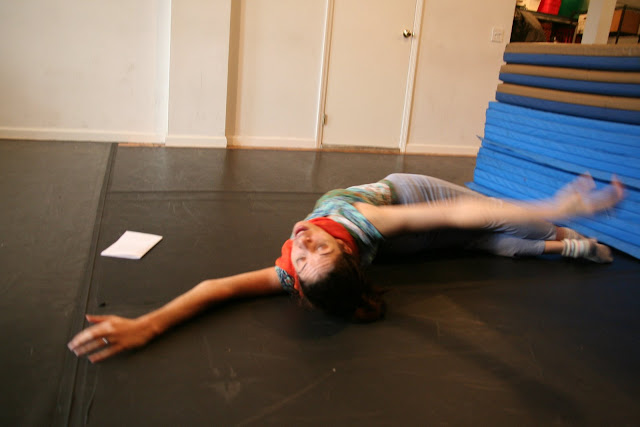
  • Lazzo of Sicilian mourning (which I made Liza do 5 times.  She thinks I was trying to explore different "variations."  Nope.  Just damn funny.  Wanted more more more.)
  • Lazzo of the "Oriental" Seance
  • Lazzo of the Spirit Possession
  • Lazzo of death by consumption  (picture above.  Alexia's long sinewy limbs and dancerly control, not to mention her wide eyes, transform these classic death scenes from great drama into campy high art.)
  • Lazzo of death by smothering
  • Lazzo of death by poisoning
  • Lazzo of a toddler's death
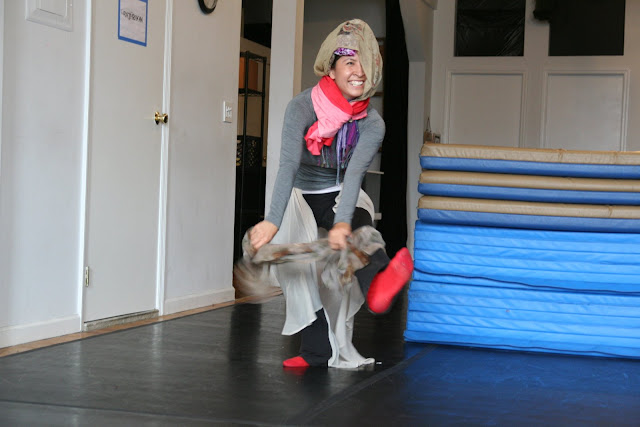
  • Lazzo of the Dance of the Seven Veils (picture below.  Rainbow, who has never seen the classic burlesque Dance of the Seven veils was asked to improvise one.  I could have laughed my way through at least another 20 veils)
After rehearsal (and an exciting design meeting), Kiran and I devised a system to rank our lazzi (and their accompanying texts) in terms of their wrongness.  Now, those of you who have followed Stolen Chair's work over the past 6 years perhaps know that Kiran and I have a special affection for the wrong.  We like to break rules.  Is this iconoclasm for its own sake?  Maybe.  But what's so bad about that?  When you smash all the statues in the temple you find out what, if anything, is still worth having faith in.  And honestly, if these (metaphorical) statues were really meant to be invulnerable, a couple of kooky artists couldn't shatter them so easily.   
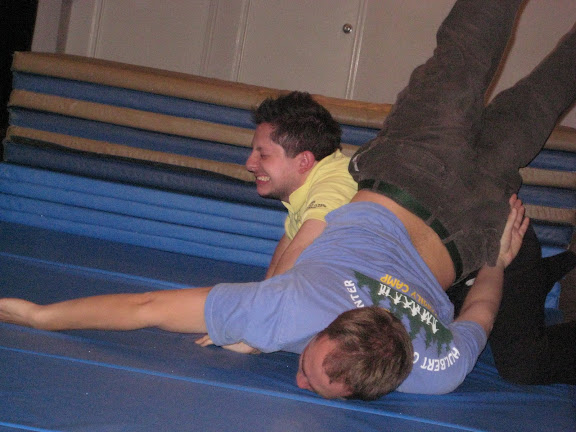
So, in an attempt to wrest our humanity and subjectivity from the monolithic pages of On Death and Dying, from the late-Victorian discomfort with corporeality, and perhaps worst of all, from the Judeo-Christian (and later Cartesian) soul-body schisms, we're trying to push past our own comfort zones and...well...do the "unthinkable" around, to, and with "dead" bodies (which, of course, are fully alive actors performing deadness: more on "dead drag" in a future post).   

And how does this have any more artistic merit than dead baby jokes?  Well, if you have any tolerance for dead baby jokes (God bless them!), I imagine it's rare that you are actually visualizing a real baby (let alone one that you have known, loved, etc) being processed in blenders, falling out of trees, getting fetal alcohol syndrome, etc.  Completely disconnected from any social realities (our real fears of infant mortality, for example), these jokes titillate on a purely intellectual level with a baby-shaped-symbol serving as a placeholder for all of the grotesque abuse.  We laugh at the transgression because we are smart enough to know that it is transgression.  The dead baby jokes point to the taboo and let us share a laugh at its expense, somehow reaffirming the taboo's validity in the process.  Yes yes, it is wrong to put babies in blenders or to even think about doing that.  

Something about theatricalizing these taboos, though, is able to make the transgression seem more real.  The human body, live on stage in front of you: you can't replace that with a baby-shaped-symbol.  This is why the dead baby scene in the Scottish play can be so very chilling; we have been asked to accept this baby (or rag doll or bunraku puppet or whatever) as a real baby and suddenly it becomes very hard to laugh at the unspeakable violence done to it.  But maybe, just maybe, if you repeat that scene a few dozen times or score it with "Hit me, baby, one more time," you can pull it just far enough into the realm of the ridiculous that it not only still possesses its visceral wrongness but also gives us the distance to examine that viscera and say: why do I instinctively react this way? To paraphrase James Kincaid in Child Loving, visceral reactions love to masquerade as untutored, universal, and otherwise bio-evolutionary-psychological "reals."  More often that not, however, these so-called "pure" reactions are as socially constructed as contemporary norms of beauty.  Now, that said, humans are social creatures who spend their days processing the world through social constructs so we're certainly not suggesting that anything we ever do on stage is intended to lead people to negate the belief systems that structure these responses.  I guess we just think that we'll all be a lot healthier if we are reminded and reminded often that (most) taboos are as variable as our weather has been this fall.  

Friday, November 14, 2008

Died laughing

Cheeks.  Still.  Hurting.  From.  Tuesday's.  Rehearsal.

In rehearsal it is often hard to tell if something is absolutely rib-bruisingly hysterical because you have a) discovered a comic moment so pure and undeniable that all audience members will be helpless to escape its contagion or b) found something that will be funny to you and only you because you know the actors very well and/or you are filling in necessary contextual blanks that actually allow the gag to make sense.

Honestly: either way, I left Tuesday's rehearsal feeling like the luckiest guy in the world.  I was actually paid (very little, it's true, but still...) to laugh so hard that internal damage was more than likely.

Though these might be famous last words, I think we may have actually tip-toed up to a workable process for Theatre Is Dead.  In the past, with the notable exception of The Man Who Laughs (which had no spoken text and was therefore immune to this particular issue), we've struggled to find theatrically viable ways to introduce text into the process.  Right now, scene fragments are trickling in as fast as Kiran can write them, and it was important to me that, as we experimented with her text in rehearsal, we didn't lose the commedia-esque stylization and physical comedy vocabulary we have been exploring in November.  Usually, we spend a few weeks exploring style-work, add the text in, get paralyzed by psychological analysis of the scripts, and wait for weeks before actors can actually feel enough ownership to begin exploring the scenes in their bodies again.  This is no good.  There has to be a way to explore style, character, relationships, physical space, and text together without one getting compromised.  

I'm hoping that the solution lies in rethinking what the "unit" of work is.  In prior shows, when rehearsing a scene, we might work page by page, or french scene by french scene, or by clusters of beats.  We may start by staging that unit silently, finding strong actions to communicate the character's objectives.  Problem #1 is that these actions are often quite "psychological;" they express the character's mental state but don't necessarily mesh well with the style in which we eventually intend to play.  Eventually, we'll layer the text in and on comes problem #2 when the physical actions dull and the actors become statues with scripts in hand.  

So, to avoid both problems we've changed the way we draft a scene's realization.  Instead of breaking scenes down arbitrarily or by psychological "units," we've tried breaking down in chunks more appropriate to the performance style.  As a vaudeville of sorts, the smallest unit of rehearsable action in Theatre Is Dead is an "act" (Not as in, "Act 1: Scene 3" but as in a "magic act").  Instead of viewing an entire scene as an "act" unto itself, we're breaking it up into many different smaller "acts" which we are, in the tradition of commedia dell'arte, calling "lazzi."  So in Tuesday's rehearsal we rehearsed "Lazzo of the Jacket," in which Dave's character tries to switch jackets with a corpse.  Before we even showed him the text of the scene in which this lazzo would appear, Dave improvised the given circumstances of the bit.  Because it was broken down as an "act," and not a "unit" of psychological thought, the same stylistic rules applied: exaggerated physicality, complicity with the audience, clown logic, etc.  

What Dave created through his improvisation was directly usable in the scene itself once we added text.  The action doesn't "mickey-mouse" the text because, unlike the actions that usually emerge from our silent scenework, it was not created to reveal hidden subtext; Dave's "Lazzo of the Jacket" was created specifically to amuse the audience.  In this model it is up to playwright, dramaturg, and director to lead the actor to lazzi that will, when complemented with text, create complexity (or at least, excess), character, and humorous juxtaposition.  

I guess the simple moral from all of this is: each aesthetic demands a drafting style befitting its ends.  You can't create a sculpture if you start with brush and palette.  Further, the tools you'll eventually use to shape the marble or clay or chickenwire or whatever will determine not only the final aesthetics but how those aesthetics affect the receiver of the work.  If you're hunting for new aesthetics and new responses, sometimes you need to invent (or repurpose) new tools, new materials.

Who knows if the seeds of these thoughts will be of any use to us in future projects.  Life in the lab is always interesting: experimental drug X may work on patient Y but not on patient Z.  But something will work for patient Z; you just need the time and the resources to figure out what that might be...

Monday, October 27, 2008

Take our sweet-@ss time to die!

For those that have been curious about what Theatre Is Dead and So Are You might actually be, our description now has a little more depth than the previous talking points ("Um...it's got death...and...uh...vaudeville?).  As is so often the case, it was our desperate attempt to meet a grant deadline that forced us to fall in line.  Below is the project description we pitched which, because this was a production design grant, is actually 1 part Stancato to 3 parts Bengali (stir, garnish with pineapple wedge).  I think, however, that it paints a clear picture of the world we're trying to create.  After you read the text, you should definitely click over to some incredible vaudeville photography that Aviva dug up.  Rehearsals start this weekend and I am very very excited.

The Theatre is Dead and So Are You is a funeral for the stage in 12 acts.  A ragtag bunch of variety veterans are laying to rest their MC and impresario and doing so for the world to see.  They'll be performing his funeral live on stage, travelling from city to city, until such time as his body is too decomposed to make the proceedings pleasant.  Their "eulogies" are performed Ć  la classic variety, each taking its own deadly turn in style or content as they celebrate the life and death of their dearly departed dead dead dead friend.  Even in their joyous performance, a spectre looms as each knows they've all been exposed to the fatal disease that killed their MC: Life (or is it Theater?).  As part of Stolen Chair’s ongoing mission to address theatre’s continuing vitality in a world dominated by film, this piece will also ask the nearly century-old question: is theatre a dead art and if so, what makes us continue to make and attend it?  

The world of this piece is one of joy in (de)composition.  We will explore how, as things fall apart, they can be recombined into new forms and creations.  Inspired by the Dia de los Muertos, we will celebrate death as a source of renewal, an escape from one dream into another even more fantastical.  We imagine a classic Vaudevillian variety stage that is full of the detritus of production - visual evidence of what happens when closed plays go away to die.  Our proscenium space will be draped with old, once glittering fabrics.  A rich red curtain, when pulled aside, will reveal masks and puppets large and small that grin ghoulishly out of the shadows.  Our players will explore the catacombs of an old prop storage where the caskets and shrouds contain the forgotten bits of productions now past their relevance to any audience.  A testament to the transience of live performance, these objects have been lost to the memory of anyone who once knew what they were for.  Inspired by the creepy magic of the inert but once alive, the players will clear out the space, leaving us with a totally empty unadorned theatre.  By achieving a truly “dead” space, we will make room for new creative life.

Throughout the following non-linear, vaudeville, variety event, the audience is in for a raucous immersive experience using not only the stage, but the floor, the balcony surrounding them from above, and hidden areas that can be heard but not seen, just as Artaud might have wanted.  The objects from the opening of the piece will reappear, ingeniously used by the actors in ways wewill develop in rehearsal, combined in designs that reveal new and unexpected harmony and imagery.  Various objects will be strung up to utilize the full volume of the space.  Some will be thrown over the balcony to dangle above the audience or the stage before we haul them back up.  What kinds of objects will they be?  Our collaborative design and rehearsal process will answer that question over the coming weeks and months, but it is certain that symbols of death will abound: skulls, dead flowers, rotting fruit, black fabrics, candles, religious idols, masks.

We will reveal the variety acts (and the accompanying magical reconfigurations of space) by closing and opening a big red tab curtain.  If possible, additional layers of curtains will allow for multiple depths of reveals, and layers of visual texture.  With multiple layers, clever lighting, and choreographed prop and set manipulation, we hope to achieve some Dali-style trompe l'oeil and assemble objects on stage to suddenly synthesize into a form.  Perhaps a curtain will frame a piano, an urn of flowers, and some dangling masks to create the image of a giant grinning skull. Supplementary funding from the ____ Foundation would allow us to construct a more visually striking and creatively versatile curtain. It will allow us to commission high-quality fabrics and an appropriate rigging apparatus (from a supplier such as Rose Brand) to implement tab lift effects to selectively reveal parts of the playing area.  A well-made and well-rigged heavy curtain acquired with the _______ Foundation would complement the Connelly Theater’s grand proscenium arch (and the stamped tin carved Greek masks that adorn it) to create a look of a classic turn-of-century music hall or vaudeville house.  While a homemade single tab curtain of inexpensive material will serve the most basic functional needs of this piece and our space, additional funding from the _________ Foundation will give us the resources to procure a set of multiple well-rigged, attractive, and heavier curtains, allowing us to take the visuals of this beyond the functional and to create a striking physical world for the players and for the audience.

The other essential design component of this piece will be a collection of coffins.  A grand coffin will sit center stage holding the corpse of the Vaudevillians’ deceased leader, opened and closed as his lifeless body is exhumed and used in the variety acts.  Moreover, the actors will make the entrances and exits rolled on in coffins and coffins will serve as central accessories for many of the acts. A coffin designed for this project would need to do several things. It must roll both horizontally and vertically.  It must support human weight.  There must be multiple ways to get into and out of it.  With our existing resources, we can create a simple pine box that meets these needs.  With support from the _____ Foundation we can actually construct ornate coffins which carry the significance and gravity of the coffins audience members have seen at funerals.    Additionally, this funding would enable us to build “trick” coffins designed to enhance the vaudevillian acts themselves.  Perhaps a saw-the-assistant-in-half trick, or a never-ending clown-car entrance of corpses.  Maybe a coffin that opens unexpectedly on its own at inappropriate times.   With our current budget, we plan to develop vaudeville acts that do not rely on such a “trick” coffin.  If granted support from the ______ Foundation, however, we would use our remaining development and rehearsal time (during the month of December) to generate new and more exciting choreography that can interact with the more elaborate and customized coffins.

Stolen Chair develops each new piece collaboratively: text, performance style, and design emerge organically together over the course of the rehearsal and developmental process.  The Theater is Dead and So Are You is in its earliest phases of creation, and as such we don't yet know in what direction the piece will go.  Our visual concepts for the piece, however, are beginning to take shape, and we welcome all opportunities to bring them to a more fully realized level of development.   

Tuesday, January 08, 2008

"Retreaaaat!"

This is the much much much belated recap of our mid-December creative retreat for The Tragic Swashbuckler (working title). It was easily the best retreat in recent memory: good interpersonal vibes, good food, good drink, and um...good theatre! Click here to skip right to the photos.

The goal of the retreat was to figure out how the production's concept would balance the two influences: swashbucklers and Greek tragedy. Was this going to be a swashbuckler staged in Ancient Greek period? Would this be a Greek tragedy set on the Renaissance high seas? 20% swashbuckler, 80% tragedy? We left very confident about how to steer this ship (oh the nautical references are only just beginning, my friends!). We decided we would borrow some plot tropes, use of the chorus, and portrayal of violence from Greek tragedy and fuse it with the character archetypes, overall plotting, and moral/national fluidity from swashbucklers.

We also spent some time messing around with the biography of John Paul Jones, the "American" (really Scottish) pirate who is considered the father of the American navy. And it disturbed/delighted me oh so much to see us play around with the idea of American patriotism in an earnest way. Scary potent stuff. Talk about alienation-effect: scream at a downtown NYC audience and flash bright lights at them and they'll eat it up; but offer them up a slab of American patriotism (without the side of irony) and you'll have people lining up at the exits. Who'd of thunk that could be so darn provocative?

Another visceral discovery: combining swashbuckling and tragic modes of violence. In a swashbuckler, laughter abounds in climactic duels to the death but the deaths in the tragedies are...well...tragic. They are heavy. Devastating. Irrevocable. You get the sense that Sabatini (the novelist who penned most of the stories that would later become swashbuckler films, most of which starred Errol Flynn, were directed by Michael Curtiz, and scored by Erich Korngold) would hardly blush at the idea of bringing a character back from the dead after he's been run through, but Sophocles...if Sophocles is bringing someone back from the dead, it's to torture the already miserable protagonist. So, the idea of watching two laughing antagonists prance around with swords as they exchange witty repartee and then deal with the actual tragic consequences of their actions just gives me the shivers. I like the shivers.

One more thing. Or rather, one more thing before I paste in a few pages summarizing our activities over the weekend. Read Sabatini's Scaramouche and see the awful Mel Gibson movie The Patriot right now. They are both tragic swashbucklers, brilliantly and manipulatively dealing with the same cliches and contradictions that we're exploring in this piece. Do not, however, SEE Scaramouche (an awful unfaithful adaptation) or READ anything Mel Gibson says.

Here's what day 1 looked like (sorry for the wacky font sizes and any obscurely named exercises):

10:15-11:15: Warm up and Exercises

  • Personal Warm-up
  • One-Two, Princes Who'll Adore You
  • Chorus work:
    • Balancing the stage
    • 2, 4, 6
    • Shipwreck: using only the body and voice, create a shipwreck. you are the elements (water, wind), the boat, and the people on it.
  • Swashbuckling characters

11:15-11:35pm: "Ha ha ha ha ha" (Comp #3)

  • Plot of Robin Hood
  • Only text can be laughter
  • One moment of Choral laughter

11:35pm-1pm: "Pirates of the Aegean" (Comp #4)

  • Use plot from Trojan War (Greeks vs Trojans, Gods), but each character on stage must correspond to a swashbuckling archetype
  • Chorus is onstage the entire time and two actors play all roles.
  • Chorus watches a battle which is appearing in the audience
  • An oath declaring what separates the Greeks from the Trojans
  • Use 4 different levels
  • Curtain peels back to reveal tableaux of tragic ending
  • Use 5 lines of text from the Iliad and 5 lines from Sea Hawk screenplay (Spend no more than 10 minutes finding text)

1pm-1:45pm: Lunch

1:45-2:30: "Captain Blood Curse" (Comp #5)

  • Adapt plot and characters of Oedipus Rex into swashbuckling archetypes
  • Use a maximum of 10 lines from Sophocles' text (Spend no more than 10 minutes finding text)
  • One "sped up" fighting sequence
  • Do not use a chorus
  • The entire scene must be set to the soundtrack of The Sea Hawk

2:30-4:00: "I have not yet begun to fight" (Comp #6)

  • Plot from the biography of John Paul Jones
  • The scene must be structured: Prologue, Parados, First Episode, First Stasimon, Second Episode, Second Stasimon, Third Episode, Third Stasimon, Exodus (http://socrates.berkeley.edu/~pinax/Structure.html)
  • The chorus is American revolutionaries
  • The song "God Save the Thirteen States" should be the Parados (stanzas 1, 3, & 4) (http://www.mcgath.com/freelyr.html)
  • 6 purposes of chorus pg 148 of packet
  • Use quotes from biography

4pm-4:30: Coffee break

4:30pm-6:30pm: Swordplay exercises (@ Molinari Hall)


And day 2:

10:15-12:15: More swordplay exercises

12:15-12:30: Snack Break

12:30-1:30: Comp #7

  • Work in partners
  • Use text from Prisoner of Zenda
  • Sword fight itself should be in swashbuckling style
  • When Rupert is stabbed, his death should be "real" and Rudolf is stunned and horrified by the murder he has committed

1:30-2:15: Lunch

2:15-4:00: Comp #8

  • Setting is Jacobean England, English colonies, and Caribbean Sea
  • Plot must include:
    • Incestuous relationship unknown to lovers
    • Someone's life must be sacrificed to save a ship
    • Protagonist must avenge a death even though he/she will be punished for that vengeance
    • Hubris
  • Characters must include:
    • Captain Blood archetype
    • Queen Elizabeth archetype
    • Rupert or Basil Rathbone archetype
    • Colonel Bishop or Prince John archetype
    • Arabella Bishop archetype
  • The protagonist must go through 4 identity transformations (pirate, Englishman, etc.)
  • Laughter in every episode
  • Choral prologue and then no chorus after that
  • Call and response speech ("What are we going to do with this money?" "Give it to Richard!")
  • A sea battle
  • 6 levels
  • Patriotic pageantry
  • Sped up duel which ends in off stage tragedy which is revealed in tableaux
  • Happy ending (not ironic!)

And now...silly photos:


Thanks to Dave Gochfeld and Barbara Seifert for joining the Chairs for the weekend!

Sunday, July 08, 2007

Language of Play: Kids, Dada, Expressionists, etc.

"Her lips trembled, colon, quotation marks, Eleanore, dash, Eleanore, dash, quotation marks, quotation francs, quotation dollars--going, going, gone!"
-From Alfred Doblin's Berlin Alexanderplatz, 1929

"The little girl comes. The mother comes. The daddy. The brother. A dog. They go to sleep. They wake up. They have breakfast. Then they eat lunch. Then they eat dinner. They brush their teeth. They go to sleep. They wake up. They eat breakfast."
-a 4-year old's story as transcribed by Vivian Paley for her book The Boy Who Would Be a Helicopter

**********
"
Dada doubts everything. Dada is an armadillo. Everything is Dada, too. Beware of Dada. Anti-dadaism is a disease...But the real dadas are against Dada.'
-Tristan Tzara, co-founder of Dadaism

"There's a no-helicopter in my story. A not-helicopter. It's a not airplane. My helicopter is in it. The helicopter goes up to the sky. Then crash! This helicopter. Crash! Then I fix it. A not-airplane story."
-Another 4 year-old in Paley's classroom
I've spent the past few days with my head alternately buried in 3 Kinderspiel-related books: Paley's The Boy Who Would Be a Helicopter (hat tip to Liza for pointing me to her work!), Doblin's Berlin Alexanderplatz, and Lucy Lippard's dadas on art. Musings on storytelling in the classroom, a Weimar-era expressionist novel, and an anthology of dadaist manifesti...While it's truly amazing how the mind naturally seeks to make coherent sense of stimuli it's fed (my favorite dream theory, activation-synthesis, posits that dreams are just the narratives our minds try to develop around the automated synapse firings that our brains perform as part of their nightly 100-point check-up inspections), I think, in this case, there's a strange and beautiful bond between these three source materials which have been commingling in my wee little brain of late.

The moments in which Doblin's masterpiece transcend formal modernist linguistic play and ease towards a glorious sort of post-modern jouissance send me immediately towards the often unintentional post-structuralist puns of the under-5-year-old set, each, in its own way, celebrating language's slippery nature. Children, not yet having gained mastery of their language, incorporate allusions, repetition, and poetic devices like assonance, alliteration, and rhyme in ways strangely reminiscent of such 20th century wordsmiths as Joyce and Nabokov and even Tom Robbins. Are these modernists cum post-modernists emulating kidspeak? Doubtful. Have these writers internalized and reprocessed the decades-long obsession with the "brilliant naivete of the child" that the dadas championed? Possibly. Do I need to come up with an answer to these whys and wherefores? Nope.

Because that's what Stolen Chair tries to do, right? We try to find these unholy hybrids (film noir and absurdism, commedia and rape, "Ridiculous" drag and Elizabethan boy-actors) in the hopes that mashing them together teaches us something about their commonalities and their divergences. In merging the worlds of dadaist Weimar cabaret and children's literature we are hoping to uncover parallels which can shed light on questions of art's role in times of distress (be they the terrifying uncertainties of childhood or post-war Berlin), capitalism's power to absorb and commercialize all transgression, and the ways in which nihilism always seems to give way to another -ism. On a formal level, we get to explore the relationship between chaos and control, between spontaneity and precision. And we get to play with language and in language and on language to the point at which the rules of language become as improvised and fluid as those of play.

Tuesday, February 27, 2007

Alma Mater matters: On Stolen Chair and Swarthmore

Stolen Chair HQ received 3 big emails from Swarthmore College this week. For those of you who don't know the lore (if you already do, you can click ahead to the announcements below), Stolen Chair was founded in 2002 by 10 Swarthmore College students and recent alumni to create a piece for the Philadelphia Fringe Festival. Though today's Stolen Chair is by no means comprised solely (or even mostly) of Swarthmore alumni (aka "Swatties"), we have maintained a close relationship with the college ever since.

After Kiran and I moved the company to New York in fall of 2002, we continued to collaborate in New York with founding members Kathy Walley and Keetje Kuipers, as well as a handful of other New York Swatties. Kathy is now on our board of directors and training to be an ASL interpreter, and Keetje continues to provide frequent moral support as she pursues a career in poetry.

While part of "growing-up" has obviously meant casting a wider net and beginning to play nicely with children from other schools, some uncanny connections to the college have persisted. David Bengali, our resident designer and director of production, was introduced to us through our former costume designer and current board member, Caroline Barnard, when we were looking for a lighting designer for 2005's Commedia dell'Artemisia. Caroline knew him from Princeton and knew he dug Commedia...turns out he had also collaborated quite a bit with another company founded by Swarthmore alums: Philadelphia's Pig Iron Theatre Company, a major inspiration to us while we were undergrads. And Emily Otto, our composer and dramaturg, spotted our Craigslist ad after seeing Pig Iron's Hell Meets Henry Halfway at A.R.T. (where she was working on her MFA) and meeting with the show's dramaturg, Allen Kuharski, the Swarthmore theatre professor (and continuing mentor) who inspired us to create a theatre company in the first place. And I met Alexia and Cameron while we were training with the SITI Company at....(can you guess where?)...SKIDmore--wait, that's not Swarthmore; ah well, close enough!

And somehow, strangely, the line-up of collaborators for this weekend's retreat represents the most Swattie-dominated residency we've had since that very first summer creating Portrait of Dora as a Young Man, and, I, frankly, never could have predicted that we'd be working with these three very talented Swarthmoreans. Aviva Meyer, who had never worked with a theatre company previously (but had, since Stolen Chair's inception, been the company's fairy godmother, providing house management, set-up/strike help, and endless origami out of the goodness of her own heart), was finishing up her masters in public health at Columbia in 2004 when we begged her to come head up Stolen Chair's "offices." And though Sam Dingman (who co-founded the company when he was just a wee college sophomore) performed a curtain-raiser for Commedia dell'Artemisia, Kiran and I hadn't collaborated with him in over 4 years when we began work on Kill Me...! Elisa Matula, another co-founder of the company (who, as you might be able to glean from the inset picture, co-starred with Sam in my directing thesis production of The Dybbuk, adapted by Kiran), has returned to play with Stolen Chair after an even longer hiatus: nearly 5 years living in Paris! Elisa trained for two years at the Ecole Jacques Lecoq and spent a few years after that touring work to international festivals throughout Europe and training at the Roy Hart Theatre (and about a dozen other places I'm still slowly learning about), and though Kiran and I treasured our annual dates in cute little Parisian cafes and wine bars (Kiran has family she visits regularly in Paris and I accompany her to hang out in her Parisian digs and get some work done in what is certainly our most "fancy-pants" retreat destination), we never imagined we'd ever see Elisa in New York, let alone have the opportunity to create work with her again.

And speaking of opportunity, with the support of the Swarthmore Project in Theatre, a program that grants creative residencies in the college's Frear Ensemble Theatre (often with cozy lodgings in a nearby bed and breakfast), Stolen Chair has kicked-off the development processes of 5 of our 9 original productions. Retreats, both at Swarthmore at our Greenwich, CT location, have since become a vital part of each project's conceptualization.

Lastly, whenever we're producing a show, we reach out as much as possible to the Swarthmore alumni network in New York; they're smart, politically engaged, ready to laugh their asses off, and equally willing to be moved--could there be a better audience?!

Now onto the emails:
  1. A tear-sheet from the Kill Me Like You Mean It review and Stolen Chair profile which Jeff Lott wrote for the forthcoming March issue of the Swarthmore Alumni Bulletin. I'll post a scan of the review when we get it in the mail in a few weeks.
  2. Allen Kuharski, head of Swarthmore's Theatre Department, invited Stolen Chair to present a work as part of the featured entertainment for the 2007 Alumni Weekend. This will be a really nice way to commemorate Stolen Chair's 5th anniversary and Kiran and my (and Elisa and Kathy's) 5th college reunion. We just received confirmation that funding has come through for the project so now we're trying to decide which piece we should resuscitate from our repertory. I'll post details as soon as I have them.
  3. Okay, to be fair, this item isn't exactly Stolen Chair news, but yours truly is currently trying to sort through logistics so that I can be the guest director for a Swarthmore acting student's solo performance thesis. This is exciting for at least half a dozen reasons, but one that I just realized while typing is that I was the first directing student to devise an original work with professional actors hired by the theatre department for my thesis (a movement-theatre adaptation of The Dybbuk...yes, I did double-Dybbuks for my thesis, I'm that guy!). Coming back to the program as the "hired help" has will be a nice dramaturgical book-end :)
Long enough post?

Monday, February 19, 2007

Breakin' the law, breakin' the law!

Well, there wasn't too much happening in Stolen Chair-land this long weekend (though next weekend we have our unfundraiser party, a weekend of Commedia masterclasses taught by Antonio Fava, and the NYC premiere of Pulcinella's War performed by Fava and Merve Engin), so I've spent the day lurking around the blogosphere...

Quite a few of the theatre bloggers have been buzzing about David Cote's new posting on "fraud" over at Histriomastix, and Isaac Butler from Parabasis pointed to Jonathan Lethem's related article on plagiarism, copyright, public domain, and intellectual property. Anyone who's heard me ranting about the public domain, cursing Mickey Mouse, Sonny Bono, and George Gershwin for infinitely extending copyright laws, and threatening to go to law school so I can defend artists against monopolistic estates in intellectual property disputes can see why Lethem's open-source approach appeals to me.

While Stolen Chair has certainly been guilty of cribbing a line or two for each of our shows, we are more conspicuous creative criminals in our theft of styles and stories. Though we didn't have this sort of theft in mind when we chose our name, it's become the company's calling card over the past half-decade. While I don't think we're in danger of finding ourselves in court anytime soon, I do spin my wheels thinking about where, exactly, legal lines should be drawn.

In some senses (and this could be the director in me talking), the poaching of style is perhaps more commercially threatening than stolen stories, which, provided they are attributed in the program materials, are, in many ways an advertisement for the original source material. Commedia and Kabuki troupes in days gone by fought bitterly (um...not with each other; or rather, yes with each other, but "like with like"...though I would pay good money to see Harlequino take on an Onnagata) when they found themselves competing with copycats trying to ride on the coat-tails of their innovation. (From my understanding, contemporary popular entertainers in the burlesque, circus, and neovaudeville circuits tend to be rather intolerant of an "uncredited homage.")

But that's what Stolen Chair proudly does: ride on the coat-tails of any theatrical or cinematic tradition that had, in its own time, broad popular support. Just because Raymond Chandler (and Ionesco and Moliere and Ludlam and Hugo, for that matter!) is not around to complain doesn't mean he would be too keen on our mimicry. And if we became profitable in sampling his literary voice [insert laughter here], I find that becomes almost as troubling for the concept of intellectual property law as Vanilla Ice's infamous dispute with Queen...all right, it's true: few things are as troubling as Vanilla Ice...

So, where does that leave us outlaws? Well, I don't really know. I'll keep thinking...Comments?

Thursday, February 01, 2007

Back in the game...

"Weimar culture was the creation of outsiders, propelled by history into the inside, for a short, dizzying fragile moment"
-Peter Gay, Weimar Culture

Leaving no time for the inevitable post-partum depression which follows any Stolen Chair show (I mean, come on, the show "gestates" for nearly as long as a frickin' baby so we're bound to get at least a little bit weepy when it's all over...), we've already started hunting for our next idee fixe. So today I wandered into my local Barnes and Nobles to buy some clutter for my coffee table. $30 later (with my nifty faculty discount card) I'm the proud owner of The Complete Works of the Brothers Grimm, Erich Kastner's Emil and the Detectives (an insanely popular 1929 German children's book by the author who penned another children's novel about two identical twin girls that meet at a summer camp...um...which has been turned into quite a few Disney movies bearing the moniker The Parent Trap), and Peter Gay's Weimar Culture. These will keep good company with Glitter and Doom, the stunning catalogue of Weimar portraiture currently on exhibit at the Met.

So, in case you haven't pieced it together yet, a few of the Chairs are leaning heavily towards some Weimar-inspired handling of childhood. The absolutely terrible working titles: "Wrestling with Children" and "Why More Weimar?" (the latter should be pronounced with a German accent and the former should probably not be pronounced anywhere near local authorities). Imagine the love child of Shockheaded Peter, The Cabinet of Dr. Caligari, and Cabaret, with Lemony Snicket's Series of Unfortunate Events and William Golding's Lord of the Flies thrown in for good measure. We want to create a piece which will be racier and edgier than anything we've ever done but simultaneously more "child-friendly." We're digging for that deeply f*#ked up wonderland where pure id meets, I don't know, cold and calculating capitalist exploitation, where all of the agency that has been traditionally stripped from children (I know, I know, I should stop with the child handling and wrestling and stripping!) can be thrown back into adults' faces in a celebration of how wondrously perverse we all long to be.

If the project of Commedia dell'Artemisia was to provoke "real" outrage (about sex, gender, art, fame, etc) whilst tickling some giggles out of the audience, and the project of The Man Who Laughs was to create a truly devastating "real" melodrama with tongue firmly planted in cheek, and the project of Stage Kiss was to blend the "real" of arousal with irreverence, and the project of Kill Me Like You Mean It was to create a world of "real" suspense which deconstructed itself through comic absurdity...then the mission of this upcoming piece would be to experiment with how "real" revulsion and laughter might mix to celebrate the elements of humanity we collectively sweep under a rug of propriety.

...Now, we haven't even had the first company meeting for this project and we're a month away from the first creative retreat, so all of this hyperbole might prove to be a tremendous waste of your time and mine, but I think it's so much easier to transfer inspiration from one obsession to another than to wait until the stars align into a perfect project. As long as you're turned on and looking at the world as your canvas, it doesn't really matter what you're painting...yet.

Friday, January 19, 2007

Comparing chocolate brownies and asparagus...

The posting's title is courtesy of Stolen Chair's Managing Director Aviva Meyer, who was trying to solicit critical feedback from her mother that did not frame Kill Me... in relation to the other four Stolen Chair pieces she had seen.

For those who are new to Stolen Chair's work: buying a ticket to a Stolen Chair show is a little bit like hitting a piƱata. There's something tasty awaiting you, but you have no idea what is in until you put the blindfold on and start swinging...

Here's what I mean: Even if you only go back to 2005, Stolen Chair audiences have stepped into a commedia dell'arte-inspired masked farce in rhyming couplets, a live silent film, an Elizabethan blank-verse gender-bent farce performed in the style of Charles Ludlam's Ridiculous Theatrical Company, and an absurdist live film noir. Throughout these projects, the writing, directing, design, and performance styles shared very little except some continuity in the creative team itself, a rigorous research and development process, a commitment to create the most visually ravishing work that a minuscule budget can buy, and a dedication to theatrical ventriloquism, throwing our voices into the diverse film and theatre styles we've stolen.

What's tricky is that I've still got some people telling me that Portrait of Dora as Young Man (2002) was Stolen Chair's best work, and each play since then has amassed its fair share of diehard fans. There is, as the saying goes, no accounting for taste, and it seems to us that people tend to have strong preferences when it comes to theatrical style: one member of our audience might wish we'd return to a commedia-based show, while another might wonder why we didn't stick to Elizabethan-style verse. It becomes, therefore, nigh impossible to get any feedback about the company's evolution that isn't tied to individual stylistic preferences or production values.

Now, faithful blog readers, if you wouldn't mind participating in an experiment, I turn to those among you who have seen more than one Stolen Chair show to comment below and let us know what you've come to expect from us and how we've developed over the years., assuming of course, that you believe we've grown over the years :).

Thursday, December 14, 2006

Light Bondage: On Restraint in the Theatre

Les Freres Corbusier's Executive Director Aaron Lemon-Strauss (whose Very Merry Unauthorized Children's Scientology Pageant is now playing at NYTW--go see it now!) was kind enough to sit down with Stolen Chair's management team and chat about his company's work. He said quite a few interesting things, but one quotable quote which seemed blog-worthy (and which I can't actually quote because I didn't write it down so I'll paraphrase) was Aaron's comment about the relationship between artistic direction and management. According to him, it's the job of the producer/manager to restrain the artist and the job of the artist to challenge that restraint, creating a Hegelian synthesis of risky but responsible art (okay, it's true, he said nothing about Hegel, but I've got a quota of continental philosophers I've got to mention on this blog...).

This got me thinking more generally about the effect of restraint on theatre. Would Moliere have written Tartuffe if he didn't have to continually battle against the Catholic Church? Would Stanislavsky have emerged with, well, the entire basis of naturalistic performance if he didn't have to bump against Lenin and Stalin?

And how does restraint affect process? A large portion of Stolen Chair's looooong development period is devoted to finding the creative constraints which will allow style to emerge. But the balance between "freedom and structure" (a favorite phrase of Stolen Chair's Director of Education Alexia Vernon) has been a little bit different with each project.

In Commedia Dell'Artemisia and Stage Kiss, Kiran acted as a literary ventriloquist, doing her best Moliere and Shakespeare imitations, respectively, while I reconstructed/paid homage to the physical stylings of Commedia dell'Arte and Ridiculous Theatre, respectively. At the end of the day, we could make sure we were on the right track by checking back in with our source material.

One could say there was considerably more "freedom" in Kill Me Like You Mean It, at least insofar as in our pursuit to create a hybrid of Ionescoan absurdism and Chandleresque film noir, neither Kiran nor I had any clear models to mimic, er, "draw inspiration" from. But, lacking our familiar restraints from projects goneby, I must admit the entire creative process has carried much more anxiety. Are we being faithful enough to noir? Are we being faithful enough to absurdism? Have we successfully merged the two in a way that provocatively comments on the parallels between the societies that gave rise to both them and us?

Who knows? I suppose if the show's a wild success, we'll come to respect the anxiety which accompanies risk and perhaps give ourselves permission to swing a little further towards the freedom side of the spectrum. And if we flop, it's paint-by-numbers from here on in :)...

Tuesday, November 14, 2006

A train that turns into a bird: Performing absurdism

Today I was asked to articulate how absurdism and naturalism differ from the actor's point of view. This is roughly what I came up with:

One can visualize a character's naturalistic "through-line" as a train moving progressively closer towards a final destination. It might change speed, it might have to avert obstacles and change tracks, but its only objective is to arrive at its scheduled station stop. Once the train reaches its destination, it has undergone a complete (and coherent) journey and this journey changes it (or at least its location).

Now, imagine that same train cruising towards its final destination, only this time the train temporarily turns into a bird. It flies along for a little while, perhaps reaching its nest or perhaps not. At some point it transforms back into the train in exactly the same spot it flew away. As it continues to drive down its track, it might change into a car, a submarine, a bumble-bee, each time diverting into a new journey, only to return back to the tracks. And then, once the train finally arrives at its appointed destination, it finds itself back at the station it originally departed from; there has been no change, and the train simply begins the journey again.

Did anyone follow that over-extended metaphor? I'm not sure I even did, but I guess what I'm getting at is that in absurdism, the character may have a primary objective, but he/she has to indulge quite a few other objectives which might have nothing at all to do with that super-objective (ex. Romeo's super-objective might be to marry Juliet; absurdist Romeo still wants to marry Juliet, but must stop along the way to count his chest hairs, to pretend to be a lizard, and to prove that God is dead, all with the same commitment as his romantic goals). These detours will run to the end of their course and then deposit the actor right back into the struggle to reach his/her final destination. Unfortunately, due to the cyclical nature of most absurdist plays, the character never has the opportunity to reach the final destination, and even if he/she does, this success is often tempered by the realization that the achievement of the objective was ultimately futile (turns out Romeo and Juliet have gotten married, divorced, and remarried several times a day for the past 10 years).

Where this clearly gets frustrating for a perfomer is the attempt to create a character that can contain the primary objectives AND all of the divergences. It might be more useful to think of a multiple-character model, as there is rarely any thread connecting these disparate moments. Robert Leach, in an essay on Meyerhold (not an absurdist), articulated what could be extrapolated as a primer on absurdist performance, substituting "set role" and "mask" for "superobjective" and "detour":

"When he [Hamlet] finds Claudius praying, his set role is that of the Revenger; but moments later, in his mother's bedroom, his mask is that of the disobedient child...like Hamlet, we change: we behave as a child when with our parents...as a supplicant to our Bank Manager, as a 'good fellow' to our acquaintances at the pub, as a conscientous worker to our boss, and so on."

Where absurdism throws all of this into disorder is that the absurdist playwrights would have us act like a child with the Bank Manager and as a conscientous worker with our parents. But the actor's task remains fundamentally the same...

Okay. Enough. Comments?

Monday, November 13, 2006

Ka-Pow

During yesterday's "stumble-through," the whole cast had the opportunity to see the brilliant fight sequence that company member Jon Campbell choreographed for Sam Dingman and Cameron J. Oro. Though it, like everything else in the show, still needs quite a bit of rehearsal (it's okay, we don't open until after New Year's), it really reminded me why I love stage combat so much and made it very clear why combat is currently so in vogue (see Vampire Cowboys, Friday Night Fight Club, et al). For starters, it's undeniably a lot of fun: fun to create, fun to rehearse, fun to perform, fun to watch. More importantly, it models so many components of Stolen Chair's rehearsal philosophies:
  1. It demands collaboration, not only between the doers, but between the choreographer and the combatants. As Stolen Chair has learned (time and time again), stage combat which isn't created on/for the specific bodies of the participants will invariably look wooden or worse, actually endanger one or more of the combatants. The same level of collaboration is vital for the director-actor relationship. No matter how many hours I spend researching and working theatrical moments out in my head, once I step into the rehearsal I need to table those dreams and schemes and deal with the "real": the actors' abilities, interests, and passions.
  2. In order for either combatant to pull off the fight sequence, they need to work very hard to make their scene partners look good--if only actors could approach every scene with this selfless commitment.
  3. It provides a complex physical score which the actors must use as a vehicle to carry the characters' emotional dynamics. When Stolen Chair creates a production, every moment is precisely "scored," and this challenges any actor working with the Chairs to find the freedom within that structure.
  4. It forces an important playful distance between the actor and the character. In order to prevent mutual injury, the actors can never actually yield (even in the slightest) to the anger and aggression they are performing, retaining the space between the actor and the mask.
We look forward to sharing our li'l brawl with you in January. Tickets are already on sale for Kill Me Like You Mean It...

Oh, and if you are reading this entry (and especially if you are a regular reader of this blog), drop a comment so we know you're out there.

Sunday, November 12, 2006

The Renaissance

"In Italy, for thirty years under the Borgias they had warfare, terror, murder and bloodshed, but they produced Michelangelo, Leonardo Da Vinci and the Renaissance. In Switzerland, they had brotherly love, they had 500 years of democracy and peace--and what did they produce? The cuckoo clock"
-Orson Wells, THE THIRD MAN
The last time I was in Italy, I was out to dinner with the late Larry Sacharow and our entire group (it was an abroad program hosted by Fordam which brought theatre students to train with Thomas Richards at the Jerzy Grotowski Workcenter in Pontedera, Italy...sadly, they no longer offer it!) was still quite devastated by the 2000 election--for many it was our first electoral experience. Someone, I think it was Anthony Cerrato, was asking Larry about how artists were going to survive the conservative wave (note: this is pre-9-11 and Iraq War). Larry prophesied a great renaissance in the New York theatre, likening the political climate to Reagan and Nixon era antecedents.

While Stolen Chair is certainly in no position to assess whether or not New York theatre has experienced a renaissance in the past 6 years, I think many of us in the indie/off-off world have felt something palpable in the air; I've heard many artists claim that downtown theatre has grown more consistently "watchable" in recent years (whatever that means). Is this because of a dozen years of Republican rule? Who can say? Will artists lose their steam after last week's Democratic coup? That sounds awfully silly, doesn't it?

And yet, as Kiran and I sit here hammering out rewrites of the last few scenes of Kill Me Like You Mean It, I worry that our electoral elation might siphon some of the vitriol from our approach to the play. Stolen Chair has always avoided creating explicitly "political theatre," and has instead tried to weave our ever-insightful (to us, at least!) sociopolitical commentary into the fabric of a "well-made play," allowing our ideas to insidiously crawl into the audience's brains while they're sucked into the world of the play. That said, Kill Me... is much more "aggressive" than our prior works, if only because there are fewer layers of theatricalized distance between 2006 America and the playworld's setting in 1946 America and the dialogue, though borrowing heavily from early Ionesco and early Film Noir, is much more realistic than our last 3 productions (in reverse order: Elizabethan blank-verse, silent film intertitles inspired by Victor Hugo, and Moliere-ian rhyming couplets).

And if we're worried that our subtle jibes and allusions may seem dated or irrelevant, what about those theatre artists putting the finishing touches on their latest Bush-parodies? What about Subjective Theatre's Party Discipline, a mock Republican convention? How are New York theatre-goers going to react when artists try to preach to the same choirs who have been of late, so vocal in their enthusiasm for liberal solidarity? Will this push artists to challenge their audiences a little bit more, or to altogether give up on the very idea that theatre can be socially engaged/relevant?

Put simply: do artists need "warfare, terror, murder and bloodshed" (or in the very least, political frustration and ennui) to create great art?

Sunday, November 05, 2006

On being a laboratory theatre (Warning: Long post)

I've (first person singular pronouns will usually refer to me, Jon Stancato, Co-Artistic Director of the company) decided to write our first real entry on an aspect of the company John Clancy noted interest in when we spoke last week. A lot of theatre companies on our scale in the indie theatre community have the word "experimental" theatre somewhere in their mission statement. When we first sat down to write ours (almost 5 years ago), we felt it was important to call ourselves a "laboratory theatre."

Now, the only other lab theatre we knew of then (and the only one besides us that I can think of today) was Jerzy Grotowski's Polish Lab and we knew for certain that our aesthetic and mission had absolutely nothing to do with that company and its legacy. Nevertheless, we liked what the term lab theatre conjured up: artists working with scientific diligence to discover what is or is not possible, every so often discovering something valuable (which a commercial enterprise could put on the market and sell).

I guess the primary difference, as far as I see it, between a laboratory theatre and an experimental theatre, is that a lab is focused on the research (which, in addition to study and discussion, often necessitates many experiments) while an experimental theatre is focused on an experiment ("to test or establish a hypothesis" according to M-W). It seems the former model can start from a place of uncertainty, where the latter requires a starting principle.

Like it or not, we're stuck with the uncertain laboratory approach--we have NO CLUE what our next project will be (after Kill Me Like You Mean It closes at the end of January)!!! We can't plan our next production because we can't project what our lab's collective knowledge base will be so many months into the future. We like to think about each new show as somehow filling in gaps in our theatrical understanding left open by the last completed production. After The Man Who Laughs, our incredibly earnest heart-string-tugging live silent film for the stage (script available in Playing with Canons), we wanted to see it it was possible to connect as fully with our audience in a world that reveled in artifice as much as The Man Who Laughs celebrated sincerity. That led us to Stage Kiss, our original Elizabethan gender-farce in blank verse...

So what's next after an absurdist film-noir for the stage? We'll keep you posted. Though we do know that at some point over the next 2 years we'll need to approach the last two installments of our CineTheatre Tetralogy (4 years, 4 productions, 4 classic film styles adapted for the stage...), but I think the film styles we choose will be entirely dependent on what shores this current project deposits us on.

One last thing about a laboratory theatre: with the exception of labs supported by academic institutions, research labs today often must create some commercially viable product to keep their doors open and their Bunsen burners burning. It was always our hope that our lab theatre would create a product with a shelf-life longer than our too-brief performance experiments. The closest we've come to this so far is the publication of The Man Who Laughs in script form (Thank you, Martin Denton and the New York Theater Experience). Perhaps (we can dream, can't we?), productions of MWL will dot the country, nay the globe, and we'll rake in the royalties, reinvesting the money into our humble little lab...

(I see how once you get started on the first post, others seem to naturally follow. Expect some future posts on our looooong developmental process, the Great American Play, and stage combat)