


 Posts
Posts


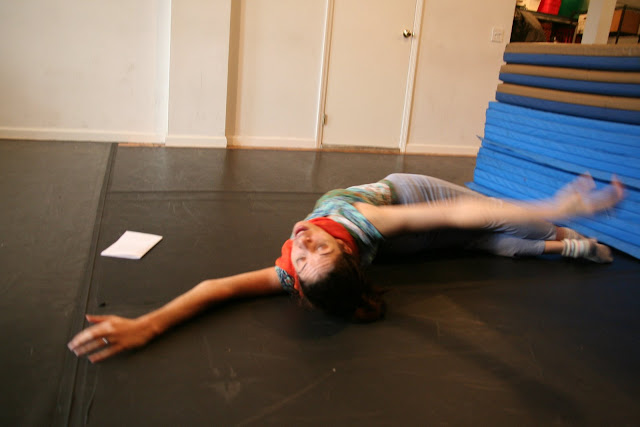 Ah, now that Vi is back in rehearsals full time again, it looks like we'll have a steady stream of rehearsal photos. Good. We played with some really fun/sick lazzi today:
 - Lazzo of Sicilian mourning (which I made Liza do 5 times. She thinks I was trying to explore different "variations." Nope. Just damn funny. Wanted more more more.)
- Lazzo of the "Oriental" Seance
- Lazzo of the Spirit Possession
- Lazzo of death by consumption (picture above. Alexia's long sinewy limbs and dancerly control, not to mention her wide eyes, transform these classic death scenes from great drama into campy high art.)
- Lazzo of death by smothering
- Lazzo of death by poisoning
- Lazzo of a toddler's death
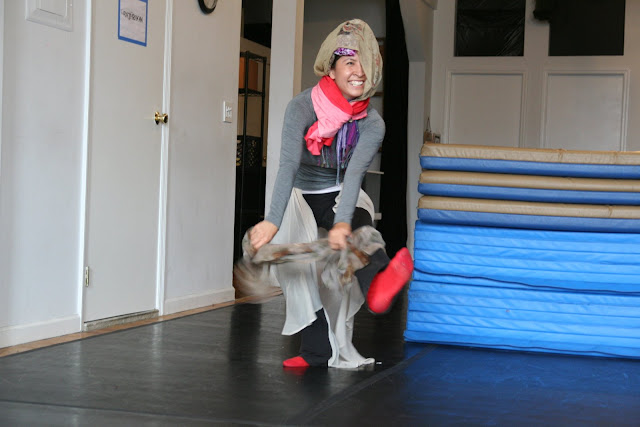
- Lazzo of the Dance of the Seven Veils (picture below. Rainbow, who has never seen the classic burlesque Dance of the Seven veils was asked to improvise one. I could have laughed my way through at least another 20 veils)
 After rehearsal (and an exciting design meeting), Kiran and I devised a system to rank our lazzi (and their accompanying texts) in terms of their wrongness. Now, those of you who have followed Stolen Chair's work over the past 6 years perhaps know that Kiran and I have a special affection for the wrong. We like to break rules. Is this iconoclasm for its own sake? Maybe. But what's so bad about that? When you smash all the statues in the temple you find out what, if anything, is still worth having faith in. And honestly, if these (metaphorical) statues were really meant to be invulnerable, a couple of kooky artists couldn't shatter them so easily.
 So, in an attempt to wrest our humanity and subjectivity from the monolithic pages of On Death and Dying, from the late-Victorian discomfort with corporeality, and perhaps worst of all, from the Judeo-Christian (and later Cartesian) soul-body schisms, we're trying to push past our own comfort zones and...well...do the "unthinkable" around, to, and with "dead" bodies (which, of course, are fully alive actors performing deadness: more on "dead drag" in a future post).
And how does this have any more artistic merit than dead baby jokes? Well, if you have any tolerance for dead baby jokes (God bless them!), I imagine it's rare that you are actually visualizing a real baby (let alone one that you have known, loved, etc) being processed in blenders, falling out of trees, getting fetal alcohol syndrome, etc. Completely disconnected from any social realities (our real fears of infant mortality, for example), these jokes titillate on a purely intellectual level with a baby-shaped-symbol serving as a placeholder for all of the grotesque abuse. We laugh at the transgression because we are smart enough to know that it is transgression. The dead baby jokes point to the taboo and let us share a laugh at its expense, somehow reaffirming the taboo's validity in the process. Yes yes, it is wrong to put babies in blenders or to even think about doing that.
Something about theatricalizing these taboos, though, is able to make the transgression seem more real. The human body, live on stage in front of you: you can't replace that with a baby-shaped-symbol. This is why the dead baby scene in the Scottish play can be so very chilling; we have been asked to accept this baby (or rag doll or bunraku puppet or whatever) as a real baby and suddenly it becomes very hard to laugh at the unspeakable violence done to it. But maybe, just maybe, if you repeat that scene a few dozen times or score it with "Hit me, baby, one more time," you can pull it just far enough into the realm of the ridiculous that it not only still possesses its visceral wrongness but also gives us the distance to examine that viscera and say: why do I instinctively react this way? To paraphrase James Kincaid in Child Loving, visceral reactions love to masquerade as untutored, universal, and otherwise bio-evolutionary-psychological "reals." More often that not, however, these so-called "pure" reactions are as socially constructed as contemporary norms of beauty. Now, that said, humans are social creatures who spend their days processing the world through social constructs so we're certainly not suggesting that anything we ever do on stage is intended to lead people to negate the belief systems that structure these responses. I guess we just think that we'll all be a lot healthier if we are reminded and reminded often that (most) taboos are as variable as our weather has been this fall.


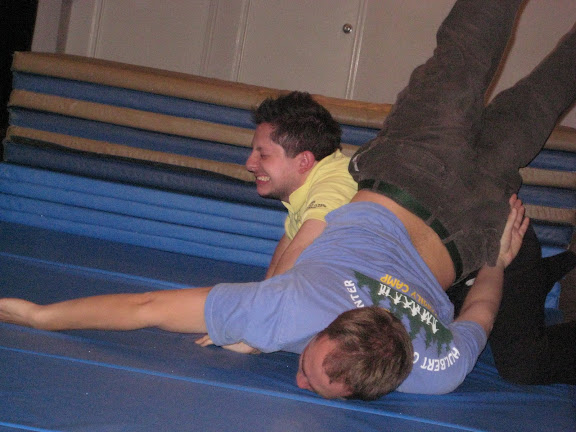 In rehearsal it is often hard to tell if something is absolutely rib-bruisingly hysterical because you have a) discovered a comic moment so pure and undeniable that all audience members will be helpless to escape its contagion or b) found something that will be funny to you and only you because you know the actors very well and/or you are filling in necessary contextual blanks that actually allow the gag to make sense.


 So, we spent about 3 weeks toying with a concept for
  Kiran, Cam, Liza, Emily, and I crouched down and crawled through the Brick's adorably lilliputian entrance for the first time today. The space is like an airier, brick-ier Red Room, with a layout that all the Chairs are really familiar with, narrow and deep. It was nice directing in the space and all of the Brick associates we met were really welcoming.
 A few weeks ago, Kiran and I got quite a thrill listening to the new cast (featuring Stolen Chair's evil genius* set designer David Bengali,
  Kiran and I are here in Stolen Chair's
  Our entire cast is capable of creating compelling and believable characters that are under the age of 10. Some of our actors are more natural fits for specific age brackets within that range.
 We must beware of "school play syndrome." This syndrome pops up when children are performing material handed down to them by adults and/or when audiences are led to respond to the humor inherent in children doing things "badly" (because of lack of motor-skills or cognition). Our project needs to avoid taking advantage of the comedy of children failing to measure up to adult standards, and instead try to find the comic delight of children doing what children do best when left to their own devices (and this includes the violence and sexuality that we often diminish/ignore in child's play).
 Our conceit of having adult actors portraying adults who portray child cabaret performers who perform their cabaret act will fall primarily on playwriting, dramaturgy, direction, and design. It is not possible to convey this layering without giving a lot of thoughts to these elements. The difficulty of communicating age-drag was surprising when compared to our gender-drag explorations in the