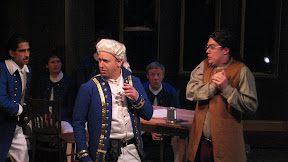
This production from Stolen Chair Theatre Company is more than irreverent. It ruthlessly and riotously dispenses with notions of respect for the deceased...But while proclaiming theatre dead, the show's sharp, thoughtful writing, high-impact direction, and skillful performances justify its preservation.
Monday, January 26, 2009
Sharing the spotlight with Shrek
Saturday, January 24, 2009
The Enfant Terrible weighs in
I want to state immediately, [it] was TERRIFIC and you SHOULD SEE IT. It's about death, and it's very very funny, though maybe you need to be able to find the various thoughts about death both very funny and very disturbing (often at the same time) to appreciate it -- I found myself laughing a lot, but also torn and slightly upset by remembrances of human deaths I have witnessed in person or been near to, memories of the funeral home run by my grandparents and the bodies I saw there (which generally gives me a cold, dispassionate eye to mortal remains and cremains), and the increased sense of mortality that has hit me the last few years. A good mix of emotions for a show to give you...
One reviewer somewhat dismissed the show as having been done before, and better, by some famous names (a dicey reason for critically dismissing anything, really; at a certain point you can dismiss anything, including masterpieces, as treading ground covered by earlier masterpieces)
Friday, May 09, 2008
A rave for the Patriot

Here's a teaser of what Mister Martin Denton of NYtheatre.com had to say about Stolen Chair's The Accidental Patriot:
[I]n terms of both audacity and entertainment value it's a fine example of indie theater at its best...and a harbinger of still greater things to come from this remarkable troupe.Read the full review here and buy your tickets now! Just 6 performances left!!!
Saturday, November 10, 2007
"Continuing Education" : SCTC in Backstage
But until then...content thyselves with this week's Backstage article about alumni-founded theatre companies, featuring a section about Stolen Chair's Swarthmorean history and quotes from yours truly.
Wednesday, October 17, 2007
4 Stars from Time Out NY
Though the TONY online edition hasn't yet been posted, here's a snippet of Raven Snook's 4-star review of Kinderspiel:
"The inventive folks at the Stolen Chair Theatre Company explore the [Weimar] era with the existential KINDERSPIEL; think NO EXIT decked out in fishnets and Art Deco decay...Jon Stancato directs Kiran Rikhye's unsentimental script with a minimum of fuss...The overall effect is haunting. Watching these slightly cracked adults play with desperate abandon reminds us that the worst of times may bring out the best in artists, but in the end it's the politicians who get to rule (and ruin) the world"
Tuesday, October 16, 2007
A flavorful pill to swallow
"There's a delightful irony in watching Kiran Rikhye's delectable frolic of a play Kinderspiel: audiences sit in a musty — yet appropriately atmospheric — basement to watch a play about a bunch of Weimar-era demimonde oddballs who sit around and play like children while customers pay to watch. The playwright provides insight into a glorious era of Berlin history, contrasting it with the economic depression and political upheaval of its time and drawing parallels to contemporary affairs. The childlike idiom is brilliantly developed and performed by the talented cast, leaving Under St. Marks' crowd wanting more."
Friday, October 12, 2007
Rants and Raves
Jerry Portwood from Backstage calls it "obnoxious." (Read more...)
Come to the show and decide for yourself. You can buy your tickets here.
Thursday, October 11, 2007
FREE WINE and rave review
And while you go order your tickets, make sure to browse Aaron Riccio's rave review of the show over at New Theater Corps. A snippet:
Stolen Chair bills itself as a company dedicated to the "theft" of "historical performance styles," but it's a crime for which they'd never be convicted. Between this and their recent Commedia dell'Artemisia, they're dramatic Robin Hoods, stealing from a rich theatrical past and producing for a poorly educated present, and I look forward to their next production.
Friday, October 05, 2007
Open for business
I'll post thoughts on the weekend as a whole this Sunday, but here is what the esteemable Mister John Clancy had to say (full disclosure: in addition to being the co-founder of FringeNYC, an Obie-Award winning director, the author of the totally kick-ass Fatboy, and the first winner of the Edinburgh International Festival Award, John and his wife Nancy have been Stolen Chair's consultants for about a year now, advising us as we move forward to the company's 2nd five years):
"Once again, Stolen Chair demonstates what a company can achieve when it commits to the discipline and sacrifice of the laboratory process. Kinderspiel has all of this company's burgeoning trademarks: exquisite, surprising language, fluid, meticulous direction and mesmerizing and courageous performances from an outstanding ensemble. It is a pleasure to watch this young company grow in strength and confidence."Only 11 performances left! Buy your tickets now...
Wednesday, February 28, 2007
Erik Erikson on Childhood
"Every adult, whether he is a follower or a leader, a member of a mass or of an elite, was once a child. He was once small."
Saturday, February 10, 2007
"Dada" is often a baby's first word!
While I can't seem to find anything on the web to back me up on this, I'd like to pretend that the Dadaists took the name of their movement from one of the first syllables babies can easily pronounce (okay, Kiran, you're an exception--we couldn't all start with bird!). I was combing through some entries in David Cote's blog (Histriomastix) last night and found this fun comment on the work of Richard Foreman:Sounds pretentious and headache-inducing, maybe? Not at all. It’s simply a yearly pilgrimage into the antic, forbidding cranium of Richard Foreman and I seriously, frivolously enjoy it. (I would like to see the work presented in a matinee performance for kids. See how they react to it. As I recall, there’s nothing inappropriate for children.)Perhaps, in developing the concept for this piece, we've been so singularly focused on identifying the grotesque with childhood glee (Shockheaded Peter, Roald Dahl et al) that we're neglecting the hypnotic delight kids get from surrealism, dadaism, and pretty much any other -ism that splinters signs from their usual signifiers (sidenote: one of the audience members for Kill Me Like You Mean It mentioned he was regretted not bringing his 7 year-old son "who would have had a blast with all that repetition."). I think kids would really dig Foreman in much the same way they dig Dr. Seuss (and, I suppose, "Teletubbies").
Read the full entry here.
And, in chatting with Kiran over the past few days (especially after watching the gorgeous 1926 silhouette stop-action animation The Adventures of Prince Achmed), I realize we've missed another possible element of kid-vice: "wonder. " Now, Kiran is reluctant to use "wonder" as a shorthand because it is too passive to describe a child's very active appreciation of "beauty" (a term that I am, in turn, bothered by because it is so culturally-mediated that it becomes reductive when trying to evaluate the complex web of associations that cause "wonder"). Kiran thinks the way around "wonder" and "beauty" is to talk about "immersion" and "atmosphere," and I like this framework because the appeal of The Little Princess, Shockheaded Peter, Slava's Snowshow, Disney World (total theatre for tots?), and even Richard Foreman can all be analyzed using these same two constructs.
All right. That's it for now. I'm probably not going to post again until Tuesday, but, in the meantime, make yourselves at homes in the "Comments" section.
Wednesday, February 07, 2007
Twisted Weimar Fairytales
-From Joachim Ringelnatz's "Kuttel Daddeldu Tells His Children the Fairy Tale About Little Red Cap"
I'm about half-way through Jack Zipes' Fairy Tales and Fables from Weimar Days and everything about it is pretty much brilliant. This will prove to be essential source material for the development of this project, from the introduction which contextualizes why all of Germany's best writers were, in the Weimar period, writing fairy tales for children, all the way through the excellently translated crypto-Marxist/sexually liberated/deliciously macabre collection of fairy tales Zipes has assembled.
This will most certainly be in the reading packet!
(If anyone out there in blogland knows Zipes, please drop me a line and let me know how we can get in touch with him.)
Tuesday, February 06, 2007
"Irony was no laughing matter for him"
So I glossed over the parts that made my eyes glossy, but I still took away quite a few useful tidbits. Some choice quotes, which struck a chord of interest with me for a variety of aesthetic, theatrical, literary, personal, and political reasons:
- On the widespread violence that followed the November Revolution which ushered in the Republic: "Everyone was armed, everyone was irritable, and unwilling to accept frustration, many had been trained and remained ready to kill..."
- On the independent journalists who attempted to reign in the political violence: "[They] fought the assassins with facts and sarcasm."
- On the sociopolitical efficacy of art: "But for many, even in Weimar, poetry and the theatre were entertaining or civilizing forces, with no, or only indirect and subtle, effects on conviction and conduct...the kind of poet the Germans seemed to love the most lent himself to conflicting interpretations, and could be recited with approval by members of many parties."
- On political instability in the period: "...in the less than fifteen years of Weimar, there were seventeen governments."
- On the party press: "...millions of voters read only the newspapers of 'their' party, thus hardening attitudes they already had."
- On Heidegger: "What Heidegger did was to give philosophical seriousness...to the love affair with unreason and death that dominated so many Germans in this hard time."
- On Weimar's destruction of the Empire's popular mythology: "By its very existence, the Republic was calculated affront to the heroes and cliches that every German child knew..."
- On the Bauhaus' pedagogical principles: "...it was not an academy where the great teacher reproduces little editions of himself, but 'a laboratory,' where 'students stimulated teachers' and teacher, students."
- On Dr. Caligari: "Caligari continues to embody the Weimar spirit to posterity as palpably as Gropius' buildings, Kandinsky's abstractions, Grosz's cartoons, and Marlene Dietrich's legs."
- On the Weimar artists' reactions to the war: "Poets, dancers, composers, sculptors, even cartoonists, tried out new techniques to rescue the world from itself, or at least to express their disgust with what had happened."
- On the surge of Weimar playwrights: "These plays had much life, little elegance, and absolutely no humor."
- On the mirroring of art and life: "Expressionism dominated politics as much as painting or the stage."
- Willy Haas, film reviewer, on Berlin: "I loved the rapid, quick-witted reply of the Berlin woman above everything, the keen clear reaction of the Berlin audience in the theatre, in the cabaret, on the street and in the cafe, that taking-nothing-solemnly yet taking-seriously of things, that lovely, dry, cool, and yet not cold atmosphere, the indescribable dynamic, the love for work, the enterprise, the readiness to take hard blow--and go on living."
- On sexual licentiousness: "Young ladies proudly boasted that they were perverted; to be suspected of virginity at sixteen would have been considered a disgrace in every school in Berlin."
- On Berlin's appeal: "In those days 'one spoke of Berlin as one speaks of a highly desirable woman, whose coldness and coquettishness are widely known'...but she was the center of everyone's fantasies and the goal of everyone's desires."
I learned quite a few German words, my favorite being "Bildungsroman," a literary trope which followed the education of a young man. I also learned about director Leopold Jessner's stock staging device, the Jessnertreppe, "a jagged arrangement of bare steps" on which the actors sat, stood upon to declaim lines, or fell behind to die.
In sum: while I think I've certainly enriched my understanding of the political, literary, and artistic movements that gave rise to the peculiar creature that was Weimar, the book didn't really add too much to the toolkit. I'm excited to read Alexia's copy (hurry up, Lex!) of Mel Gordon's Voluptous Panic, which probably covers similar ground as Gay's book, but sounds, from its description, to devote more attention to the variegated worlds of Weimar performance.
Friday, January 05, 2007
Some kind words...
-Martin Denton, NYtheatre.com
Thursday, December 14, 2006
Light Bondage: On Restraint in the Theatre
This got me thinking more generally about the effect of restraint on theatre. Would Moliere have written Tartuffe if he didn't have to continually battle against the Catholic Church? Would Stanislavsky have emerged with, well, the entire basis of naturalistic performance if he didn't have to bump against Lenin and Stalin?
And how does restraint affect process? A large portion of Stolen Chair's looooong development period is devoted to finding the creative constraints which will allow style to emerge. But the balance between "freedom and structure" (a favorite phrase of Stolen Chair's Director of Education Alexia Vernon) has been a little bit different with each project.
In Commedia Dell'Artemisia and Stage Kiss, Kiran acted as a literary ventriloquist, doing her best Moliere and Shakespeare imitations, respectively, while I reconstructed/paid homage to the physical stylings of Commedia dell'Arte and Ridiculous Theatre, respectively. At the end of the day, we could make sure we were on the right track by checking back in with our source material.
One could say there was considerably more "freedom" in Kill Me Like You Mean It, at least insofar as in our pursuit to create a hybrid of Ionescoan absurdism and Chandleresque film noir, neither Kiran nor I had any clear models to mimic, er, "draw inspiration" from. But, lacking our familiar restraints from projects goneby, I must admit the entire creative process has carried much more anxiety. Are we being faithful enough to noir? Are we being faithful enough to absurdism? Have we successfully merged the two in a way that provocatively comments on the parallels between the societies that gave rise to both them and us?
Who knows? I suppose if the show's a wild success, we'll come to respect the anxiety which accompanies risk and perhaps give ourselves permission to swing a little further towards the freedom side of the spectrum. And if we flop, it's paint-by-numbers from here on in :)...
Tuesday, November 14, 2006
A train that turns into a bird: Performing absurdism
One can visualize a character's naturalistic "through-line" as a train moving progressively closer towards a final destination. It might change speed, it might have to avert obstacles and change tracks, but its only objective is to arrive at its scheduled station stop. Once the train reaches its destination, it has undergone a complete (and coherent) journey and this journey changes it (or at least its location).
Now, imagine that same train cruising towards its final destination, only this time the train temporarily turns into a bird. It flies along for a little while, perhaps reaching its nest or perhaps not. At some point it transforms back into the train in exactly the same spot it flew away. As it continues to drive down its track, it might change into a car, a submarine, a bumble-bee, each time diverting into a new journey, only to return back to the tracks. And then, once the train finally arrives at its appointed destination, it finds itself back at the station it originally departed from; there has been no change, and the train simply begins the journey again.
Did anyone follow that over-extended metaphor? I'm not sure I even did, but I guess what I'm getting at is that in absurdism, the character may have a primary objective, but he/she has to indulge quite a few other objectives which might have nothing at all to do with that super-objective (ex. Romeo's super-objective might be to marry Juliet; absurdist Romeo still wants to marry Juliet, but must stop along the way to count his chest hairs, to pretend to be a lizard, and to prove that God is dead, all with the same commitment as his romantic goals). These detours will run to the end of their course and then deposit the actor right back into the struggle to reach his/her final destination. Unfortunately, due to the cyclical nature of most absurdist plays, the character never has the opportunity to reach the final destination, and even if he/she does, this success is often tempered by the realization that the achievement of the objective was ultimately futile (turns out Romeo and Juliet have gotten married, divorced, and remarried several times a day for the past 10 years).
Where this clearly gets frustrating for a perfomer is the attempt to create a character that can contain the primary objectives AND all of the divergences. It might be more useful to think of a multiple-character model, as there is rarely any thread connecting these disparate moments. Robert Leach, in an essay on Meyerhold (not an absurdist), articulated what could be extrapolated as a primer on absurdist performance, substituting "set role" and "mask" for "superobjective" and "detour":
"When he [Hamlet] finds Claudius praying, his set role is that of the Revenger; but moments later, in his mother's bedroom, his mask is that of the disobedient child...like Hamlet, we change: we behave as a child when with our parents...as a supplicant to our Bank Manager, as a 'good fellow' to our acquaintances at the pub, as a conscientous worker to our boss, and so on."
Where absurdism throws all of this into disorder is that the absurdist playwrights would have us act like a child with the Bank Manager and as a conscientous worker with our parents. But the actor's task remains fundamentally the same...
Okay. Enough. Comments?
Sunday, November 12, 2006
The Renaissance
-Orson Wells, THE THIRD MAN
While Stolen Chair is certainly in no position to assess whether or not New York theatre has experienced a renaissance in the past 6 years, I think many of us in the indie/off-off world have felt something palpable in the air; I've heard many artists claim that downtown theatre has grown more consistently "watchable" in recent years (whatever that means). Is this because of a dozen years of Republican rule? Who can say? Will artists lose their steam after last week's Democratic coup? That sounds awfully silly, doesn't it?
And yet, as Kiran and I sit here hammering out rewrites of the last few scenes of Kill Me Like You Mean It, I worry that our electoral elation might siphon some of the vitriol from our approach to the play. Stolen Chair has always avoided creating explicitly "political theatre," and has instead tried to weave our ever-insightful (to us, at least!) sociopolitical commentary into the fabric of a "well-made play," allowing our ideas to insidiously crawl into the audience's brains while they're sucked into the world of the play. That said, Kill Me... is much more "aggressive" than our prior works, if only because there are fewer layers of theatricalized distance between 2006 America and the playworld's setting in 1946 America and the dialogue, though borrowing heavily from early Ionesco and early Film Noir, is much more realistic than our last 3 productions (in reverse order: Elizabethan blank-verse, silent film intertitles inspired by Victor Hugo, and Moliere-ian rhyming couplets).
And if we're worried that our subtle jibes and allusions may seem dated or irrelevant, what about those theatre artists putting the finishing touches on their latest Bush-parodies? What about Subjective Theatre's Party Discipline, a mock Republican convention? How are New York theatre-goers going to react when artists try to preach to the same choirs who have been of late, so vocal in their enthusiasm for liberal solidarity? Will this push artists to challenge their audiences a little bit more, or to altogether give up on the very idea that theatre can be socially engaged/relevant?
Put simply: do artists need "warfare, terror, murder and bloodshed" (or in the very least, political frustration and ennui) to create great art?