Thursday, March 26, 2009

Announcing Quantum Poetics, coming 2010 to a theatre near you (if you live near NYC)

Surprise surprise. It seems we only get our project pitches in anything resembling articulate shape when a grant deadline forces us to. This means, of course, that the project pitch is written in "grant-ese," a special language which requires four times as many words to communicate simple ideas. Like most grant apps for new Stolen Chair projects, the ideas are at the earlist, most zygotic stage; we won't have our heads firmly wrapped around this piece until 3 months after our first retreat and our first retreat won't be until October.

Science tells us what is true. Art tells us how those truths make us feel. Science is a building's structure. Art is the wallpaper. Science, we tend to think, will eventually know so much about the universe, perhaps art will no longer be necessary to describe human feeling. Recently, however, the fundamental truths of science have been discarded faster than last year's fashions, and new discoveries in neuroscience and theoretical physics have come to paint a chaotic, pluralistic vision of an unknowable world unrecognizable to our great-grandparents, but quite familiar to artists who have presented such fractured perspectives for decades. If art tells us the truth, then maybe science confirms the truth's truthiness? Or maybe: there is no objective, stable "truth," and scientists and artists are together joined in a journey to understand an ever-shifting reality. As science writer Jonah Lehrer writes, "Science needs art to frame the mystery, but art needs science so not everything is a mystery." In QUANTUM POETICS, Stolen Chair's 13th original work, we will fuse our experiments as a laboratory theatre with the experiments of chemistry, physics, genetics, and neuroscience laboratories around the world, guided by the question: how can theatre adapt recent scientific discoveries to the stage, creating a unique dramaturgy and performance style that speaks holistically to our contemporary human experience?

Since QUANTUM POETICS will be created over the course of our entire 2010 season--virtually doubling Stolen Chair's developmental time--we're still discovering the contours of the project. What we do know, however, is it will, like all Stolen Chair pieces, be developed by our resident company in a process likened to an "aesthetic supercollider" (Leonard Jacobs, NY PRESS), a collaboration further enriched through interviews with reknowned physicists, neuroscientists, geneticists, and chemists. We hope QUANTUM POETICS, our most far-reaching creation to date, may serve as a stepping stone for dialogue between the artistic and scientific communities, inviting each to draw inspiration from the other.

Friday, March 20, 2009

Puppet playlist recap and London street performers

On March 12, Stolen Chair joined a group of 12 other physical theatre artists and musicians at the Tank to present pieces inspired by the work of Tom Waits (as part of the first edition of Puppet Playlist).  When we first found out about the event, we were still in the thick of Theatre Is Dead but not yet in the thick of Quantum Poetics (pitch coming soon) or the possible Man Who Laughs remount (yes, you heard it here first!).  So, as devout Waits fans, we knew we wanted to participate but also knew the whole thing would sort of be a fun one-off for us.  As a company which spends 6 months developing new work, doing a little w.i.p. thrown together in a weekend is somewhat out of character, but we'll also take any opportunity to play.  

We started working with the music, splicing together a 6 minute piece out of Waits' "Temptation" and "I Don't Wanna Grow Up."  We found ourselves continually fighting the desire to craft some sort of literal narrative (being tempted to grow up) which the music could score.  It is so so so so easy (and, forgive the pun, tempting) to fall into literal storytelling when songs have lyrics.  Music videos always struggle with this.  Do you offer a video which tells the story of the song, tells a completely different story (which will either complement the song or, in the very least, not divert attention from the song), or present a series of images which create a resonance chamber in which the sonic images and figurative language can bounce around.  We decided to do the latter, structuring it so that there was still a clear frame for the audience to grab onto (Noah's "realistic" child-like character encountering a series of arresting and bizarrely erotic images staged as automaton machines by David and Liza).  

What emerged was definitely the most abstracted theatrical vignette we've created since Portrait of Dora As a Young Man in 2002.  And you know what?  We had a damn good time doing it!  I wish we could have rehearsed it more (and, um, at least once on stage) before running it for an audience, but people seemed to dig it (a few strangers coming up to compliment the actors after the show). This was the 4th Stolen Chair event in 2 years (the Kinderspiel staged reading, the Kill Me remount at the Brick, and Theatre Is Dead being the others) which was truly "unapologetic."  We had so fully let go of any fear that the audience was not going to "follow" us that we ended up creating a much more compelling event for the audience to "follow" than if we had let ourselves worry if we were going to be liked.  Moral of the story: there really is an audience for anything, and if one creates and present work with total conviction and faith in its worth (or simply its status as an experiment), one will please far more crowds than if one tries to craft a crowd pleaser.  May seem like a no-brainer, but it's one we routinely re-discover. :)

Speaking of pleasing crowds, Kiran and I had the good fortune to catch a remarkable street performance in Covent Garden, London last week.  They were just a pair of middle aged British clown jugglers, but as we sat there for 20 minutes on the cold pavement, I learned more about theatre than a semester worth of classes could have taught me.  Some lessons learnt:
  • Wear the structure on your sleeve...and then play!  The second thing these clowns did was introduce the unicycles (pictured at right) which would serve as the routine's finale.  Of course, they prolonged and toyed with us for over 20 minutes before delivering the promised finale.  This playful dramaturgy takes Chekhov's gun theory ("If in the first act you have hung a pistol on the wall, then in the following one it should be fired. Otherwise don't put it there.") one step further, and, I think, is especially vital for companies like Stolen Chair who tend to devise unfamiliar theatrical structures.  Show the audience the unicycles so they know where you're taking them.  (And don't take too damn long to get there!)
  • Define failure on your own terms.  The clowns told us to "Boo" loudly whenever they dropped a club or ball.  They then mocked us when we didn't "Boo" loudly enough.  This transformed what should be a net energy loss (the failure of a routine) into an energy gain (audience shouting loudly at the stage in complicity with the performers)
  • It's okay to remind the audience that they are watching live theatre and not television (and that live theatre is always an interactive event).
That last bullet helped Kiran and me re-realize (for the umpteenth time) that there is one thing that brings together all the theatre we want to make: it is ruthlessly and brazenly theatrical.  We don't just want to parade another art form on stage (film, visual art, and literature being three of the most commonly "theatricalized" culprits).  And the only thing which really, at the end of the day, separates theatre from these arts is presence: of the actors and of the audience.  The former is hard to quantify (though many have tried) beyond the simple existential fact that, yes, the actor is a live human being standing anywhere between 5 inches and 500 feet in front of you (depending on the level of play and the theatre's architecture, of course).  

But the audience?  That's simple.  They are simply there. You don't need to train them to be extra-there.  But you do have to encourage/demand/invite/bribe/threaten/tempt them to be an actual theatrical audience (one which implicitly accepts and savors the presence of the actor and the interactive phenomenon that is live theatre) or you can let them keep their distance like your actors are projections on a 30' screen, pretty pictures in a frame, or talking books.  I'm all for works of art that blur the lines of their genre and all for stealing freely from visual art, film, and literature (just look at Stolen Chair's body of work), but we (by which I mean Stolen Chair) kinda always need to be working to discover new ways of making sure the audience is present with us, not just enjoying us (or...[gulp] actively loathing us).  

Monday, March 09, 2009

Playing catch-up after playing hookie

Long time no post. Sorry 'bout that. I'd love to say that we've been playing hard-to-get or that we were off in exotic locals recharging after Theatre Is Dead's successful run (okay: Emily was!), but we've been hard at work in the lab brewing up some exciting plans for the next two years.

While we were maintaining radio silence, Back Stage's national edition published an "Ask a Director" column with yours truly. The question: "How do you deal with a cast of actors that have different processes and techniques?" Here's the tease:
"I don't really care if they're processing past traumatic memories or doing their taxes, as long as they can execute the score with precision and presence."
Thanks to Sarah Kuhn to asking such an important and provocative question.

Not content to read myself with the pesky restrictions of word counts, I was given free rein to run my mouth further in an interview at NYtheatre.com's NYtheatre Voices, where I detail, for the first time, Stolen Chair's plans to adapt the business model of Community Supported Agriculture (CSA) to laboratory theatre. This is the proposal that landed us the ERPA grant we keep talking about. If you want to read even more about this, you can head over to ERPA's blog and read about the adventures that Aviva and I had visiting New Paltz yesterday and interviewing farmers.

New newsletter will be out tomorrow and we have a wee little gig on Thursday eve (Puppet Playlist @ The Tank) if you can make it.

Monday, January 26, 2009

Sharing the spotlight with Shrek

After seven days atop the green ogre on NYtheatre.com's Picks of the Week, we now find ourselves beside the beast (and his Broadway show) on Back Stage's list of current critics' picks.  Though I am generally inclined to enjoy the writing of anyone praising me or my work, I am quite fond of Ronnie Reich's playful and thoughtful exegesis of the play.  Here's our "pull" quote:
This production from Stolen Chair Theatre Company is more than irreverent. It ruthlessly and riotously dispenses with notions of respect for the deceased...But while proclaiming theatre dead, the show's sharp, thoughtful writing, high-impact direction, and skillful performances justify its preservation.
There are only 3 performances left and two of them are just shy of sold-out so...um...HURRY!!!

(Oh, and I never linked to Aaron Riccio's lovely review over at That Sound's Cool.  Here it is!)

Saturday, January 24, 2009

The Enfant Terrible weighs in

One of Stolen Chair's most favorite people (so much so that we asked him to interview us for a radio profile last year), Mssr Ian W. Hill of Gemini Collision Works just posted his review of Theatre Is Dead. Here's a tease: 
I want to state immediately, [it] was TERRIFIC and you SHOULD SEE IT. It's about death, and it's very very funny, though maybe you need to be able to find the various thoughts about death both very funny and very disturbing (often at the same time) to appreciate it -- I found myself laughing a lot, but also torn and slightly upset by remembrances of human deaths I have witnessed in person or been near to, memories of the funeral home run by my grandparents and the bodies I saw there (which generally gives me a cold, dispassionate eye to mortal remains and cremains), and the increased sense of mortality that has hit me the last few years. A good mix of emotions for a show to give you...
Though he has many other insightful (and valuably critical) things to say about the piece (he has a special perspective as the grandson of a mortician), I especially appreciated the way in which he grappled with a frustrating review we received:
One reviewer somewhat dismissed the show as having been done before, and better, by some famous names (a dicey reason for critically dismissing anything, really; at a certain point you can dismiss anything, including masterpieces, as treading ground covered by earlier masterpieces)
Well, while this production may fall short of Ionesco and Beckett's greatest works, it's a damn good time and there are only 4 performances left.  Tonight (1/24) is almost sold out but there are still some tix available for closing weekend.  Get 'em quickly!

Monday, January 19, 2009

PICK OF THE WEEK and oversold Saturday night

The run is half a performance away from being half over, but this is where the fun really starts. We played to a teeming mass of people on Saturday night, adding seats wherever fire hazards would allow. Good press is rolling in here and here and there is more press (which may be good or bad) coming in next week over here, here, and here. And...Stolen Chair is uber-psyched to be named as NYtheatre.com's PICK OF THE WEEK for the fourth time in four years. Here is the blurb:
Scene from Theatre Is Dead and So Are You

THEATRE IS DEAD AND SO ARE YOU: This macabre vaudeville about death is not for everybody, but it's a terrific adventurous work by Stolen Chair Theatre Company featuring impressive production values, broad dark comedy, and great performances. PICK OF THE WEEK!


What are you waiting for? Buy your tickets now (and use coupon code BLOG1 for a special discount, valid this weekend only)! I'm pretty darn sure we will be turning people away closing weekend so please be sure to buy your tix in advance...

Thursday, January 15, 2009

First rave for Theatre Is Dead...

This just in from one Mr. Martin Denton:
A macabre and weirdly off-kilter cabaret that revels in death: in looking this greatest of taboos in the face and then throwing a custard pie at it..smart, stylish, and virtuosic, deconstructing what bothers us about the Final Rest by throwing as many theatrical gimmicks as possible at it.  If the opportunity to see one of indie theater's smartest and most adventurous young companies tangle with the Unknowable tantalizes you, then a visit to the Connolly may well be in order.

And then...go buy tickets here.  Use coupon code BLOG1 for $14 tix.

Oh, and in case you missed it, we launched the new stolenchair.org yesterday.  Still in beta but go check it out now and email your comments to aviva [at] stolenchair.org.  Need more incentive: the production photos from Theatre Is Dead await you there...

Saturday, January 10, 2009

Wow. Well, that was nice!

First preview of Theatre Is Dead and So Are You last night.  I don't think I've ever heard laughter like that in a theatre before (and I'm not sure I'll ever hear it again so I'm mighty glad I got this chance!).  It got to the point where the piece's big finale (no spoilers, don't worry!),  a 10-min chunk of classical text, was so drenched in audience guffaws that I heard scarcely a word.   

That's nice.  Real nice.  

And now...going into preview #2 we're likely to face an audience that is somewhat more reserved (and I've always found that Saturday audiences tend to be less fired up than Friday crowds.  Is it the day of rest which numbs their funny bones?).  We may have to find out what this show looks like when the energy only appears to be flowing one-way from stage to house (of course, it never is. whoever invented the phrase "smiling loudly" really hit something!).  It's always tempting to try to force an audience to be something it's not.  But as one of my acting teachers once said, "If you think your scene partner needs to make a change so that you can solve a problem, then you don't actually understand your problem."  In a show that is this shamelessly presentational (actors spend a good 1/8 of the show acting in the house), the audience is our scene partner, and we're going to have to find out what we need to change (perhaps ever so slightly) in ourselves to meet them where they are and travel with them to the deeply (and delightfully) wrong places this piece demands.

Supercheap discounts (w/coupon code FIRST2) are still in effect for tonight.  Visit www.theatreisdead.com to buy your tickets ASAP!

Friday, January 09, 2009

Theatre dies tonight!

tTheatre Is Dead and So Are You opens tonight.  Use coupon code FIRST2 for $12 tickets.  Free wine will be flowing.  

Buy tix and find out more at www.theatreisdead.com.

See you there!  

Thursday, December 11, 2008

Coolest grant ever!

Good news for the Chairs!  We've just been given permission by The Field to announce our acceptance into the Rockefeller-funded "Economic Revitalization for Performing Artists (ERPA)" grant.  Here's the skinny:
Economic Revitalization for Performing Artists (ERPA)
If it's broke, fix it!

ERPA grows from the premise that the traditional non-profit model of fundraising does not support the majority of performing artists in New York City. This lack of financial solvency leads to early departures from New York, early departures from art-making, and ultimately, a diminishment of New York’s vibrancy and vitality. ERPA aims to combat these challenges by asking artists to conceive dynamic solutions for financial stability, and giving them the tools, resources, and cash to help develop their ideas. As its name implies, ERPA aims to thus revitalize performing artists’ and arts organizations’ economic lives for long-term impact.
 
In 2008 more than 350 community stakeholders joined us for community dialogues (aka Invention Sessions) across New York City. Moving into 2009, The Field invests in seven artists who brought forth innovative ideas to generate new revenue streams from their art for their art...
 
Congratulations to Kahlil Almustafa, Nick Brooke, Rachel Chavkin, Connie Hall, JoAnna Mendl Shaw, Jon Stancato, and Caroline Woolard.
 
These seven artists will be paid $5,000 to research and develop their projects under the auspices of the ERPA entrepreneurial lab. In the fall of 2009 their ideas-in-progress will be presented and publicly adjudicated to receive up to $25,000 in additional project implementation funds.
 
More than 100 ERPA applications were received and adjudicated by a panel of veteran arts and business leaders, including: June Choi, Shawn Cowls, Corey Dargel, Trajel Harrel, Jaki Levy, Kristin Marting, and Heather Rees. ERPA projects were selected based on their potential vision, impact, relevance, and viability.
And here's my proposal: 
Jon Stancato/Stolen Chair proposes a way to adapt the business plan followed by most Community Supported Agricultures (CSA). Like the CSA model, Stolen Chair hopes to build a membership community which would provide ‘seed’ money for the company’s development process and then reap a year’s worth of theatrical harvests.
You can read about the other thrilling proposals on the ERPA website.  We have an exciting 9 months ahead of us.  Please contact me if you'd like to hear more about the proposal or jump on board and help make this crazy idea a reality.  And...um...watch this space for further updates as plans begin to take shape.

Tuesday, December 09, 2008

Real skuls are too distracting?

The Chairs and I have been so busy trying to make this play that there hasn't been much time to write about the play, but I couldn't resist posting this link sent in by Kiran's father.  Apparently, the RSC was bequeathed an actual skull to use in their production of Hamlet but the audience was paying more attention to the skull than the bard so...

Read the full story here

In other news, tickets are now on sale for Theatre Is Dead and So Are You.  Get 'em while they last...

Sunday, November 16, 2008

Born to die

Ah, now that Vi is back in rehearsals full time again, it looks like we'll have a steady stream of rehearsal photos.  Good. We played with some really fun/sick lazzi today: 
  • Lazzo of Sicilian mourning (which I made Liza do 5 times.  She thinks I was trying to explore different "variations."  Nope.  Just damn funny.  Wanted more more more.)
  • Lazzo of the "Oriental" Seance
  • Lazzo of the Spirit Possession
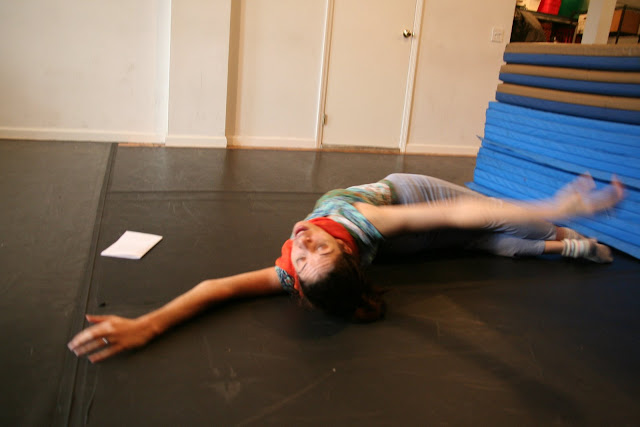
  • Lazzo of death by consumption  (picture above.  Alexia's long sinewy limbs and dancerly control, not to mention her wide eyes, transform these classic death scenes from great drama into campy high art.)
  • Lazzo of death by smothering
  • Lazzo of death by poisoning
  • Lazzo of a toddler's death
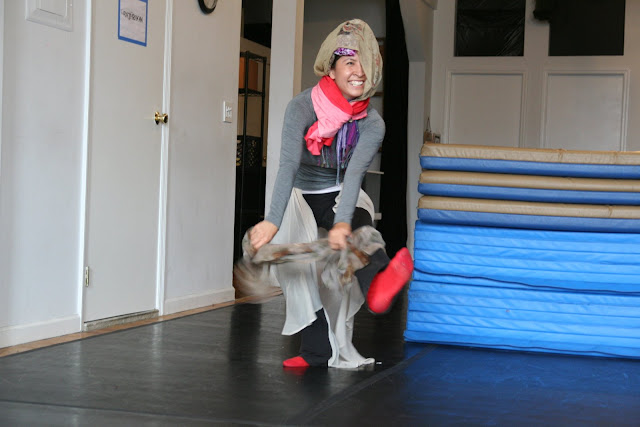
  • Lazzo of the Dance of the Seven Veils (picture below.  Rainbow, who has never seen the classic burlesque Dance of the Seven veils was asked to improvise one.  I could have laughed my way through at least another 20 veils)
After rehearsal (and an exciting design meeting), Kiran and I devised a system to rank our lazzi (and their accompanying texts) in terms of their wrongness.  Now, those of you who have followed Stolen Chair's work over the past 6 years perhaps know that Kiran and I have a special affection for the wrong.  We like to break rules.  Is this iconoclasm for its own sake?  Maybe.  But what's so bad about that?  When you smash all the statues in the temple you find out what, if anything, is still worth having faith in.  And honestly, if these (metaphorical) statues were really meant to be invulnerable, a couple of kooky artists couldn't shatter them so easily.   

So, in an attempt to wrest our humanity and subjectivity from the monolithic pages of On Death and Dying, from the late-Victorian discomfort with corporeality, and perhaps worst of all, from the Judeo-Christian (and later Cartesian) soul-body schisms, we're trying to push past our own comfort zones and...well...do the "unthinkable" around, to, and with "dead" bodies (which, of course, are fully alive actors performing deadness: more on "dead drag" in a future post).   

And how does this have any more artistic merit than dead baby jokes?  Well, if you have any tolerance for dead baby jokes (God bless them!), I imagine it's rare that you are actually visualizing a real baby (let alone one that you have known, loved, etc) being processed in blenders, falling out of trees, getting fetal alcohol syndrome, etc.  Completely disconnected from any social realities (our real fears of infant mortality, for example), these jokes titillate on a purely intellectual level with a baby-shaped-symbol serving as a placeholder for all of the grotesque abuse.  We laugh at the transgression because we are smart enough to know that it is transgression.  The dead baby jokes point to the taboo and let us share a laugh at its expense, somehow reaffirming the taboo's validity in the process.  Yes yes, it is wrong to put babies in blenders or to even think about doing that.  

Something about theatricalizing these taboos, though, is able to make the transgression seem more real.  The human body, live on stage in front of you: you can't replace that with a baby-shaped-symbol.  This is why the dead baby scene in the Scottish play can be so very chilling; we have been asked to accept this baby (or rag doll or bunraku puppet or whatever) as a real baby and suddenly it becomes very hard to laugh at the unspeakable violence done to it.  But maybe, just maybe, if you repeat that scene a few dozen times or score it with "Hit me, baby, one more time," you can pull it just far enough into the realm of the ridiculous that it not only still possesses its visceral wrongness but also gives us the distance to examine that viscera and say: why do I instinctively react this way? To paraphrase James Kincaid in Child Loving, visceral reactions love to masquerade as untutored, universal, and otherwise bio-evolutionary-psychological "reals."  More often that not, however, these so-called "pure" reactions are as socially constructed as contemporary norms of beauty.  Now, that said, humans are social creatures who spend their days processing the world through social constructs so we're certainly not suggesting that anything we ever do on stage is intended to lead people to negate the belief systems that structure these responses.  I guess we just think that we'll all be a lot healthier if we are reminded and reminded often that (most) taboos are as variable as our weather has been this fall.  

Friday, November 14, 2008

Died laughing

Cheeks.  Still.  Hurting.  From.  Tuesday's.  Rehearsal.

In rehearsal it is often hard to tell if something is absolutely rib-bruisingly hysterical because you have a) discovered a comic moment so pure and undeniable that all audience members will be helpless to escape its contagion or b) found something that will be funny to you and only you because you know the actors very well and/or you are filling in necessary contextual blanks that actually allow the gag to make sense.

Honestly: either way, I left Tuesday's rehearsal feeling like the luckiest guy in the world.  I was actually paid (very little, it's true, but still...) to laugh so hard that internal damage was more than likely.

Though these might be famous last words, I think we may have actually tip-toed up to a workable process for Theatre Is Dead.  In the past, with the notable exception of The Man Who Laughs (which had no spoken text and was therefore immune to this particular issue), we've struggled to find theatrically viable ways to introduce text into the process.  Right now, scene fragments are trickling in as fast as Kiran can write them, and it was important to me that, as we experimented with her text in rehearsal, we didn't lose the commedia-esque stylization and physical comedy vocabulary we have been exploring in November.  Usually, we spend a few weeks exploring style-work, add the text in, get paralyzed by psychological analysis of the scripts, and wait for weeks before actors can actually feel enough ownership to begin exploring the scenes in their bodies again.  This is no good.  There has to be a way to explore style, character, relationships, physical space, and text together without one getting compromised.  

I'm hoping that the solution lies in rethinking what the "unit" of work is.  In prior shows, when rehearsing a scene, we might work page by page, or french scene by french scene, or by clusters of beats.  We may start by staging that unit silently, finding strong actions to communicate the character's objectives.  Problem #1 is that these actions are often quite "psychological;" they express the character's mental state but don't necessarily mesh well with the style in which we eventually intend to play.  Eventually, we'll layer the text in and on comes problem #2 when the physical actions dull and the actors become statues with scripts in hand.  

So, to avoid both problems we've changed the way we draft a scene's realization.  Instead of breaking scenes down arbitrarily or by psychological "units," we've tried breaking down in chunks more appropriate to the performance style.  As a vaudeville of sorts, the smallest unit of rehearsable action in Theatre Is Dead is an "act" (Not as in, "Act 1: Scene 3" but as in a "magic act").  Instead of viewing an entire scene as an "act" unto itself, we're breaking it up into many different smaller "acts" which we are, in the tradition of commedia dell'arte, calling "lazzi."  So in Tuesday's rehearsal we rehearsed "Lazzo of the Jacket," in which Dave's character tries to switch jackets with a corpse.  Before we even showed him the text of the scene in which this lazzo would appear, Dave improvised the given circumstances of the bit.  Because it was broken down as an "act," and not a "unit" of psychological thought, the same stylistic rules applied: exaggerated physicality, complicity with the audience, clown logic, etc.  

What Dave created through his improvisation was directly usable in the scene itself once we added text.  The action doesn't "mickey-mouse" the text because, unlike the actions that usually emerge from our silent scenework, it was not created to reveal hidden subtext; Dave's "Lazzo of the Jacket" was created specifically to amuse the audience.  In this model it is up to playwright, dramaturg, and director to lead the actor to lazzi that will, when complemented with text, create complexity (or at least, excess), character, and humorous juxtaposition.  

I guess the simple moral from all of this is: each aesthetic demands a drafting style befitting its ends.  You can't create a sculpture if you start with brush and palette.  Further, the tools you'll eventually use to shape the marble or clay or chickenwire or whatever will determine not only the final aesthetics but how those aesthetics affect the receiver of the work.  If you're hunting for new aesthetics and new responses, sometimes you need to invent (or repurpose) new tools, new materials.

Who knows if the seeds of these thoughts will be of any use to us in future projects.  Life in the lab is always interesting: experimental drug X may work on patient Y but not on patient Z.  But something will work for patient Z; you just need the time and the resources to figure out what that might be...

For my next trick...

...I will make a press release appear out of thin air.

Saturday, November 01, 2008

New show, new process

As with each new Stolen Chair collective creation, Theatre Is Dead and So Are You, presents us with a radically new rehearsal challenge, one which our past productions have prepared us for only insofar as they have helped us build a language to talk about what's working and what's not. Stepping into the lab today with Stolen Chair veterans Alexia, Liza, David, Emily, and Kiran, all I really knew with any conviction was that I wanted to push our characterizations to stylized grotesques and I wanted to use elements of Commedia dell'Arte to test and develop bits that will eventually become "acts" in our vaudevillian funeral.

I've been working with Alexia and David for more than 4 years now and Liza for over 2.  Cackled my ass off though as they surprised me again and again and again today.  We spent the first half of rehearsal attacking character from a few different angles: from prose descriptions, from photographs, outside-in, inside-out, upside-down and everything in between.  Tried to capture it all on video but they had the nerve to let their impulses take them out of frame.  How dare they!

After lunch (during which I decided that my clothes just didn't have enough black bean sauce on them), we came back to lazzi and concetti, some fun throwbacks to my Commedia training.  What's pretty funny here, though, is that I think this developmental process will more closely mirror Commedia training than our masked Commedia dell'Artemisia.  As of this moment, I imagine most of the elements that will eventually find their way into the script and onto the stage at the Connelly this January will begin their lives as improvised Commedia-esque scenarios.  While Stolen Chair actors have always collaborated intensely on the playwriting and directing processes of our productions, offering compositions to create plots, physical worlds, kinesthetic dynamics and more, Kiran has never had the opportunity to script with quite so much support from improvising performers and the only other project on which I've been able to cull my staging from moments of actorly inspiration has been Kinderspiel.  

Theatre is dead.  Long live theatre.

Monday, October 27, 2008

Take our sweet-@ss time to die!

For those that have been curious about what Theatre Is Dead and So Are You might actually be, our description now has a little more depth than the previous talking points ("Um...it's got death...and...uh...vaudeville?).  As is so often the case, it was our desperate attempt to meet a grant deadline that forced us to fall in line.  Below is the project description we pitched which, because this was a production design grant, is actually 1 part Stancato to 3 parts Bengali (stir, garnish with pineapple wedge).  I think, however, that it paints a clear picture of the world we're trying to create.  After you read the text, you should definitely click over to some incredible vaudeville photography that Aviva dug up.  Rehearsals start this weekend and I am very very excited.

The Theatre is Dead and So Are You is a funeral for the stage in 12 acts.  A ragtag bunch of variety veterans are laying to rest their MC and impresario and doing so for the world to see.  They'll be performing his funeral live on stage, travelling from city to city, until such time as his body is too decomposed to make the proceedings pleasant.  Their "eulogies" are performed à la classic variety, each taking its own deadly turn in style or content as they celebrate the life and death of their dearly departed dead dead dead friend.  Even in their joyous performance, a spectre looms as each knows they've all been exposed to the fatal disease that killed their MC: Life (or is it Theater?).  As part of Stolen Chair’s ongoing mission to address theatre’s continuing vitality in a world dominated by film, this piece will also ask the nearly century-old question: is theatre a dead art and if so, what makes us continue to make and attend it?  

The world of this piece is one of joy in (de)composition.  We will explore how, as things fall apart, they can be recombined into new forms and creations.  Inspired by the Dia de los Muertos, we will celebrate death as a source of renewal, an escape from one dream into another even more fantastical.  We imagine a classic Vaudevillian variety stage that is full of the detritus of production - visual evidence of what happens when closed plays go away to die.  Our proscenium space will be draped with old, once glittering fabrics.  A rich red curtain, when pulled aside, will reveal masks and puppets large and small that grin ghoulishly out of the shadows.  Our players will explore the catacombs of an old prop storage where the caskets and shrouds contain the forgotten bits of productions now past their relevance to any audience.  A testament to the transience of live performance, these objects have been lost to the memory of anyone who once knew what they were for.  Inspired by the creepy magic of the inert but once alive, the players will clear out the space, leaving us with a totally empty unadorned theatre.  By achieving a truly “dead” space, we will make room for new creative life.

Throughout the following non-linear, vaudeville, variety event, the audience is in for a raucous immersive experience using not only the stage, but the floor, the balcony surrounding them from above, and hidden areas that can be heard but not seen, just as Artaud might have wanted.  The objects from the opening of the piece will reappear, ingeniously used by the actors in ways wewill develop in rehearsal, combined in designs that reveal new and unexpected harmony and imagery.  Various objects will be strung up to utilize the full volume of the space.  Some will be thrown over the balcony to dangle above the audience or the stage before we haul them back up.  What kinds of objects will they be?  Our collaborative design and rehearsal process will answer that question over the coming weeks and months, but it is certain that symbols of death will abound: skulls, dead flowers, rotting fruit, black fabrics, candles, religious idols, masks.

We will reveal the variety acts (and the accompanying magical reconfigurations of space) by closing and opening a big red tab curtain.  If possible, additional layers of curtains will allow for multiple depths of reveals, and layers of visual texture.  With multiple layers, clever lighting, and choreographed prop and set manipulation, we hope to achieve some Dali-style trompe l'oeil and assemble objects on stage to suddenly synthesize into a form.  Perhaps a curtain will frame a piano, an urn of flowers, and some dangling masks to create the image of a giant grinning skull. Supplementary funding from the ____ Foundation would allow us to construct a more visually striking and creatively versatile curtain. It will allow us to commission high-quality fabrics and an appropriate rigging apparatus (from a supplier such as Rose Brand) to implement tab lift effects to selectively reveal parts of the playing area.  A well-made and well-rigged heavy curtain acquired with the _______ Foundation would complement the Connelly Theater’s grand proscenium arch (and the stamped tin carved Greek masks that adorn it) to create a look of a classic turn-of-century music hall or vaudeville house.  While a homemade single tab curtain of inexpensive material will serve the most basic functional needs of this piece and our space, additional funding from the _________ Foundation will give us the resources to procure a set of multiple well-rigged, attractive, and heavier curtains, allowing us to take the visuals of this beyond the functional and to create a striking physical world for the players and for the audience.

The other essential design component of this piece will be a collection of coffins.  A grand coffin will sit center stage holding the corpse of the Vaudevillians’ deceased leader, opened and closed as his lifeless body is exhumed and used in the variety acts.  Moreover, the actors will make the entrances and exits rolled on in coffins and coffins will serve as central accessories for many of the acts. A coffin designed for this project would need to do several things. It must roll both horizontally and vertically.  It must support human weight.  There must be multiple ways to get into and out of it.  With our existing resources, we can create a simple pine box that meets these needs.  With support from the _____ Foundation we can actually construct ornate coffins which carry the significance and gravity of the coffins audience members have seen at funerals.    Additionally, this funding would enable us to build “trick” coffins designed to enhance the vaudevillian acts themselves.  Perhaps a saw-the-assistant-in-half trick, or a never-ending clown-car entrance of corpses.  Maybe a coffin that opens unexpectedly on its own at inappropriate times.   With our current budget, we plan to develop vaudeville acts that do not rely on such a “trick” coffin.  If granted support from the ______ Foundation, however, we would use our remaining development and rehearsal time (during the month of December) to generate new and more exciting choreography that can interact with the more elaborate and customized coffins.

Stolen Chair develops each new piece collaboratively: text, performance style, and design emerge organically together over the course of the rehearsal and developmental process.  The Theater is Dead and So Are You is in its earliest phases of creation, and as such we don't yet know in what direction the piece will go.  Our visual concepts for the piece, however, are beginning to take shape, and we welcome all opportunities to bring them to a more fully realized level of development.   

Tuesday, October 07, 2008

Logo contest: $$$ & wine

This from Liza Green, our director of Marketing:

Stolen Chair Theatre Company (aka Stolen Chair) announces LOGO DESIGN CONTEST.

Calling all graphic designers, Stolen Chair is in search of a new logo. Ours is no longer a fit for our growing indie theatre company, and we are holding a design contest to find our next image. The winner will receive $200, a case of wine and tickets for our 2009 season. We will be accepting logo submissions until Oct 13, 2008.

About Us:

The Stolen Chair Theatre Company is a critically-acclaimed award-winning collaborative theatre laboratory dedicated to the theft, recycling and re-examination of historical performance styles, and to the creation of visually stunning and uniquely contemporary work where the earnest and
ironic happily co-exist. Find out more and check out our old logo at www.stolenchair.org

What we’re looking for in the logo design:

* object and/or text based
* clean/modern
* can stand on its own
* scalable (should look good on business cards and on t-shirts)
* easily change color scheme
* no human figures
* include company name: Stolen Chair

Ideas that we'd like our logo to convey:

* delightfully wrong
* hip
* multilayered
* irreverent
* twisted authenticity
* collective/collaborative

Please submit designs (high res. pdf) before Oct 13, 2008 to logo@stolenchair.org. Students welcome. Sketches welcome. Designs that are not chosen will be destroyed. Winner will be notified by November 1, 2008.

Sunday, August 03, 2008

And...we're back!!! Summer round-up.

Whoah. Not a single posting since Kiran's scripts for Kill Me Like You Mean It and Kinderspiel were published (click here to purchase). So, what's happened since then? Nice run of Kill Me at the Brick Theater's Film Festival: A Theater Festival. With only two performances, the piece didn't get reviewed, but Ian W. Hill said:
It was an excellent rethinking of the show for a different context, but it was hard to put the original version, which I loved, out of mind.

It was reconfigured as a radio play, done entirely upstage behind The Brick's movie screen, with the actors barely visible as occasionally moving forms. Video of the original production was front-projected, mostly out of sync with the scene being played on the microphones (though a fight scene was amusingly synced up with live foley that got more and more absurdist as it went on). But most of the time, the video "burned" as though in a projector and we were looking at a "MISSING REEL" title card as the actors went on with the story (by the end of the show, it had become "MISSING REAL"). It was a beautiful alternate version of the show, but I probably would have liked it better if I hadn't seen the original version.

The actors were all outstanding as voice-over/radio actors, with excellent mic technique.

Overall we had a blast creating and performing this little ditty and we loved working with the Brick again.

Other news: We were also very pleased to see the excellent work of Cameron J. Oro and Barbara Charlene rewarded with Innovative Theatre Awards nods for Leading Actor and Best Choreography for their respective turns in The Accidental Patriot this spring. Best of luck, guys!

E. H. Sothern as Hamlet with Yorick's skullWork has already begun for our next production, The Theater Is Dead and So Are You, which is booked for a run at the gorgeous Connelly Theatre in the East Village this January. We were one of the 200 saps who busted our butts for the NEA's New Play Development grant so we actually had to move pretty quickly on creating a preliminary concept for this piece, though I'm sure once we go into retreat this September we'll probably toss much of what we've worked so hard to articulate. At any rate, here's the blurb we're currently working with:
The Theatre Is Dead and So Are You is a vaudevillian meditation on mortality that will stare death in the face and laugh. Audiences will enter an East Village performance space transformed into a Bowery music hall circa 1890, with peanuts for sale and rotten vegetables to throw. As they struggle to understand their mortality, twelve variety verterans burlesque Death, using Vaudeville's unsentimental vernacular to theatricalize one of the most sentimental (and sensitive) subjects.
I'm excited that, like Kinderspiel, this play will allow us to play around with taboo. As we've been sowing the seeds for an image overhaul (new branding, logo, website, etc. more on that coming soon!), Kiran and I have really fallen in love with the phrase "delightfully wrong" as a concise tag for our work, and I think Theatre is Dead will certainly let us work within that rasa (a word I'm borrowing from Richard Schechner who borrowed it from Sanskrit drama to denote a "flavor" of performance). I'm also really curious to see how the non-linear variety structure of the v'ville inspiration will reconcile with the narrative storytelling which we will be weaving through it.

This will be Kiran's twelfth play for the company. Not bad for our 6th season.

The research so far has been downright thrilling. Emily, our intern Rachel, and I are collaborating on it all via a Google Doc so you can sneak a peak at the evolving reading list. It has been such a treat reading vaudeville and burlesque sketches, some of which are well over a century old and hearing them leap off the page. Sure they're hoary chestnuts, but once you get past the groans, they offer sheer delight and, formulaic as they are, they really create a world as anarchic as Stage Kiss' Ludlam-esque, Kill Me's Ionesco-an, and Kinderspiel's Weimar cabaret influences. Here's a fun raunchy bit from classic burlesque (don't think pasties and sequins, think n: A work designed to ridicule a style, literary form, or subject matter either by treating the exalted in a trivial way or by discussing the trivial):

Comic (dressed as young schoolboy): Teacher, can an 11-year old get pregnant.
Teacher: No, that would be ridiculous.
Comic (to a woman dressed as a young schoolgirl): See, honey, I told you we had nothing to worry about.

A couple of features of the above show why v'ville a particularly perfect container to process taboo: [Warning: forthcoming joke analyses are anything but funny]
1) It is amoral, not immoral. It is immoral to use such a set-up to libidinous effect. It is amoral, however, to use such a set-up to delight us by referencing the moral universe in which such a scenario is "wrong" and give us the opportunity to laugh about it without condemning or otherwise participating in the inappropriate content.

2) The gags revolve far more often around that which remains unsaid than that which is explicitly said, unlike more contemporary punchlines which only leave unspoken the cultural norms that make them funny.

A very grotesque modern joke: "What's green and eight inches long? Cribdeath." While it's certainly revelling in taboo humor, it says everything. We laugh because of the punchline's unexpected yet ultimately reasonable revalation. It's inappropriate to laugh about infant mortality, but we've already made ourselves complicit by letting our mind browse through what we thought would be humorous answers to the vague question.

The burlesque above operates a bit differently, confronting taboo in a slightly more oblique manner. It never explicitly says that the two 11-year olds have carnal relations, and, therefore, our complicity is an active choice we have to make as audience members. If we choose to fill-in-those-blanks, we are rewarded with a laugh. It transforms what might be groan-inducing fodder into a sort of conspiratorial pleasure: "Oh, I know what he's talking about! That's very naughty, but very funny." This difference may be more due to the fact that the modern joke is a single question followed by a punchline whereas the burlesque is a series of narrative circumstances culminating in a punchline that refers backs to the "clues" that have been dropped.
...yeesh I must love to read my own words. I suppose I have to make up for nearly two months of a "dark" blog. So...I'll keep going.

Those that know me even a little know that I am viscerally entangled in my own fears of death and dying on a nearly daily basis. It was therefore surprising to pick up Elisabeth Kubler-Ross' On Death and Dying (origin of the 5 stages of dying/grief) and find myself cracking v'ville jokes throughout. I really have to say that this seminal interdisciplinary work of the 1970's is far more dated than any of these v'ville bits, its seriousness begging to be burlesqued. Part of me is excited that I'm able to conduct this theatrical and academic research into death and dying without getting emotional and weird, but the other part of me is displeased that it's so easy to gain critical, safe distance from a topic so intimate and personal.

All right. Off to do more research. I'm going to ask our collaborators to post comments below about their early thoughts on the project and hope some of our other readers will do the same.

Saturday, May 24, 2008

The New News: May 24, 2008

While I have very little idea how this magically seems to happen every time we close a show, we started rehearsing the new version of Kill Me Like You Mean It one day after we struck The Accidental Patriot. And while Kiran was cutting Kill Me down to 45 minutes for the festival gig, she was also revising Kill Me and Kinderspiel, which will be published THIS Thursday by United Stages and launched at a book party at the Drama Book Shop that evening (that's a caricature of Kiran in the Drama Bookshop's display window!).

So: all this news and more awaits you in our last e-newsletter, which you can receive regularly in your inboxes if you sign-up here.

Tuesday, May 20, 2008

Memorable Highlights of the Theatre Season

We're on Martin Denton's list of moments to treasure from this year's season:
"12. Stolen Chair Theatre Company mounted two fascinating, ambitious, and entirely different new plays this year, both written by Kiran Rikhye and directed by Jon Stancato: The Accidental Patriot and Kinderspiel."