Friday, May 16, 2008

A couple choice pull quotes from New York Cool

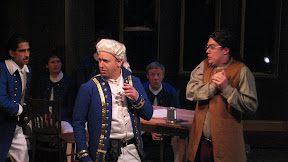
To be fair, I haven't read the whole review yet, but here are two "leaked" quotes from Bryan Close's New York Cool review of The Accidental Patriot.
"If Stolen Chair didn't already exist, someone would have to invent it...At its best, The Accidental Patriot is happily over-the-top, rollicking fun. (Think The Princess Bride.)"
I'll post a link to the review (and, presumably, read the entire thing) as soon as it is posted.

In the meantime, what are you doing reading this when you could be buying tickets for one of the two remaining performances? Use coupon code BLOG for a special discount...

Friday, May 09, 2008

A rave for the Patriot


Here's a teaser of what Mister Martin Denton of NYtheatre.com had to say about Stolen Chair's The Accidental Patriot:
[I]n terms of both audacity and entertainment value it's a fine example of indie theater at its best...and a harbinger of still greater things to come from this remarkable troupe.
Read the full review here and buy your tickets now! Just 6 performances left!!!

Monday, April 21, 2008

Interview: Jeff Lewonczyk of Babylon Babylon

Our next interview in the series building up to Friday's opening of The Accidental Patriot (our new swanky website for the show is up and running) is with Jeff Lewonczyk, creator of Babylon Babylon. What I love about Jeff and his collaborators and Piper McKenzie is that if you asked us to cite our influences, describe our processes, talk about our work, etc, one would think our respective companies would produce wildly similar work. Nope. Not even close. Ain't that grand?

Jeff and I had the pleasure of chatting a bit on the air when we podcasted together a couple weeks back, but we didn't have enough time to delve as deep into the conversation. I thought it'd be nice to continue it here. Enjoy! And go buy your tickets for his show and for ours! If you bring your Babylon Babylon program to the Accidental Patriot (and vice versa), you get in for only $10. Incredible deal, eh? At any rate, here's the interview:

1) Tell us about Piper McKenzie Productions and its founding. How does Babylon Babylon fit in with your overall mission and body of work?

For a company that’s been in existence in one form or another for ten years, we’ve been taking our sweet time crafting a mission statement. Still hasn’t fully come together yet, but phrases like “heightened theatricality,” “fascination with forms and content from the past,” and “the gray area between comedy and seriousness” all come to mind.

As for that founding, it was in 1998 in upstate New York, after my partner (and now wife) Hope Cartelli and I graduated from Bard College. We had produced plays together extracurricularly at Bard, and we never even really had a conversation about whether or not we were going to do it after finishing school, we just kind of started. Our first show was an ensemble-created piece based on vintage comic strips called “Piper McKenzie Presents the Tinklepack Kids in the Great Yo-Yo Caper,” which featured a magical Abraham Lincoln; it’s all been downhill from there.

2) I know that, like Stolen Chair, you and your actors work collectively to generate material. Can you talk us through the origin, from stage to page and back to stage again, of one of Babylon Babylon's scenes?

Well, it’s a bit more of a challenge than I’m ready for to pluck a single scene out of the roiling mass of humanity that is BABYLON BABYLON, but I’ll give you an idea of how the process worked as a whole. Even before we started working on stage, I gave the actors a raft of source material to sift through and start working with – selections from Herodotus, the Bible, the Epic of Gilgamesh, some contemporary scholarship, and much more. While everyone was digesting this, we did a number of improv exercises dealing solely with the mechanics of the Temple of Ishtar, the seat of Babylonian ritual prostitution in which the show takes place. Over the course of the process these exercises got more and more particular, and I started introducing characters that I wanted to see, and then started being more specific about the character distribution until it pretty much bled into casting. After everyone had a role, we did some more improv, exploring in more detail the characters and relationships we’d be bringing to the stage. Throughout it all, I was working on script material both inspired by and often separate from the material we were generating in rehearsal. With everyone’s common grounding in the source material, the world developed as richer and stronger than it would have otherwise.

3)This show has a cast of thousands, live music, and combat. Have you ever played on such an "epic" scale before? Any surprising challenges? Surprising delights?

Every single moment of working with a cast of 31 is filled with surprising challenges – especially when you’re determined to give everyone a handful of interesting moments and not let any of the characters devolve into some sort of vague, mushy “ensemble.” And even though I knew scheduling was going to be a difficulty, well, let’s just say there are difficulties and there are difficulties.

Interestingly, I thought the sexually loaded subject matter was going to cause some leeriness, but everybody was surprisingly game – I suppose that anyone who wouldn’t have been comfortable with that kind of material declined the opportunity to do the show. The surprising delights are hopefully what you’ll be seeing onstage – the fact that everybody came together to put something this huge together with very little time, and even less money, is something that I’m immensely proud of.

4) In your press materials (and in our discussions), you've disclosed Demille's influence on your production? Did Demille's camera work influence the staging in any way?

The DeMille influence was first and foremost a question of scale and content – we were hoping to reproduce the epic historical sweep of one of his productions. It was secondarily a matter of sensibility – throughout the show, there are moments and characters that employ the grandiloquent speech and presentational style that ran through his films. In terms of camera angles, though, it was both impossible and inevitable to approach the show’s visuals on those terms. The audience, you see, is lining both sides of a long, deep stage, and the action plays out on every square inch of it, sometimes isolated into a small scene in some corner, sometimes all at once and all over the stage. With actors sometimes playing right in your face and sometimes at a significant distance, I’ve found that the experience is not unlike watching a movie that cuts between close-ups and long shots. And during the scenes where simultaneous action is taking place all around the stage, the audience gets to be their own camera operators and editors, cutting the shots, panning, making cuts, etc. The show is not the same from any two seats, so we like to think it will reward multiple viewings…

5) As a director, how do you balance homage with pastiche when you take on style work, especially film styles? To what degree do you strive for a purity/accuracy of the forms you borrow? How do you work to get your cast on the same stylistic page?

After a certain point – and a fairly early point it is – I usually end up letting go of all the striving for emulation of style, and let the show start being whatever it is. Rather than forcing the cast into a particular style, I tend to allow the style to develop according to the chemistry of the cast. I have certain quirks and tics and preferences that I’ll try to throw here and there, some of which just occur naturally, but in general all of our shows end up having a different feel, because different groups of people absorb the original materials (and my own direction) differently. In BABYLON, one of the big questions was how modern we should make it – should we have everybody walking around talking in faux-Babylonian cadences and strive for a supposed “authenticity,” or should we go fully contemporary and allow people to use modern slang and references in order to make the world feel more immediate? The result ended up finding a natural balance somewhere between the two. In the end, I like to believe that we go beyond homage and pastiche and create something new and unique out of the material we’ve digested – homage and pastiche being significant tools that we use to get to that point.

6) Where can we find out more about your company and this show?

Why, at pipermckenzie.com, bricktheater.com, or at our show’s blog – the Babylblog Blogbylon – at babylonbabylon.wordpress.com.

7) What are you going to miss about this production when it goes to the great production in the sky? What's next for you and Piper McKenzie? Are you eager to do something on a smaller scale?

Every time I try to conceive of something small it just starts ballooning towards a larger scale, so I don’t know that I can be trusted to accurately answer the last part of this question.

What I will miss most, I think, will be the sense of community we’ve built – when you have this many people in the room at any given time, it becomes more like a functioning mini-society – with all of its pitfalls and rewards – than the typical cast of a show. The Monday after it’s finished I’ll turn to Hope and say, “Why is it so quiet?”

As for what’s next, I’m doing a staged reading of the new play by William Peter Blatty (he of The Exorcist) at The Brick’s The Film Festival: A Theater Festival. I say I want it to be a reading, but it might evolve into something slightly more ambitious. And we’re planning a winter production of a cycle of short plays that take place in an alternate Arctic reality, based on a one-act that was produced at The Brick a few years ago entitled “Granduncle Tells the Children a Story of Kisselsrite During the War.” It will have a cast of only five or six, but I’m wondering if that’s where the smallness is going to end.

Friday, April 11, 2008

The New News: April 11, 2008

An e-newsletter just went out to our subscribers. You can read it here, but you all really should be on the mailing list so go sign up!

NYTheatrecast: Episode #209 - From Film to Stage Roundtable

Read more about the podcast below or download now.
More and more we see film influencing theatre. To discuss this trend and the various manifestations it takes are three directors whose upcoming works are strongly influenced by film. They are Jeff Lewonczyk (Babylon Babylon), Jon Stancato (The Accidental Patriot), and Ian W. Hill (The Magnificent Ambersons) and are joined by nytheatrecast moderator, Trav S.D.

The listener will quickly discover that the title of Jon’s show is really much longer and far more expressive.

There is much to learn from these three gentlemen about how and why they use film as a starting point and Trav S. D. draws this information expertly from each. Jon is more interested in the form itself which he uses to blend the swashbuckling era of Errol Flynn with the classicism of the Greek chorus and more.

Ian has recreated for the stage the original Orson Welles cut of this famous film. His knowledge of the making of this film is astounding and should fascinate any film buff. Jeff amazes Trav S.D. when he notes the inspiration for his play is the book by Herodotus. Deciding it has to be an epic film in the Cecil B. DeMille mode, his cast numbers 31 and includes battles and belly dances.

Interview: Kevin Lapin of Floating Brothel

Kevin Lapin and his collaborators are now presenting what promises to be a stunning piece of a physical theatre over at the Tank. In this interview, Kevin talks all about The Floating Brothel and how his company developed the piece.

1) So...tell us about the piece.

Adapted from historical accounts, Floating Brothel follows three women—a down-on-her luck country girl, a thirteen-year old prostitute and a high-class con artist—on their harrowing year-long voyage from the underbelly of London to the underside of the world.

It starts in London, 1789. A whirlpool of filth, thievery and political unrest. Jails overflow with petty criminals, many of them women forced out of work and onto the streets as jobs are reclaimed by soldiers returning from the American war. The penal code hasn't been updated in more than a century, and crimes as trivial as pickpocketing are hanging offenses. Faced with a legal system in crisis, and a growing humanist movement opposed to executions, the courts hit upon an innovative solution: ship the woman convicts to Australia to revive the failing all-male penal colony in New South Wales.

2) Can you give a brief description of your source material for The Floating Brothel? What drew you to the story and what sort of research did you do before the development process began?

Our source material was a number of historical accounts of exile to Australia like "The Fatal Shore", "Mary Bryant" and the journal of one of the characters, John Nicol. There's also a book that's actually called "Floating Brothel" that we drew from as well. We came across the material while working on another project. We loved it but couldn't use it on that project, so decided to save it for later.

We describe the play as historical fiction. This time period is extremely rich in its details, stories and even the types of jobs people did to survive. For example, in the play one of the secondary convict women says that she used to be a "pure-finder" which was a real job that involved going around and collecting dog turds to sell to the tannery at 3 pence a bucket. Even the love story between Sarah and John Nicols is based on his memoirs. With details as rich and colorful as this, why make stuff up?

We link to several of the most important references on our website in the "About" section, for those who want to read more.

3) I believe many in your troupe are graduates of Ecole Jacques Lecoq. Can you tell me how that training informed the process you used to create this piece?

The Lecoq school influenced not only the process for creating this play, but it's central stylistic conceit. The small stage that we use is called a "tréteau" at the Lecoq school and is linked historically to the small stages of traveling Commedia troupes.

I think one of the most important thing that you learn at Lecoq is creating new work as an ensemble. Every week, you work in small groups to create a short scene or piece which you present to the group on Friday. Both Megan and I very much enjoyed working with the tréteau at Lecoq and were curious to see if it would be possible to perform a whole show on one.

The way we worked to create "Floating Brothel" was very much in the style of ensemble creation that we practiced at Lecoq, that is to say, we started with nothing but an idea and then worked collaboratively to develop the final work of theater. I think it is true with any ensemble or collaborative creation that at some point in the process people step forward and take on certain responsibilities, so not every word or decision is made as a group or by vote, nevertheless almost every aspect of this play from the text, to the staging, to the costumes, to the marketing materials exist as a result of our group's collaboration and I don't think any of it would be the same if they had been the purely the product of individual creation. From my experience at Lecoq and working on other ensemble projects since, the group is better than the sum of its parts. I should add that in this case, we were extremely lucky that Megan started off the process by bringing us a fairly full outline or rough draft of the script. Although it has changed quite a bit in terms of structure and actual dialogue, it is a real gift to have a strong starting proposition like that to use as a spring board. It's the same thing in improvisation, which is another key element of the Lecoq method, that is getting on your feet and improvising to create and try things out, good improvs start with a concrete proposition and proceed by all the actors adding to it, "Yes, and..."

4) You face the extraordinary challenge of creating a ship on stage, and on a 3'x 6' platform, no less. How did you approach the staging of these nautical scenes?

One of the reasons that we chose this story was precisely because we wanted to stage it on the small "tréteau" platform. From our work with the tréteau at the Lecoq school, we felt that part of the magic of the style comes from trying to tell as big and as epic a story as possible from the confines of the reduced space. It wouldn't be particularly interesting or challenging, in terms of the staging at least, had we chose to tell a story that took place in an elevator, for example, because then the platform would remain exactly what it is, a small space. The goal, and challenge, is to transport the audience to many different places, the high seas, bustling London, a dirty bilge, all from the confines of a small 3' x 6' space.

5) Your press release mentions your use of cinematically-inspired staging. How did that vocabulary evolve? Were you looking to any specific films or directors in your approach?

The challenge of the "tréteau" which I just described in response to the previous question, that is of telling an epic story from a 3' x 6' platform (with just a few simple props), in many ways is the magic of cinema. Images flash and cross on a small screen and transport us to other worlds, big and small. The "tréteau" is like a TV or movie screen without the special effects. You have to consider establishing shots and close-ups in order to provide the audience with perspective and create the story line. On the small stage, we don't have the luxury of changing sets, or crossing to a new space to tell the audience that the next scene is taking place somewhere else. Similar to film, one scene often cuts directly to the next and the audience or viewer fills in the blanks of what happened in between. If we hear a knock, and then see a character closing a door and speaking to someone else, we understand that the person must have just arrived at this new room. Similarly, in Floating Brothel we often cut from one scene to the next or use small scale images (the boat on the high seas) and allow the audience to fill in the blanks with their imaginations.

6) How can people find out more information about your show?

www.floatingbrothel.com

Wednesday, April 09, 2008

Our ears are burning...

Yes it's true, I was googling us. Turns out our li'l show is the first search result for "Accidental Patriot." That's pretty cool. And speaking of cool, or kül, I just found out that Aaron Riccio has been buzzing about us over at kül: What Sounds Cool. Here's what he says as he recommends our upcoming swashbuckling adventure:
The Accidental Patriot (After seeing Commedia dell'Artemisia and Kinderspiel, I'm ready to go wherever Stolen Chair Theatre is willing to take me -- in this case, that's to the high seas of the American Revolution, and -- keeping with their CineTheater Tetrology of adapting film styles to the theater, one a year for four years -- as a 1930s swashbuckler. Tragedies, sea shanties, and drinking songs; shiver me timbers, folks, I'm going overboard.)
Thanks, Aaron!

Buy your tickets now! Use coupon code BLOG for $15 tickets!!!

And here are some photos to get you even more excited, all exquisitely shot by Carrie Leonard.


So...um...buy your tickets!!!

Monday, April 07, 2008

Some Inspiration

Stanley Brode, one of the awesome merry men in our tragic chorus (Is it merry? Is it tragic? Stop, you're both right!) told me to check out this YouTube clip. Glad he did!


Whoa, Nelly. Stolen Chair explodes.

We had a very full weekend with scene work, music rehearsals (5 original songs in multi-part harmony), combat rehearsals (2 mass battles and 3 duels), production meetings, a podcast, and our postcard design (see right), not to mention all of the costume and set building that's happening for the show. I still haven't seen the entire 18 person cast in the same room yet, but I'll have that chance over the weekend. Big as this show is (it's really really really BIG!), the production itself is only one of the many many things that will be happening during the run. On the evenings that The Accidental Patriot will not be running, Stolen Chair will be producing quite a few exciting events.

Commedia dell'Arte Maestro Antonio Fava will be returning for a masterclass on April 26th, and on April 27, he will bring his performance, Pulcinella's War, back for its second NYC engagement (we produced its premiere last year in front of an oversold crowd!) in a one-night stand. More details on that will follow soon...

During some of our other "dark" nights, we'll be presenting Pirates, Patriots, Patricides, several evenings of short works of theatre inspired by ancient Greece, the American Revolution, and...Pirates! We've got some really wonderful work lined up, including a visit from the Strike Anywhere Performance Ensemble which will be creating a live "soundpainting" of a Sophocles text, a Commedia-inspired take on colonial America from Ron Nicholson, and at least two very silly pirate plays: one from the inestimable li'l Jimmy Comtois of Nosedive Productions and the other from L. Pontius (off Broadway's Umbrella), directed by our very own Emily Otto (who might I add is doing quadruple-duty as the piece's director, the curator of this entire short works program, our dramaturg, and our music director!!!).

Oh, and did I mention that we'll spend the last couple weekends of our run rehearsing a new version of Kill Me Like You Mean It, which will have two performances (June 2 & 8) in the Brick Theater's Film Festival: A Theater Festival?

We'll have more details about all of this in the coming days and we'll also have interviews with Kevin Lapin of Floating Brothel and Jeff Lewonczyk of Babylon Babylon coming up in the next week. Stay tuned!

Friday, March 21, 2008

The New News: March 17, 2008

So after months of blog & website silence, we've updated (check out the new header of our press bling on the homepage!) and e-blasted with lots of exciting news, summarized in ye ol' newsletter:
  • We formally announce the new play, The Accidental Patriot: The Lamentable Tragedy of the Pirate Desmond Connelly, Irish by Birth, English by Blood, and American by Inclination, the third installment of Stolen Chair's CineTheatre Tetralogy, an original 1930s-style swashbuckler (as Sophocles might have written it if he’d been under contract to Warner Brothers), set against the tumultuous backdrop of the American Revolution. This mash-up of Greek tragedy and Errol Flynn-era pirate films features both rapier duels and rapier wit as it satirizes heroism, patriotism, altruism, and all of the other flimsy –isms that move us to action.
  • We formally announce that tickets are on sale for aforementioned new play.
  • We formally announce the beginning of our first 2008 fundraising drive and kindly ask you all to make an online donation. If you could find it in your hearts/wallets to spare a few dollars for our fundraising cause we'd be especially appreciative--we're working with more zeros than we ever have before and it's taking all of our resources to turn that red into black!
  • We formally announce the airing of Stolen Chair's profile on WPS1 Art Radio, with Ian W. Hill donning his interviewer hat (and dishy baritone voice!). I talk about how the company was founded, discuss its unique collaborative process, cover all of our productions, previewing through the end of the 6th season, and even reveal the origin of Stolen Chair's name.
Kiran, Aviva, I are in Stolen Chair's Parisian "offices," stuffing ourselves with food and culture (in the next few days, you can read about our experiences with the former on my food blog: Three Little Truffle Pigs) and trying to put the finishing touches on the script for The Accidental Patriot.

The blog, quiet since our fundraising party in early February, will soon see a flurry of activity as I talk about the recently wrapped development process for The Accidental Patriot, preview the upcoming rehearsal process, and interview some of the artists who have been drinking the same Kool Aid we've been guzzling.

Stay tuned! And donate now! Oh, and we just launched a new Stolen Chair opportunities listserve for actors, designers, technicians, interns etc. If you're interested in that or our regular ol' newsletter, just click here.

Thursday, January 31, 2008

Voices in print and on the air

Big press day for Stolen Chair and our Pirates of the Aegean party. We're a VOICE CHOICE (with the inset picture taking up almost the entire page!) in this week's Village Voice, and a podcast I moderated about indie theatre fundraising hit the NYtheatrecast website today.

So...hit the new stands, plug in your ipods, and get inundated by Stolen Chair's media-industrial complex :)!

And...um...BUY YOUR TICKETS!!!

Wednesday, January 30, 2008

The new news: 1/30/08

Last newsletter of the month went out today. The pirate party headlined, accompanied by a reminder that admission is 33% cheaper if you buy online before party time rolls around. So...do it. Buy online. Now.

Only other item was a plug for the K'spiel photos and the announcement that K'spiel DVDs are now for sale. $10 if you want 'em. Just email me.

Tuesday, January 29, 2008

Kinderspiel stills...at long last

Wow it took me a long time to get Aviva's lovely K'spiel photos on the company hard-drive, into our Picasa page, and then on the website. Here they are, looking quite Kantor-ian, if we do say so ourselves:

Monday, January 28, 2008

The busiest weekend of Stolen Chair's life...or one of them

Whoah. I am astonished I've survived to write this. This weekend (by which I only mean Saturday and Sunday) featured 2 marathon rehearsals of the swashbuckler culminating in a semi-staged reading (for which nearly 25 people showed up: surprising, since we were expecting 3), a podcast for nytheatre.com I moderated about indie theatre fundraising (posting later this week), a decorating party for our fundraiser (less than a week away! visit www.partylikepirates.com and buy your tickets now!), and our quarterly board meeting.

Here's what John Clancy over at Scrappy Jack's had to say about last night's reading. (He even manages to plug like mad for our party. Oh, John, how we do love thee!)
Saw the first reading of the first part of Stolen Chair's latest last night, working title The Tragic Swashbuckler. Going to be great. Part three of their Cinetheatre Tetralogy, this time it's Errol Flynn meets Sophocles. So fucking funny and smart. Everyone needs to go to their big Pirate Party this weekend, Saturday the 2nd at the Underwater Lounge out in Dumbo. Nancy and I will be out on Long Island, partying like respectable people, but the rest of you can party like pirates. Live swordfighting, a Delphic oracle, DJs, all like that. Info and tickets at www.partylikepirates.com.
So, yeah, the reading went pretty well (I will post a pic as soon as we get them downloaded); we never know what to expect with these things. It was great to hear people laughing at the reading. Sure, we camped up some material that might be a little more earnest in production, but I think a lot of laughs showed that people were on board with this crazy concept. Still working out the kinks with the tragic chorus but I feel like that's a pretty universal struggle for all playwrights and directors dealing with that trope.

Mission for the next few days is to turn our working title into a title that works...

Tuesday, January 22, 2008

Raping and Plundering and Photoshopping!

Here are my faves from our ever-so-much-fun photoshoot with the brilliant Carrie Leonard, shot on location at our party venue, the Underwater Lounge (one swanky space, if I might add!).

Enjoy!

Monday, January 21, 2008

PartyLikePirates.com

Aviva Meyer's swanky design for the pirate party website is now uploaded and pretty damn cool. Check it out at www.partylikepirates.com and buy your tickets now!!!

We just did a photo shoot to promote the party. Best. Stolen Chair activity. Ever. I'll post photographer Carrie Leonard's gallery for the day tomorrow or later in the week.

Wednesday, January 09, 2008

The new news: Party like pirates!!!

January newsletter #1 of 2 just went out to our subscribers. Read it here and sign up here to have the next one delivered straight to your email.

Here's the headlining news:
Stolen Chair presents Pirates of the Aegean (2/2)
A swashbuckling pirate dance party with an Ancient Greek twist.

Dust off your eye-patch and finish sewing your tunic, because on February 2nd, Stolen Chair will be swashbuckling our way into the Underwater Lounge for our Pirates of the Aegean fundraising party. DJ's, live swordfights, a Delphic oracle, and more.

Buy your tickets now at www.partylikepirates.com.

  • Enter an underground pirate ship and maraud the coasts of ancient Greece!
  • Witness live swordfights fought with naked steel on the dance floor!
  • Discover what the fates have in store for your future at our Delphic Oracle!
  • Savor a glass ’er two o’ Captain’s Blood!
  • Dance as our sails are filled by music from three rockin DJ’s:
    -Been Jammin makes you shake your booty with Soulful Funky House Beats o
    -Friar Tuck’s hip-shakin' mix of funky house, breakbeat, and electro-techno will get you on the dancefloor and put a smile on your face
    -Shane Digital brings you thumpin mashup and some Baltimore club

…with clairvoyant performances by Lulu Miller and Jonathan Harford, spectacular swordplay by fight master Barbara Seifert, and décor by Laura Sheedy and David Bengali.

Doors open at 9pm and the party runs until 3am.

Tickets are $14 at the door (or $9 in costume) and $9 advance tickets are available at www.partylikepirates.com

@ The Underwater Lounge
located in the Water Street Restaurant
66 Water Street, Brooklyn
-Click here for map-

Tuesday, January 08, 2008

"Retreaaaat!"

This is the much much much belated recap of our mid-December creative retreat for The Tragic Swashbuckler (working title). It was easily the best retreat in recent memory: good interpersonal vibes, good food, good drink, and um...good theatre! Click here to skip right to the photos.

The goal of the retreat was to figure out how the production's concept would balance the two influences: swashbucklers and Greek tragedy. Was this going to be a swashbuckler staged in Ancient Greek period? Would this be a Greek tragedy set on the Renaissance high seas? 20% swashbuckler, 80% tragedy? We left very confident about how to steer this ship (oh the nautical references are only just beginning, my friends!). We decided we would borrow some plot tropes, use of the chorus, and portrayal of violence from Greek tragedy and fuse it with the character archetypes, overall plotting, and moral/national fluidity from swashbucklers.

We also spent some time messing around with the biography of John Paul Jones, the "American" (really Scottish) pirate who is considered the father of the American navy. And it disturbed/delighted me oh so much to see us play around with the idea of American patriotism in an earnest way. Scary potent stuff. Talk about alienation-effect: scream at a downtown NYC audience and flash bright lights at them and they'll eat it up; but offer them up a slab of American patriotism (without the side of irony) and you'll have people lining up at the exits. Who'd of thunk that could be so darn provocative?

Another visceral discovery: combining swashbuckling and tragic modes of violence. In a swashbuckler, laughter abounds in climactic duels to the death but the deaths in the tragedies are...well...tragic. They are heavy. Devastating. Irrevocable. You get the sense that Sabatini (the novelist who penned most of the stories that would later become swashbuckler films, most of which starred Errol Flynn, were directed by Michael Curtiz, and scored by Erich Korngold) would hardly blush at the idea of bringing a character back from the dead after he's been run through, but Sophocles...if Sophocles is bringing someone back from the dead, it's to torture the already miserable protagonist. So, the idea of watching two laughing antagonists prance around with swords as they exchange witty repartee and then deal with the actual tragic consequences of their actions just gives me the shivers. I like the shivers.

One more thing. Or rather, one more thing before I paste in a few pages summarizing our activities over the weekend. Read Sabatini's Scaramouche and see the awful Mel Gibson movie The Patriot right now. They are both tragic swashbucklers, brilliantly and manipulatively dealing with the same cliches and contradictions that we're exploring in this piece. Do not, however, SEE Scaramouche (an awful unfaithful adaptation) or READ anything Mel Gibson says.

Here's what day 1 looked like (sorry for the wacky font sizes and any obscurely named exercises):

10:15-11:15: Warm up and Exercises

  • Personal Warm-up
  • One-Two, Princes Who'll Adore You
  • Chorus work:
    • Balancing the stage
    • 2, 4, 6
    • Shipwreck: using only the body and voice, create a shipwreck. you are the elements (water, wind), the boat, and the people on it.
  • Swashbuckling characters

11:15-11:35pm: "Ha ha ha ha ha" (Comp #3)

  • Plot of Robin Hood
  • Only text can be laughter
  • One moment of Choral laughter

11:35pm-1pm: "Pirates of the Aegean" (Comp #4)

  • Use plot from Trojan War (Greeks vs Trojans, Gods), but each character on stage must correspond to a swashbuckling archetype
  • Chorus is onstage the entire time and two actors play all roles.
  • Chorus watches a battle which is appearing in the audience
  • An oath declaring what separates the Greeks from the Trojans
  • Use 4 different levels
  • Curtain peels back to reveal tableaux of tragic ending
  • Use 5 lines of text from the Iliad and 5 lines from Sea Hawk screenplay (Spend no more than 10 minutes finding text)

1pm-1:45pm: Lunch

1:45-2:30: "Captain Blood Curse" (Comp #5)

  • Adapt plot and characters of Oedipus Rex into swashbuckling archetypes
  • Use a maximum of 10 lines from Sophocles' text (Spend no more than 10 minutes finding text)
  • One "sped up" fighting sequence
  • Do not use a chorus
  • The entire scene must be set to the soundtrack of The Sea Hawk

2:30-4:00: "I have not yet begun to fight" (Comp #6)

  • Plot from the biography of John Paul Jones
  • The scene must be structured: Prologue, Parados, First Episode, First Stasimon, Second Episode, Second Stasimon, Third Episode, Third Stasimon, Exodus (http://socrates.berkeley.edu/~pinax/Structure.html)
  • The chorus is American revolutionaries
  • The song "God Save the Thirteen States" should be the Parados (stanzas 1, 3, & 4) (http://www.mcgath.com/freelyr.html)
  • 6 purposes of chorus pg 148 of packet
  • Use quotes from biography

4pm-4:30: Coffee break

4:30pm-6:30pm: Swordplay exercises (@ Molinari Hall)


And day 2:

10:15-12:15: More swordplay exercises

12:15-12:30: Snack Break

12:30-1:30: Comp #7

  • Work in partners
  • Use text from Prisoner of Zenda
  • Sword fight itself should be in swashbuckling style
  • When Rupert is stabbed, his death should be "real" and Rudolf is stunned and horrified by the murder he has committed

1:30-2:15: Lunch

2:15-4:00: Comp #8

  • Setting is Jacobean England, English colonies, and Caribbean Sea
  • Plot must include:
    • Incestuous relationship unknown to lovers
    • Someone's life must be sacrificed to save a ship
    • Protagonist must avenge a death even though he/she will be punished for that vengeance
    • Hubris
  • Characters must include:
    • Captain Blood archetype
    • Queen Elizabeth archetype
    • Rupert or Basil Rathbone archetype
    • Colonel Bishop or Prince John archetype
    • Arabella Bishop archetype
  • The protagonist must go through 4 identity transformations (pirate, Englishman, etc.)
  • Laughter in every episode
  • Choral prologue and then no chorus after that
  • Call and response speech ("What are we going to do with this money?" "Give it to Richard!")
  • A sea battle
  • 6 levels
  • Patriotic pageantry
  • Sped up duel which ends in off stage tragedy which is revealed in tableaux
  • Happy ending (not ironic!)

And now...silly photos:


Thanks to Dave Gochfeld and Barbara Seifert for joining the Chairs for the weekend!

Saturday, December 22, 2007

Winter cheer from the Chairs

Stolen Chair would like to wish you and yours our fully non-denominational winter cheer and the best wishes for the coming year!

August 30, 2007 marked Stolen Chair's 5th anniversary, and it's hard to believe how far we've come since we presented Portrait of Dora as a Young Man on a $50 budget in 2002. This year we presented three critically-acclaimed productions, were chosen as New York Press' "Best of Manhattan," and secured public funding from both the city and the state. And we could not have done any of this without your invaluable support!

2008 will bring even bigger projects for the company. This spring, we'll present the world premiere of the third installment of our CineTheatre Tetralogy: The Tragic Swashbuckler (working title), a 1930's swashbuckler as Sophocles might have written it. This comic mash-up of Greek Tragedy and Errol Flynn-era pirate films will feature rapier duels and rapier wit as it satirizes humanity's dependence on moral codes, however flimsy they might be.

There are just a few days left to earn deductions for this tax year, and we hope you'll help us get a head start on next year's fundraising goals by making a charitable contribution to Stolen Chair. Please visit http://donate.stolenchair.org to find our more or click the button below make an online donation.

Wishing you the very best,

The Chairs

Make payments with PayPal - it's fast, free and secure!

Friday, December 14, 2007

Noir in the News...

Kudos to Brooks Reeves and State of Play Theatre for their recent write up in the Times on The City That Cried Wolf. We interviewed Brooks here on the blog almost a year ago in the lead up to our absurdist film noir for the stage, Kill Me Like You Mean It. You can read that interview here or you can find out about the third installment of our CineTheatre Tetralogy (4 years, 4 productions, 4 classic film styles adapted for the stage), a 1930s swashbuckler as Sophocles might have written it. We go into retreat to begin creating the work in...whoah, in 13 minutes! And while we're retreating, go see City..., it's quite a lot of fun, or at least was in FringeNYC two summers ago!